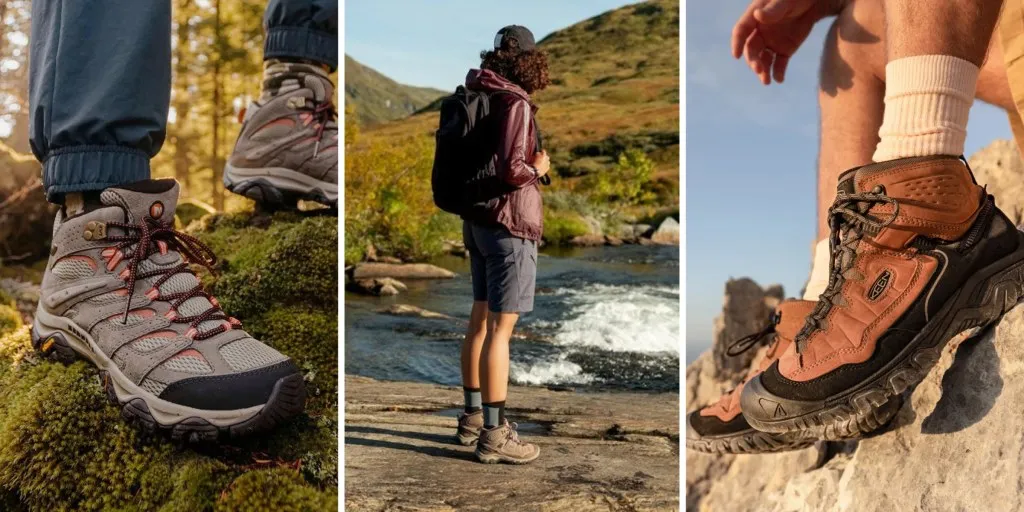
Hiking shoes come in different styles and cuts. Which is right for you depends on your needs.
Whether you are walking on local dirt paths or planning to complete the entire Appalachian Trail, you'll want a pair of hiking shoes -- they offer more traction, support, protection and weather-resistance than everyday walking and running shoes.
Hiking footwear is as diverse as the terrain you'll tackle. I spoke with outdoor experts to better understand what makes hiking shoes different from everyday sneakers and what to look for when shopping for your next pair.
My top picks come from a mix of staff-recommended and top-rated brands like Salomon, Merrell and Keen. I included both hiking shoes and hiking boots, but not trail running shoes, which you learn more about in this guide.
I've been wearing Salomon X Ultras for years -- I use them for hiking and rainy or snowy days in New York City. They were my first pair of "serious" hiking shoes, and the excellent traction reduced slips and slides to almost zero compared to hiking in running shoes. They are supportive and comfortable, with long laces that loop around strong eyelets, adding extra support around the ankle for technical terrain. They are also easy to take on and off because of the flexible tongue and fabric loop on the back of the heel.
They run warm -- I've worn them comfortably in 0-degree temperatures, but they feel too warm to me in anything above 65 degrees.
Former NBC Select production coordinator Kelsey Fredricks has worn these Moab boots for nearly five years (yes, experts told us to replace our shoes more often than this). She's worn them on snow-covered trails in Ireland and muddy, wet treks in the Hudson Valley in New York. (She has also used them as rain boots in a pinch.) "Whenever I decide to go hiking, I know I have these boots as my trusted sidekick," she says. "I can be kind of clumsy sometimes and I feel like these boots hold me up right."
NBC Select senior editor Nikki Brown has worn these budget-friendly hiking boots in all sorts of places, think hiking through national parks in Montana and shoveling snow on New York City streets. They’ve held up well and given her no issues in either environment, plus they are much lower priced than every other shoe on this list.
“These are some of the most (if not the most) comfortable shoes I’ve ever worn,” says NBC Select senior editor Shalwah Evans. She’s trekked up and down the rainy, rugged hills of Iceland in them, as well as piled of unplowed, icy NYC snow—they handled each just fine with their grippy five millimeter outsole lugs. The toe box, like many Hoka walking shoes, is roomy, leaving plenty of space for thick socks.
Like Merrell, Keen is another top-rated hiking shoe brand with a loyal following. Former NBC page Hannah Fuechtman has used her Keen Targhee boots for over eight years, and calls them her “emotional support boots.” She has used them on summery paved trails and snow-covered rocky paths on hikes in Glacier National Park and the Rocky Mountains. Her feet stayed dry through them all.
Fuechtman prefers a more supportive shoe to combat her frequent knee pain and finds Keen Targhee boots very comfortable. For added ankle support, Fuechtman loops the laces around the eyelets all the way to the top of the boot to help keep her foot secure.
I spoke with experts to better understand the different types of hiking footwear. Combining their advice with NBC Select staff experience, I chose shoes and boots using the following criteria:
Experts recommend considering the type of hike you're planning, the weight of your shoe and the tread of the outsole when shopping for hiking footwear. But the process for finding the right shoe isn't as straightforward as it seems. Below are a few tips to keep in mind when shopping.
Your foot is a bit larger at the end of the day than in the morning, says Maggie Peikon, the manager of communications at the American Hiking Society. Trying on shoes at the end of the day can help you find a better fit, as your feet will similarly be a little larger when you are hiking.
It's best to feel secure while wearing your hiking shoe or boot -- your heel and toes shouldn't be slipping and sliding around with each step, says Peikon. At the same time, footwear shouldn't be too tight -- your toes shouldn't be touching the front of the shoe, for example.
You can go to your local outdoors shop to try on different boots and get advice from experienced staff. When trying on a new shoe, wear the socks you plan to hike in. Heather Neis, a sales lead at REI, recommends wool or synthetic hiking socks. This will give you a better idea of how the shoes will actually feel on the trail.
Plan to go on a few walks or light hikes to break them in (within their return period), but in most cases, very little breaking in is needed, says Neis. "If they don't work for you, whether they cause blisters, numb toes or are just uncomfortable, those feelings won't go away after the break in period," says Neis.
The stiffness of your shoe can help protect you from accidental rolls and slips that can injure your ankles -- a stiffer shoe is more stable than one that flexes easily, according to the Appalachian Mountain Club, the U.S.' oldest conservation and recreation organization. Try grabbing the shoe at the front and back and twisting it side-to-side -- the harder it is to twist, the more stable it will be, according to the organization.
Hiking shoes come in low, mid and high ankle cut versions:
- Low cut: More flexible, more breathable, but can let in more debris
- Mid cut: More debris protection, can help with ankle support when carrying heavy packs
- High cut: Uncommonly, usually for more serious purposes like logging or wildland fire
Still, the height of your shoes is personal -- your individual foot profile and intended purpose will determine the best cut for you, says Neis.
The type of hike -- and the weather conditions that come with it -- can determine your priorities when thinking about which footwear to buy.
- For hiking in dry, hot environments, Peikon prefers trail running shoes, as they tend to be the most breathable.
- For rugged, uneven terrain that has sharp rocks or plants on the path, hiking boots can provide more support and protection -- they sit highest on the ankle.
- Hiking boots are also typically the warmest and most weather-resistant, according to our experts.
Most of our staff picks have some amount of water-resistant fabrics or treatments. This is great if you live in a rainy, damp or cold-climate with changing conditions,” says Peikon.
If you are going on a multi-day (or week) adventure in warmer climates, however, consider a breathable, non-waterproof shoe,” says Matthew Rowbotham, the program manager of geographic information systems at North Country Trail Association. Sweat and water will evaporate faster with a well-ventilated, non-waterproof shoe than a fully-weatherized boot.
The outsole is the bottom part of the hiking shoe that makes contact with the ground. It is usually made of rubber that will easily grip onto surfaces. The outsole also typically features lugs, indentations or grooves that add grip and traction when walking through rocks or rough surfaces.
The midsole, located inside of the shoe between the outsole and the upper, is one of the most important elements for cushioning and protecting your feet from the terrain. A midsole is typically made from ethylene vinyl acetate (EVA), which is soft and common in most trail or light hiking shoes, or polyurethane (PU), a more durable, heavier option that's common in heavy-duty backpacking and mountaineering boots that can have a break-in period,” according to our experts.
The upper is what covers and protects most of your foot and ankle; it makes up most of the top part of a shoe. The material of the upper affects how breathable, weather-resistant, insulated and heavy the shoe is,” according to our experts.
At NBC Select, we work with experts who have specialized knowledge and authority based on relevant training and/or experience. We also take steps to ensure all expert advice and recommendations are made independently and without undisclosed financial conflicts of interest.
I'm a reporter at NBC Select who covers technology and fitness, including stories on fitness trackers, running shoes, wireless earbuds and more. I also cover health and preparedness topics like air purifiers, power outage kits and hiking emergency kits. For this story, I spoke with outdoor experts and leveraged years of hiking to recommend the best hiking footwear.