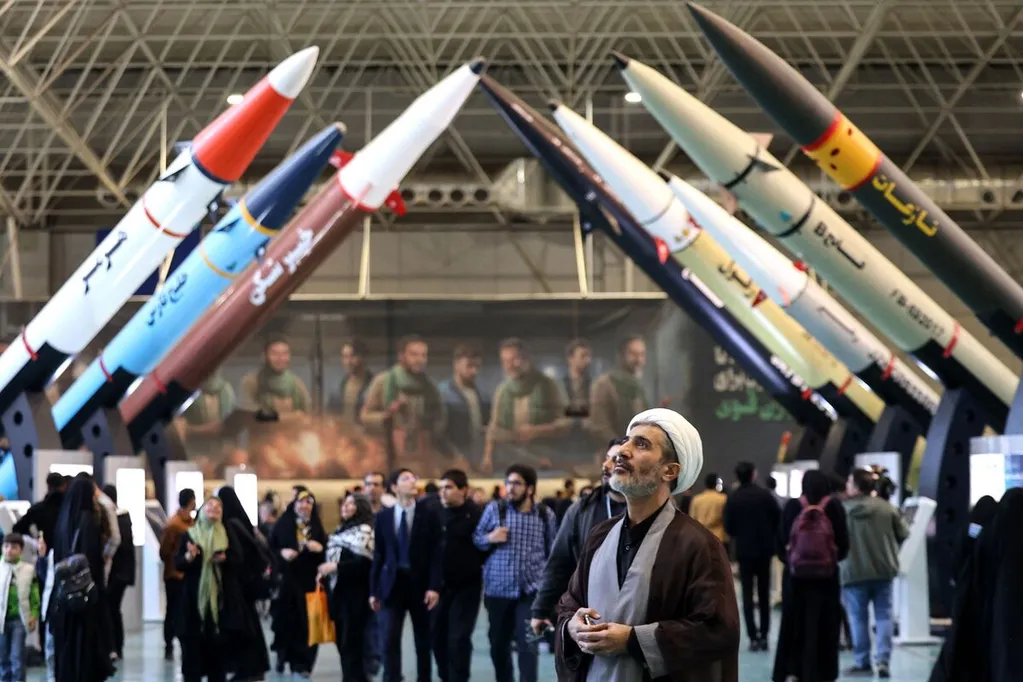
The power of its air force diminished by Western sanctions, Iran invested heavily in missiles and drones over the years, amassing what US intelligence called in early 2025 the "largest stockpile" of such systems in the Middle East. Its capabilities are both a target of the war on Iran being waged by the US and Israel, which have long aimed to neutralize this threat, and Iran's main means of responding to the assault.
Iran has deployed these weapons against Israel, US forces in the Middle East, and other targets in a dozen countries. It surprised the world on March 20 when it demonstrated the ability to deliver ballistic missiles as far away as 2,500 miles (4,000 kilometers) by striking at a US-UK military base on Diego Garcia, an island in the Indian Ocean. West European cities such as London and Paris are within that range of Iran.
Why have Iran's missiles and drones been a focus of concern?
Iran has spent decades trying to expand the destructiveness and range of its missiles and drones. Before the Iranian strike targeting the Diego Garcia base -- which suffered no damage according to a person familiar with the matter -- it was thought that the most far-reaching of Iran's missiles had southeastern Europe within its sights.
Fears that Iran will build a nuclear weapon raise the stakes; ballistic missiles would give the country the ability to deliver such a device from a considerable distance, assuming its scientists mastered the technical requirements.
Iran has exported its missiles and drones, or the know-how to build them, to allied militias in the region including Hezbollah in Lebanon and the Houthi rebels in Yemen. This has enhanced those groups' standoff capacity -- the ability to strike at a distance without drawing immediate fire directly from the target area. They have used standoff weapons to attack Israel and assault ships in the Red Sea. The Houthis claimed responsibility for a devastating attack on a Saudi oil processing facility in 2019, a strike the Saudis blamed on Iran.
The Iranians deployed their missiles and drones against US and Israeli targets in previous rounds of hostilities: after the US killed Iranian General Qassem Soleimani in Iraq in 2020; in exchanges of fire with Israel in April and October 2024; and in another episode in June 2025 that the US participated in.
Iran's low-cost Shahed drones have also been central to Russia's war on Ukraine. Russia imported the Iranian unmanned aerial vehicles early in the full-scale conflict and then began to manufacture them at scale. By March 2025, Russia was firing 1,000 Shaheds a week to saturate Ukrainian air defenses, according to the Center for Strategic and International Studies (CSIS). Shaheds have proven effective at slipping through air defenses and causing damage including casualties.
What types of missiles does Iran have?
Iran's arsenal has included cruise missiles, which are capable of maneuver during flight. But ballistic missiles have formed the core of its missiles cache. These weapons are guided during the initial, rocket-powered part of their flight, then follow an unpowered trajectory to deliver a warhead to a predetermined target. Iran's arsenal has featured about half a dozen variants each of short- and medium-range missiles of this type.
It's unclear what type of ballistic missile Iran used to strike at Diego Garcia or whether it possesses any more of them. Experts have suggested Iran may have fired a prototype missile, extended the range of one of its existing versions by stripping it of weight or even removing its warhead, or converted a civilian space launch vehicle into a ballistic missile.
What types of drones does Iran have?
Iran's well-developed military drone program produces a variety of pilotless combat vehicles. Iran claims the latest version of its Shahed-149 can fly as far as 4,000 kilometers (2,480 miles) and carry as much as 500 kilograms (1,100 pounds) of munitions. Many of Iran's drones are called "kamikazes" because they aren't designed to survive their mission. They can cost as little as $20,000 to $50,000, according to CSIS.
How many missiles and drones does Iran have left?
The Israeli army estimated that Iran possessed 2,500 ballistic missiles at the start of the current conflict. Iran has fired at least 1,200 at a dozen countries since the outbreak of the fighting, according to the Tel Aviv-based Institute for National Security Studies (INSS) think tank. Israel said it destroyed hundreds more in airstrikes. The US and Israel have estimated they've destroyed more than 70% of Iran's missile launchers, making it harder for the country's forces to fire their remaining ballistic missiles. Airstrikes have also targeted manufacturing facilities for ballistic missile components.
Israeli officials haven't given an estimate for Iran's drone arsenal. But Iran is believed to have a much larger number of drones than missiles. More than 2,100 Shaheds have been fired so far, according to Bloomberg estimates. The weapons don't need much launch infrastructure and can be manufactured more easily than complex ballistic missiles.