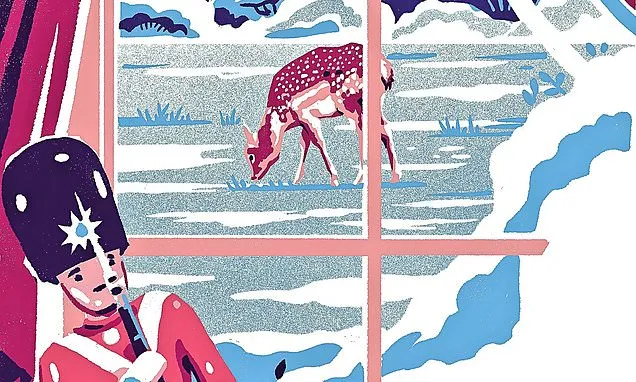
'What are we going to do today?' This is what he asks every morning.
The person who replies has tawny hair, which she pushes back from her forehead with an impatient hand. 'Today,' she says, 'I'm not going to dignify that question with an answer.'
He gets up, as she orders him to do.
She disappears (he never knows exactly where) and he walks to his bedroom window. Beyond the window lies the place people refer to as 'the real world'. This world contains different things on different days. Sometimes, there is a docile animal stumbling around on wounded legs, tearing at the grass with a soft, wet mouth.
He looks to see what's there now: a lovely salty brightness which has spread itself everywhere, even on the naked limbs of a tree. He stands completely still - a watchman at his post. This seems to be what's being asked of him this morning, that he stand guard at the window, immersed in the clear light, until what is seen is also understood. But he knows that this may take a while because he remembers - from some days or months lived long ago when he was young and fearless - that watchmen are frequently called away or tire or fall down where they stand, that the world they're watching is forever taken from them.
'Chop, chop,' says the voice he should recognise by now. 'Chop, chop.'
He turns from the window, turns from the real world and looks at her. Sometimes, she appears beautiful and he remembers that her skin tasted of cinnamon and he would try to lick her and she would push him away and say, 'no, no, no, not that'. But at other times, he's not quite sure whether there hasn't been some error, some misunderstanding, and that she shouldn't be there at all.
'Come on,' she says. 'Bath.'
Water runs. As it falls, it seems to hold a friendly conversation with itself. Enclosing the conversation, keeping strangers out, are smooth white walls, which he often examines closely. He knows there are pieces of the world which are real and other pieces which are only pretending to be real. And he has never been sure, in this place, of what he is actually looking at. It reminds him of a mountainside he visited in Italy once, long ago. Carrara was its name. Chunks of the mountain had been carved away, but much of it was left behind. He touched its profound and unimaginable whiteness...
'Pay attention,' she says,'remember where you are.'
She stands behind him, holding him steady, lining him up in front of the ever-welcoming lavatory bowl. He says,'I feel humble gratitude towards this thing.'
He hears her snigger. Sniggering is not laughter. It's some distant cousin of laughter, one-time-removed, and it's never kind.
Now, he wears a check shirt and some old trousers which are soft to the touch. A plate of sliced pink meat is put in front of him and coffee is poured into his cup. He asks, ‘What is this?’ but no one answers. He turns to see her at the other end of this large space, wearing her apron, her face gathered into a frown. Her arms are bare and enfolding something too heavy for them. He feels sure that this frown and these arms are requesting help from him, but he also knows that he probably has no help to give.
He feels that there may be no alternative to eating the meat. It tastes of salt. She comes and sits down opposite him. ‘I made your favourite glaze this year,’ she says, ‘the one with mustard and demerara.’
‘Not demerara,’ he says. ‘Carrara.’
‘As you wish,’ she says. ‘Now I’m going to lay the table for lunch.’
He watches her leave. Instead of trying to eat, he would willingly follow her.
He would make himself small, so that he could lay his head on her breast. But he seems to remember that she often warns him against doing this. ‘Mind the gap,’ she says. ‘Please mind the gap between the train and the platform.’
A bell tolls. Everything is calm and cold now and half-lit by shards of glass, through which the sun shines. The shards are every colour you could think of - lavender-blue, tangerine, Bordeaux rouge - and other colours that you can't think of. He is standing, holding in his unsteady hands a hard little book. He remembers that when a book is given to you, it means that you should find something you want to know written there, but now he would actually prefer just to watch the shard-light spreading patterns over the stone floor and listen to the voices all around him, which are making an old familiar sound, the kind of sound which goes up into the space above your head and then falls gently into your mind. The silent stars go by.
When the sweet singing ends, his mind revisits a dream. It's black night over some distant sea and he is piloting his Phantom, his beloved plane. His. Or he thinks of it as his, like you can think of a woman as 'yours', even when you remember that everything in life is borrowed. He has to land the beloved on the carrier deck, but there is no carrier, only the darkness of the sky inseparable from the fathoms below. In pointless agony, he and the plane turn and turn. The fuel gauge flickers. Ark Royal, come in, Ark Royal, do you read? Over. But no sounds come. The silent stars go by.
'That's it,' she says suddenly. 'Did you enjoy the carols?'
He's not sure what she means, but he knows she's asked him a question and that the word 'yes' usually serves to prevent another question following on. But instead he finds himself saying, 'In the dream, I was in my Phantom but there was no carrier to land on. I was completely fked.'
'Try not to swear,' she says. 'Please try not to swear in this place.'
'No, but I was, completely -- '
'Hush,' she hisses. 'Enough. Sherry soon. And the children.'
They are here now, the children. She still calls them this, but they're children no more. They're shapeless people with greying hair, who sit in deep armchairs and regard him with terror. They have brought with them an actual child—a little agitated boy with brown curls—who charges back and forth with parcels in his hands, throwing them down into people's laps. To him, this child says, 'These are yours. All these.'
He looks down into his lap. He seems to know that whatever these parcels contain, he doesn't want them. What other people decide you need is never the unnameable thing you yearn for.
Before the child can escape, he grabs him by his thin little arm and says, 'Listen to me. When I was your age, I was sent away. How would you like that? I was sent away to a cruel and terrible place. Can you imagine such a farce?'
The boy stands still for a moment and looks at him. He notes that the child's eyes are brown and deep, like the eyes of Bambi, with a sweet, cinematic kind of flicker.
'Are you going to open your presents?' asks the boy. 'Let me finish,' he says. 'In this place where I was sent when I was your age, letters from home were given out once a week. And I took the letter from my mother to my iron bed and read it and do you know what she said? She said, I am leaving your father. I am never coming back.'
Everything has gone quiet in the room. Bambi stares an imperious, animal kind of stare. Then one of the greying 'children' rises up and tugs the boy away and the boy goes back to delivering parcels. Far too many.
Time ticks by on the mantelpiece carriage clock. Then, everyone is instructed to 'move next door'. And feeling now that explanation is needed, he says,'There is no "next door" really. There's only the "real world" where that animal lives.The one with damaged legs.'And the boy Bambi stares at him and says,'Why do you say so many weird things?'
'Enough,' comes her commanding voice.'Lunch now.'And she steers him to a pretty room with red walls and red-and-gold berries in a kind of cascade over a white cloth.
There is wine,the stench of roast parsnips and now the enormous mound of a bird she has roasted and furnished.One of the grey male children slices the bird’s breast with an electric knife.The shivering blades make a complaining kind of noise.Piled-up plates of food are handed out and everybody starts exclaiming,’wonderful’,’delicious’,’perfect’,like sometimes happens on TV when peculiar cooking has brought itself to a climax on an oval dish.
He tries to eat.He has a moment of wishing he were the animal in the real world,munching grass made soft by the morning dew.He knows that he is letting everything pass by on this day:the parcels he was told to open and which only revealed to him objects he thought he already had.He’d held up a pair of green socks and asked,’Did somebody go to my sock drawer and nick these?’And everybody laughed and clapped.They seemed to think he’d made a joke.
Now, there are more presents exploding out of little decorated tubes.His gift is a kind of metal worm and when Bambi sees this he says,’I quite like those,you can make them go down the stairs on their own.’So then he feels compelled to say loudly,’Well I’m not the only one to say weird things.Am I?’But no one replies so he turns and looks out of the window and is surprised to see that darkness has come.But after a moment or two he remembers how,at certain moments in his life,days ended and turned into nights before you had prepared yourself for them to do this and what you were faced with then was a long,long wait for somebody to order up some new daylight;knowing that orders,every when they had been placed and paid for,could take a very long time.
But he thinks he will place his order for light right now and let the wait begin.He leaves the red room and the stink of gravy and the worm which can go downstairs on its own.He makes his way to the small room that used to belong to someone else,but is now his.He gets into the narrow bed,still wearing his clothes and shoes,and closes his eyes and after a very short time he is asleep.But it’s one of those sleeps where he is also awake and participating in a dream.And it is a dream of unimaginable beauty and happiness.It’s Christmas morning and he’s climbing into his mother’s bed—the big soft bed where she sleeps alone—and she holds out her arms to him and says,’Darling,did Father Christmas arrive?Show me what he’s brought you.’
Her soft hands help him to unwrap objects of great wonder: metal soldiers, all glinting and ready for war; a heavy glass globe, inside which snow whirls round and round above a mountain palace; a tiny photograph in a silver frame. When this photo is unwrapped, his mother holds it up to the daylight which has at last been delivered as requested, and she says,‘There we are, precious boy. You and me. Just you and me on Christmas morning and all the world waiting to see what’s going to happen in your life. So, how shall we celebrate? You tell me. What are we going to do today?’