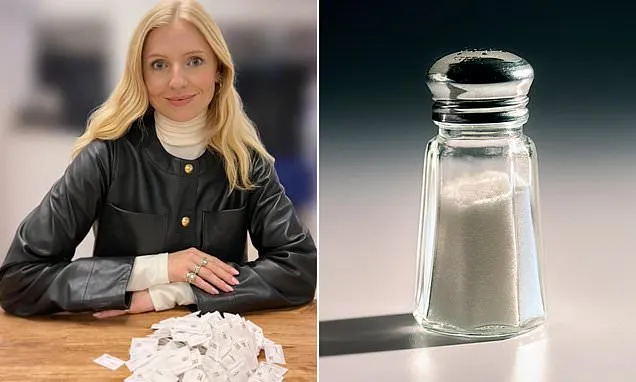
For a 30-year-old living in London, I don't have many vices. I drink at weekends but not during the week; smoking gives me the ick and in my book vaping is even worse; I'd say 85 per cent of my diet is whole foods; I weight train daily and currently I'm clocking upwards of 30km (18.6 miles) a week in preparation for a marathon.
If you think I sound awfully boring, you're not wrong. Chasing optimum health as well as fitness goals is repetitive rather than exciting. But although I take pride in my body, for the past two decades I've unconsciously been partaking in one of the most unhealthy habits there is - and you might be too.
I'm addicted to salt. I simply can't get enough of it. I shower it on every meal and sprinkle it on most of my snacks. I even carry sachets of the stuff in my handbag just in case there isn't any on the table.
I'm that person who automatically adds salt to food in a restaurant before even taking a bite. I've refilled the shaker by the hob more times than I care to admit. And, it pains me to say it, but I would even add extra salt to my McDonald's fries (yes, I've been told off before).
But to my horror, the British Heart Foundation says the official NHS recommended daily intake of salt is no more than six grams - or the equivalent of a teaspoon.
Never mind teaspoons. It turns out I have been ingesting tablespoons of the stuff every single day.
My morning electrolyte? It's full of sodium. Eggs on toast for breakfast? That's an excellent vehicle for at least two sachets of table salt.
Mid-morning slice of toast? Salty butter and generous lashings or umami-rich marmite are the only ways I want to top it.
Chicken salad and sweet potato for lunch? That obviously requires two more salt sachets.
Boiled egg snack? I couldn't possibly swallow it without another sachet of salt.
Salmon, pak choi and homemade egg fried rice for dinner? I'll throw handfuls of flakes into the pan, as well as a drizzle (deluge) of soy sauce. And when it hits the plate, it will likely get a peppering of salt crystals, again.
But I'm not the only one drenching my food in it. According to the same research, only 19 per cent of working-age adults know of this recommended 6g dose, whilst most of us eat the equivalent of 155 bags of ready salted, lightly salted or sea salt crisps in salt every single week.
To a wellness-obsessed woman like me, these stats were staggering. So I went cold turkey for a month. No more sachets, not a dash, nor a sprinkling, or even one flake of added salt.
At first I didn't feel any different. Salt doesn't elicit mood swings, nor does it change your weight on the scales.
I was just miffed that my meals had become incredibly boring. My only thought was how rubbish boiled eggs were without a dash of the good stuff. Supper became so bland, I almost gave up having it. Eating was categorically dull. And my taste buds could only recognise the absence of salt on each plate.
But after two weeks of tasteless meals, I noticed I was less bloated in general but particularly at night - my body was definitely holding less water. And I was also less thirsty in the evening, too. Previously I drank gallons of liquid before bed.
Three weeks in, my taste buds had reprogrammed themselves. Rather than registering a lack of salt, my food began to taste like, well, food.
Eggs weren't drab, but savoury and deliciously yolky. My chicken salad lunches were fresh and satiating. The salt shaker by the hob remained untouched at dinner time - I no longer needed to add handfuls of crystals to my cooking to zhuzh it up.
A whole month later, I feel genuinely reformed and ready to lead a sachet-less existence for good.
But could my insides recover after years of overeating salt?
Nicole Taylor, the Assistant Head of Undergraduate Courses at The Institute for Optimum Nutrition, confirmed that there were considerable risks linked to ingesting too much salt over a prolonged period of time.
'Eating increased amounts of sodium makes your body hold onto extra water, which raises blood pressure and puts strain on your heart and kidneys. As the pressure in your blood vessels goes up, your heart has to work harder to move blood around the body. The heart can only meet these demands for so long and ultimately it can lead to heart failure,' warns Taylor.
Having very high blood pressure increases the likelihood of developing heart disease dramatically.
'It puts mechanical strain on the endothelial lining (inner, direct-contact surface) of all blood and lymphatic vessels, contributing to potential atherosclerosis (a plaque composed of fat, cholesterol, and calcium builds up inside artery walls) and dyslipidiemia (an abnormal, unhealthy level of cholesterol) in the blood,' says Taylor.
This is also known as hypertension, which is one of the five diagnostic criteria for metabolic syndrome. People with metabolic syndrome have a 70 per cent higher risk of cardiovascular disease compared to those without it.
So why is salt so devilishly moreish?
'Salt makes food taste more like itself. Your taste buds have sodium‑sensitive channels that respond directly to it, sending a clear "salty" signal to the brain and sharpening the overall flavour of food. The threshold for salt tolerance can grow over time with excess consumption,' says Taylor, which explains my past desire to add yet more and more to my food.
But Taylor suggests there are too many factors at play to announce a general recommended daily dosage that applies to everybody. Your unique salt threshold is determined by metabolism, insulin levels and hormone levels such as thyroid, along with the rest of your diet.
Plus, not all salt is made equal. Taylor says the type, rather than the amount, of salt you add to your food is what really matters.
'Take the table salt from your cupboard and bin it,' she says. 'Or use it to make kids' crafts such as playdough. Table salt is very processed and is normally only made up of sodium and chloride ions, plus bleaching agents and anti-caking agents. All the trace minerals your body needs have been removed by the time it gets to your table.'
Taylor adds: 'You're best off replacing it with another salt entirely. When we eat salt that contains all the trace minerals, like Celtic Grey salt for instance, we are providing the body with a healthy balance of essential minerals.'
Celtic Grey salt, Maldon salt or even ethically sourced Himalayan pink salt contains more than 80 minerals. Whereas table salt contains just one - sodium.
Philip Tanswell, Cornish Sea Salt's CEO and self-confessed 'salt geek', agrees 'the main finding from the BHF study is that too much salt is bad for you. 'They are presuming all salt is processed sodium chloride - which not all are - and "too much" is too much for whom? Too much for you may be dangerously low for me. There is a factor of ten of the amount of salt an individual may need to keep healthy - and we are individuals, not averages.'
The reason sea salt is seen as a healthy alternative, if harvested correctly, is that it contains the optimum mineral balance.
'Science shows us that we evolved from the sea, one of the pointers being that our electrolyte profile matches up. So if you can scratch cook with good ingredients using a sensible pinch of natural mineralised sea salt the average person might not only have every chance of making their food taste better but also help keep their electrolytes in balance,' says Tanswell.
'Natural sea salt contains potassium and sodium which balances blood pressure,' he adds.
There you have it. Table salt is officially off the table. But a light scattering of natural sea salt flakes on my eggs hopefully won't do any harm.