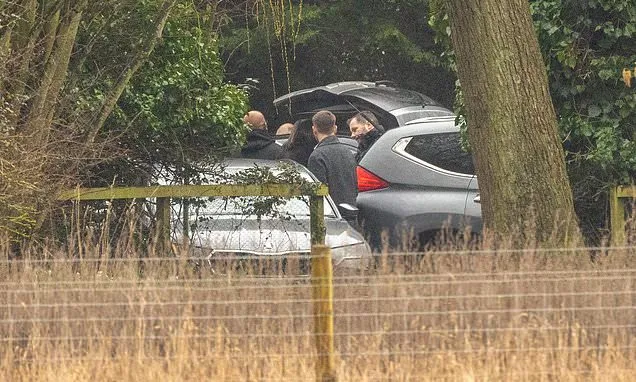
As police swooped on the Sandringham estate this morning to arrest Andrew Mountbatten-Windsor, officers set a process in motion that could see the former prince face life behind bars. A convoy of six vehicles carrying plain-clothed officers was the first sign of anything unusual happening at Andrew's new home at Wood Farm, after he was evicted from Royal Lodge over his links to Jeffrey Epstein. Officers from Thames Valley Police detained the former prince and took him into custody on what is Andrew's 66th birthday. He was arrested on suspicion of misconduct in public office, understood to be in relation to reports he may have passed sensitive information to Epstein in his role as a UK trade envoy.
The Sandringham arrest
Thames Valley Police previously said the force was reviewing allegations that a woman was trafficked to the UK by Jeffrey Epstein to have a sexual encounter with Andrew, and claims he shared sensitive information with the financier while serving as the UK's trade envoy. The arrest is without precedent in the history of the modern royal family. What happens next for the beleaguered Andrew is far from certain. Having been taken into police custody - although there is no mention of where he is - the former Duke of York will no doubt be questioned by officers today. The nearest police station to the Sandringham estate is in Kings Lynn, although this is operated by Norfolk Police.
The 24-hour clock begins
Thames Valley Police is based over in Kindlington, Oxfordshire, but also has major stations in Slough and Windsor, where Andrew lived until his recent eviction from Royal Lodge. He can be held by police for up to 24 hours without charge, although police can apply for extensions to this limit up to an absolute maximum of 96 hours. After this he must be charged or released - which could see him placed on bail with various conditions. Before and during any interview, Andrew will be able to seek legal advice and have a lawyer present. When not in an interview room, the former prince will likely be held in a standard custody suite cell, which are empty except for a bed and a toilet. Anything Andrew does say during interview can be sent to the CPS as part of the force's case, once investigators have finished gathering evidence.
The high stakes of the misconduct probe
It is the CPS who will then decide whether the royal will be charged with any offence. Misconduct in public office is classed as one of the most serious offences in British law, carrying a maximum sentence of life in prison. But Andrew will only face this if he is charged, tried and convicted in a court of law. Due to the seriousness of the offence, it is classed as indictable only, meaning any trial will take place at a Crown Court. Being a member of the royal family does not offer Andrew any protection from prosecution or jail. As the monarch, King Charles III is the only royal with sovereign immunity.
Andrew Lownie, a royal biographer who authored Entitled: The Rise and Fall of the House of York, told the Daily Mail today he 'welcomes' the arrest. He added: 'I am very pleased the police have moved quickly on this. I appreciate the arrest is only for misconduct allegation but there also seems to be evidence for the sexual trafficking claims as well. As such the police should also question his family, and by that I mean his former wife Sarah Ferguson, and also his staff as well. She knows a lot I'm told she has been very involved in his activities and she is clearly a material witness, she visited the Epstein homes so would be aware of what went on, especially the alleged sexual trafficking. But David Stern who was an associate and Andrew Mountbatten Windsors' former private secretary Amanda Thirsk should also be spoken to. This is a good day for British justice.'
On the ordeal facing Andrew in police custody, Simarjot Singh Judge, managing partner at Judge Law, told the Daily Mail: 'If someone is arrested on suspicion of misconduct in public office, the immediate next stage is police custody. That involves being formally booked in, having personal details recorded, fingerprints and photographs taken, and being informed of the reason for arrest. 'In custody, the individual has the right to legal representation and the right to remain silent. Before any formal interview under caution takes place, they would usually consult privately with their solicitor.' He added: 'In a case involving alleged disclosure of sensitive material, investigators would likely ask detailed questions about access to documents, authorisation, intent, and communications with any third parties. They may also present digital evidence or correspondence during questioning. As with any individual, former royal status does not change the custody process. The procedures are governed by statute and apply equally.' Policing commentator Danny Shaw told Radio 5 Live that arresting Andrew at his home instead of inviting him in for an interview is a departure from standard practice for historical allegations. 'Making an arrest carries the element of surprise; the person's not expecting it,' he said, adding: 'Carrying out the arrest enables them to do searches on the spot.'
He described the process of any police search, which enables vital documents and devices to be seized, as an 'invasive' process. Mr Shaw added: 'He [Andrew] will be in police custody along with the rest of them in a cell before he's questioned that's where he will be. There will be no special treatment for him.' He continued: 'I expect this process will probably end in 24 to 48 hours with him being driven away from police custody on police bail.' Confirming that an arrest had been made this morning, Thames Valley Police said in a statement: 'We have today arrested a man in his sixties from Norfolk on suspicion of misconduct in public office and are carrying out searches at addresses in Berkshire and Norfolk. The man remains in police custody at this time. We will not be naming the arrested man as per national guidance. Please also remember that this case is now active so care should be taken with any publication to avoid being in contempt of court.' Assistant Chief Constable Oliver Wright added: 'Following a thorough assessment, we have now opened an investigation into this allegation of misconduct in public office. It is important that we protect the integrity and objectivity of our investigation as we work with our partners to investigate this alleged offence. We understand the significant public interest in this case and we will provide updates at the appropriate time.'
The challenged for Thames Valley Police will likely fall on proving that Andrew 'wilfully neglected' his duty in his role as trade envoy - a phrasing which has been the source of fierce debate in recent weeks. Gareth Martin, Specialist Criminal Defence and Regulatory Lawyer at Olliers Solicitors, said: 'To secure a conviction, the prosecution must prove more than just a mistake. They must show that a public officer, acting in their official capacity, willfully neglected their duty or misconducted themselves to such a degree that it strikes at the very heart of the public's trust in that office. The threshold for this offence is exceptionally high. The courts have been clear that it should only be used where the conduct is so blameworthy that it warrants criminal punishment rather than civil or disciplinary action.' Although the arrest of Andrew for misconduct in a public office is without modern precedent, it is not the first time that the royals have faced the possibility of appearing in court. In 2002, Princess Anne became the first Royal Family member to be convicted of a criminal offence when she was fined £500 after one of her dogs bit two children. Anne also became the family's first member to have a criminal record after admitting a charge under the Dangerous Dogs Act over the incident in Windsor. She also had several convictions for speeding, all dealt with without the embarrassment of a court appearance - in 1972, 1977, 1990 and 2000.
Anne's daughter Zara Tindall was also banned from driving for six months in 2020 for doing 91mph in a 70mph zone. Historically, King Charles I was beheaded in 1649 for tyranny and treason after the English civil war. And in 1586, Mary, Queen of Scots was executed after being convicted over an alleged plan to assassinate her cousin Queen Elizabeth I. Multiple British police forces are currently assessing claims in relation to the Epstein files. Several are examining the disgraced financier's use of UK airports, while the Met is looking at claims in relation to Andrew's protection officers. Yesterday, Surrey Police issued an appeal over claims of sexual abuse made to the FBI which are alleged to have taken place in Virginia Waters in the 1990s.
King Charles signalled his readiness to assist any investigations as necessary in a statement earlier this month which struck a markedly different tone to the royal family's previous silence on Epstein. In the statement, a Buckingham Palace spokesperson said: 'The King has made clear, in words and through unprecedented actions, his profound concern at allegations which continue to come to light in respect of Mr Mountbatten-Windsor's conduct. While the specific claims in question are for Mr Mountbatten-Windsor to address, if we are approached by Thames Valley Police we stand ready to support them as you would expect. As was previously stated, Their Majesties' thoughts and sympathies have been, and remain with, the victims of any and all forms of abuse.'