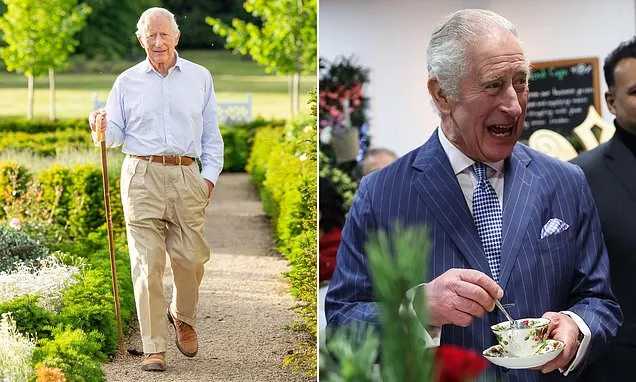
'Eating like a king' conjures up visions of lavish banquets and indulgent afternoon teas - but reigning monarch King Charles is more likely to be found tucking into a bowl of muesli or organic meat and two veg.
Now aged 77, in 2022, when he was 73, he became the oldest monarch to accede to the British throne when his mother, Queen Elizabeth, died aged 96.
And with British monarchs having a history of not only living well into their nineties - his grandmother lived until she was 101 and his father, Prince Philip until 99 - but carrying out duties until the very end, the royal diet must have some longevity benefits.
The Daily Mail spoke to the King's former butler, Grant Harrold, for insight about King Charles' typical daily diet and then asked registered nutritionist Rob Hobson to deliver his expert verdict.
Mr Harrold worked as a royal butler for King Charles - then the Prince of Wales - between 2004 to 2011.
He remembers that the King always had breakfast, often skipped lunch, and ate dinner around 10pm, which his former Butler said is due to work engagements.
Hobson warned: 'Skipping lunch means his nutritional intake is concentrated into fewer meals, which can work for some people but does place more importance on the quality of breakfast and dinner.
'Eating later in the evening, around 9-10pm, may not be ideal for digestion or sleep either, particularly if this is a regular habit.'
Research into meal timing has long suggested that earlier eating patterns and even intermittent fasting - with a shorter eating window - is associated with better metabolic health outcomes.
This is because insulin sensitivity tends to be higher in the morning, meaning the body handles glucose more efficiently, while eating later has been linked with less favourable blood fat profiles over time, which can eventually lead to type 2 diabetes.
'That said, this is an association rather than a hard rule, and overall diet quality, sleep and lifestyle still matter,' Hobson says.
However, while the King has usually forgone lunch, the Mail on Sunday reported in 2024 he was now eating half an avocado in the middle of the day to give him extra strength and energy as he battled cancer - and juggled a hectic diary.
Often described as a 'superfood', avocados are nutrient-dense and packed with heart-healthy monounsaturated fats, fibre, potassium and vitamins K, E and C.
At Highgrove House, King Charles' primary residence, breakfast is a simple but nutritionally dense affair - and when he travels, he famously takes along his 'breakfast box', a hamper filled with his favourite home comforts.
Tasting Table reports that the monarch, who is famously green-fingered -starts the day with freshly baked bread, a selection of cereals and muesli and a variety of fresh produce -including plums, asparagus and eggs -which has been grown just metres away from the dining table on his sprawling Gloucestershire estate.
He's not a huge fan of coffee so instead opts for a pot of Darjeeling tea with milk.
Also on the menu is a hot dish, either Eggs Argenteuil, a classic French dish featuring eggs, typically poached, soft-boiled, or scrambled, paired with asparagus, or cheesy baked eggs.
Clarence House formerly shared a recipe for the latter, revealing it was made from eggs, cream, spinach, and two types of cheeses; Tunworth and Old Winchester seem to be favourites of HRH.
He's also known to enjoy a simple four-minute boiled egg for breakfast.
A single large egg contains around 7.5g of protein - roughly a sixth of a woman's recommended daily intake - alongside almost no salt, just 78 calories, and a range of vitamins including B and D, which are vital for numerous bodily functions.
Eggs also contain a form of vitamin A that is more easily absorbed than the type found in vegetables, making them a useful addition to a vegetarian diet.
Aside from being a great source of dietary fibre, asparagus fits with this year's wellness obsession: gut health.
Rich in protein and low in fat, asparagus is a good nutrient dense option - but it's also packed full of essential minerals, vitamins K and A protective plant compounds such as folate helping support gut health whilst reducing inflammation and oxidative stress.
Hobson approves of his first meal of the day, especially as it needs to fuel him all the way until dinner.
He says: 'Given that the average adult in the UK still only eats around three portions of fruit and vegetables a day, this kind of regular vegetable intake is something I hope puts him comfortably above that average.'
His next meal, dinner, is a sumptuous affair. Darren McGrady, King Charles' former chef, previously revealed he loves wild mushrooms and enjoys foraging for chanterelle and porcini when visiting Balmoral.
McGrady claimed that his team would sauté the entire harvest up with butter and tarragon before freezing to be used throughout the year in dishes such as creamy mushroom risotto.
He also revealed that the King loved to enjoy the risotto with locally raised lamb chops or some other organic, farm-raised meat such as mutton.
Hobson explains: 'Mutton is less common in modern diets but is a good source of protein, iron and vitamin B12 although it is higher in saturated fat than some other meats so best enjoyed in moderation.'
Eating a diet high in saturated fat can drive up levels of so-called bad cholesterol which can block up arteries and increase risk coronary heart disease heart attack stroke.
Vitamin B12 is unique because it's generally only found animal foods but essential every cell body as plays role making repairing DNA. It's also needed carry oxygen around body ensure normal functioning nervous system.
A lack B12 can lead neurological problems like short-term memory loss difficulties balance speech; as such crucial healthy aging.
King Charles has loved growing vegetables since he was a child
King Charles' stepson, Tom Parker-Bowles, hinted that since his February 2024 cancer diagnosis, the monarch has reduced his red meat intake.
He told Saga Magazine: 'I eat meat, but I go easy on the red meat - as does my mother.
'The King, after what he's been through recently, is looking again at what - and when - he eats.'
Even before he became ill, King Charles revealed that he tried to have two meat-free days a week due concerns about emissions and other environmental factors.
In 2021, he told the BBC: 'The business of what we eat, of course, is important.
'Now, I mean [reducing the consumption of animal products] is one way to do it - if more did that, you would reduce a lot of the pressure on the environment and everything else.'
In 2018, when he guest edited an issue of Country Life magazine, King Charles revealed that his favourite meal is pheasant pie, and revealed a general penchant for game birds.
He said: 'I got this recipe from someone I know. 'It is delicious.