Here Comes The Sun is among the Beatles' many much-loved hits, but when Sir Paul McCartney's wife Nancy Shevell was spotted on a Caribbean beach this week, it was clear that she's not one to bask in its rays.
The American businesswoman was sensibly covered up in a wide-brimmed hat, a long-sleeved swimsuit and sunglasses, and it seems her attitude to sun protection has paid off.
At 66, her skin is so smooth and radiant that she could pass for someone 20 years younger.
But while Paul's wife takes sun protection seriously, others aren't so cautious - and according to Dr Ross Perry, skin specialist and founder of Cosmedics, the consequences are clear.
Speaking to the Daily Mail, Dr Ross reveals who is reaping the benefits of their rigorous SPF regime, and who is showing the effects of decades of sun worshipping.
Nancy Shevell makes sure to protect her skin from the sun - and it pays off, says Dr Ross Perry of Cosmedics
Nicole Kidman and Ulrika Jonsson, aged 58
Australian actress Nicole Kidman is known to be precautious when it comes to sun protection - but TV host Ulrika has previously said she doesn't care about wrinkles
Dr Ross: 'What we're really seeing here is a textbook example of cumulative sun exposure over time.
'Looking at Nicole Kidman, her skin appears relatively even in tone, with minimal pigmentation and a smoother texture overall. That suggests consistent sun protection habits, likely including daily SPF use and avoidance of prolonged UV exposure.
'There's less evidence of collagen breakdown, which is what keeps the skin firm and plump.
'Now, if we compare that to Ulrika Jonsson, we can start to see more visible signs of photodamage.
'There's increased pigmentation, a rougher skin texture, and more pronounced fine lines, particularly around the lower face and neck.
'These are classic indicators of long-term UV exposure, where ultraviolet radiation accelerates the degradation of collagen and elastin, and making Nicole's skin look more youthful than Ulrika's.'
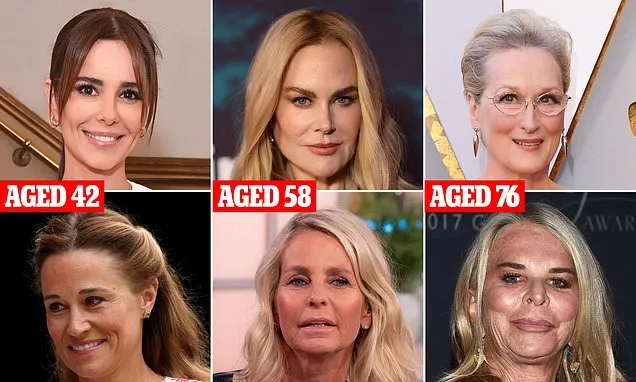
Cheryl Tweedy and Pippa Middleton, aged 42
Former Girls Aloud singer Cheryl and the sister of the Princess of Wales, Pippa Middleton, are both 42
Dr Ross: 'Pippa's skin in candid, makeup‑free photos often shows visible freckles and a bronzed, sun‑tanned tone, particularly on her cheeks and cheekbones. These features are typical signs of repeated sun exposure.
'While this does not necessarily indicate severe sun damage, it does suggest more cumulative UV exposure compared with individuals who avoid sun.
'In contrast, Cheryl’s skin in professional photographs appears smooth, even-toned, and glowing, with minimal visible texture or pigmentation irregularities.
'However, genetics, skincare routines, lighting, and photography all play significant roles in how skin looks.'
Kate Beckinsale and Kate Moss, aged 52
Unlike model Kate Moss, Kate Beckinsale prefers to fake her tan - and swears by daily SPF protection
Dr Ross: 'Kate Moss’s skin appears to show more visible signs of sun exposure compared to Kate Beckinsale.
'Moss often has a bronzed, sun‑kissed tone and in candid or lifestyle photos, her skin can display subtle uneven pigmentation and a slightly rougher texture, both common indicators of cumulative UV exposure.
'In contrast, Beckinsale’s complexion generally looks smoother, more even, and less marked by visible pigmentation irregularities, suggesting either more protective sun habits and healthier lifestyle.
'Kate Moss’s sun‑tanned appearance aligns with greater lifetime UV exposure and potential photo‑ageing; Beckinsale’s skin shows fewer surface signs of sun damage.'
Christie Brinkley and Donatella Versace, aged 72 and 70
Christie Brinkley is 15 months older than Versace designer Donatella - but you wouldn't be able to tell from her radiant skin
Dr Ross: 'What we're seeing here is a very clear distinction between preserved skin quality and significant cumulative environmental damage.
'Starting with Christie Brinkley, her skin appears notably smooth with a more even tone and relatively fine lines.
'There's still natural ageing, of course, but the overall texture suggests that collagen integrity has been better maintained. This is typically associated with long-term sun protection and consistent skincare.
'In contrast, looking at Donatella Versace, we can see much more pronounced structural changes in the skin.
'There's deeper wrinkling, particularly around the mouth and eyes,
'along with a thicker,
'almost leathery texture.
'The skin tone is also less uniform,
'which is a classic sign of chronic sun exposure.'
Helen Mirren and Goldie Hawn, aged 80
Actresses Helen Mirren and Goldie Hawn are both 80 - but their complexions look completely different
Dr Ross: 'What's particularly interesting about this comparison is that both women are in their 80s,
so we're not looking at youth versus aging,
we're looking at how the skin has aged.
'Starting with Helen Mirren,
her complexion appears relatively even,
with a softer,
more uniform skin tone.
'There are of course natural lines and wrinkles,
but they're finer and the skin retains a degree of smoothness.
'This suggests good long-term skin care,
and importantly,
protection from excessive ultraviolet exposure.
'The skin structure,
meaning collagen and elastin -
appears better preserved.
'Now,
when we look at Goldie Hawn,
we can see more pronounced signs of photodamage.
'There’s deeper wrinkling,
particularly around the mouth and cheeks,
and a more leathery texture to the skin.
'Pigmentation is also more varied.
These are hallmark signs of chronic sun exposure over many years.
'UV radiation penetrates the skin and breaks down collagen,
which accelerates sagging and deep line formation.
'It also disrupts pigment cells,
leading to uneven tone and sun spots.'
Meryl Streep and Tina Green, aged 76
Actress Meryl Streep and Lady Tina Green are both 76 - but their appearances tell a different story
Dr Ross: 'When you compare Meryl Streep and Tina Green skin,
Meryl is definitely ageing better and its clear she's protected her skin from the harmful UV rays over the years.
'Now in her mid-70s,
he shows natural lines and gentle textural changes,
subtle evidence of moderate sun exposure over decades.
'Her skin retains elasticity,
softness,
and movement,
and It's a textbook example of graceful,
realistic aging,
where sun damage is present but well-managed.
'Tina,
on the other hand,
presents a far harsher picture.
'Her skin shows clear signs of chronic sun damage:
deeper lines,
leathery texture,
and uneven pigmentation.
'Even accounting for makeup and lighting at high-profile events,
the underlying UV-induced changes are undeniable,
giving her an older appearance than her actual years.
'The combination of photo-aging,
collagen breakdown,
and long-term sun exposure has left her skin looking markedly older than Meryl highlighting just how much sun can accelerate visible aging.'
How to best protect your skin from UV, according to a beauty expert
Annabelle Taurua, beauty expert at Fresha, explained:
- Eat and drink your skincare
'As simple as it sounds, drinking enough water is an essential part of a healthy lifestyle, and ultimately, healthy skin.
'Staying hydrated can support the skin's natural detoxification process and help combat external pollutants.
'Optimal hydration can be paired with an antioxidant diet, including fruits and vegetables, as well as omega-3-rich foods like nuts, salmon, or sardines, as they can help repair your skin barrier.' - Use SPF daily
'Suncream isn't just for summer, and it's important to protect your skin from UV rays as we move into spring when the days become longer and sun exposure increases.
'UV rays penetrate clouds, meaning your skin is still exposed even on overcast days. Apply SPF 30 or higher daily and reapply every two hours where possible for maximum protection.' - Double cleanse
'Originating in Korean beauty, double cleansing has become more and more popular in skincare and is a good habit to include in your routine especially if you live in highly polluted environments.
'Every night start your skincare routine with an oil-based cleanser. This helps remove stubborn makeup,suncream,and the oil film that traps pollutants throughout the day.
'Follow with a water-based cleanser to wash away any remaining residue,dirt,and environmental pollutants ensuring your skin is deeply cleaned.' - Use antioxidant products
'After cleaning your skin,you can take a step further and incorporate antioxidant products into your routine.
'Lotions,creams,or serums containing niacinamide,green tea,or vitamins C and E can be beneficial to fight the oxidative stress that pollution causes.' - Create a strong skin barrier
'A weak skin barrier,noticeable by dryness redness or flakiness,is more vulnerable to pollution's effects. Strengthening the skin barrier especially if you live in a big urban area,is a non-negotiable for healthy skin.
'Using products containing hyaluronic acid or ceramides can help create a strong barrier which will act as a shield against external pollutants.'
Taurua's insights are part of a study highlighting the UK cities with the highest average UV exposure this Spring.