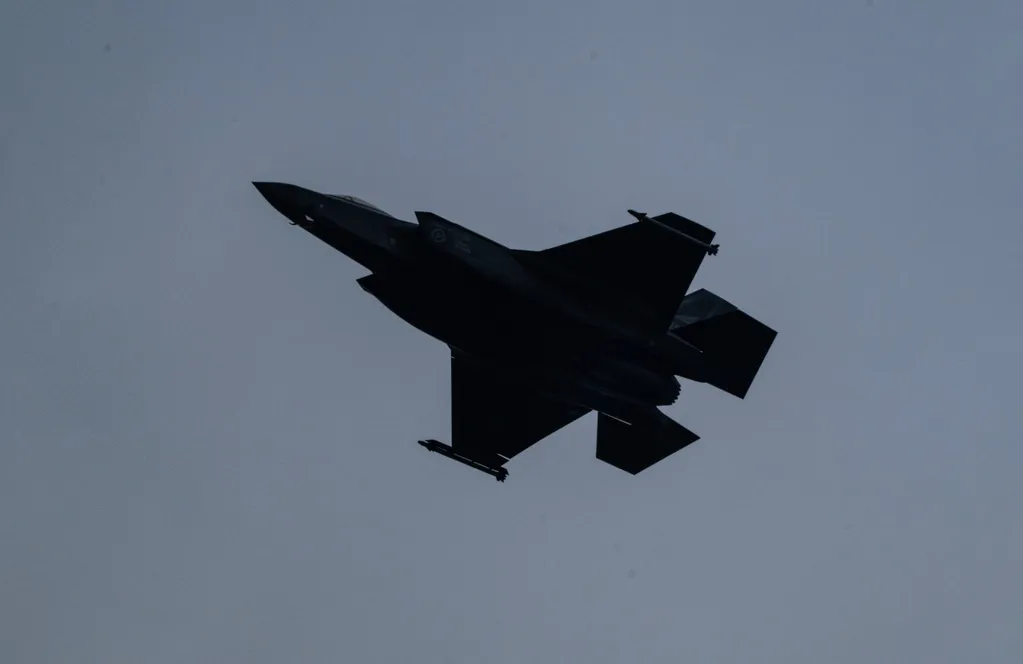
A missing U.S. airman was rescued from inside Iran on Saturday after a high‑risk operation carried out deep behind enemy lines, following the downing of an American F‑15E Strike Eagle during the ongoing Iran war.
President Donald Trump confirmed the rescue early Sunday in posts on Truth Social, writing "WE GOT HIM!" and describing the mission as "one of the most daring Search and Rescue Operations in U.S. History."
Trump said the airman -- a weapons systems officer -- spent more than 24 hours evading capture in Iran's mountainous terrain. In his post, Trump wrote the officer was "behind enemy lines in the treacherous mountains of Iran, being hunted down by our enemies, who were getting closer and closer by the hour."
Details that later emerged showed how the airman remained hidden. According to Reuters, he concealed himself inside a narrow mountain crevice after ejecting from the aircraft. The terrain provided natural cover and made him difficult to detect as Iranian forces searched the area and urged civilians to help locate him for a bounty.
Trump said the airman was injured during the ejection but remained alive and mobile while awaiting rescue.
Like other U.S. aircrew flying over hostile territory, the airman carried an emergency beacon as part of his survival equipment. The device transmitted a signal indicating his location -- but the signal itself raised concerns.
Fox News correspondent Trey Yingst reported on X: "There was concern that despite the beacon signal, it was an Iranian trap."
That concern meant the signal could not be acted on immediately without further verification.
Before authorizing a rescue, U.S. intelligence worked to confirm the beacon signal was genuine and that it was coming from the missing crew member, not being manipulated by Iranian forces. Once that verification was complete, senior U.S. leaders approved the extraction.
The response then moved rapidly, with aircraft launched within hours and forces inserted into Iran shortly afterward.
Reuters reported that surveillance drones were used to monitor the area around the crevice where the airman was hiding and to track the movement of Iranian forces nearby. The drones provided continuous overwatch, allowing commanders to see when hostile units were approaching and assess threats in real time.
According to that reporting, drones and other air assets were used defensively to keep Iranian forces from reaching the site as the rescue window narrowed.
Reuters also reported the operation included a deception effort designed to confuse Iranian search teams. According to a U.S. administration official quoted by the outlet, false signals were circulated suggesting the airman had already been recovered and was being moved elsewhere.
The aim was to divert attention away from the airman's actual hiding place long enough for rescue forces to move in.
Trump said the extraction involved "dozens of aircraft," including helicopters, fixed‑wing planes, and unmanned systems. As U.S. forces moved toward the site, Reuters reported, Iranian units attempted to reach the area.
According to that account, U.S. aircraft struck Iranian convoys and access routes to prevent those forces from closing in, clearing a path for the rescue team. The airman was ultimately extracted from the mountainous region and flown out of Iran for medical treatment.
Trump said the airman "will be just fine."
The operation also drew reactions from lawmakers. GOP Representative Nancy Mace of South Carolina wrote on X the rescue would "be a movie one day," calling it an "incredible success" marked by "insane challenges."
The ordeal drew attention from GOP Representative Don Bacon of Nebraska, a former Air Force brigadier general, who referenced his Survival, Evasion, Resistance and Escape training and the lasting impact it had in preparing aircrew for the realities of capture.
"I admire our downed airman who successfully put his survival training into action and never gave up," he wrote on X. "We never leave one of our own behind."
The rescue removed the risk of a U.S. service member being captured inside Iran -- a scenario that could have triggered a major prisoner‑of‑war crisis as the conflict continues.
While many operational details remain classified, the publicly described elements point to several key factors: the airman's ability to remain concealed in harsh terrain; careful verification of his beacon signal amid fears of deception; persistent drone surveillance; a deception campaign to mislead Iranian forces; and a tightly timed rescue that reached him before those forces could.