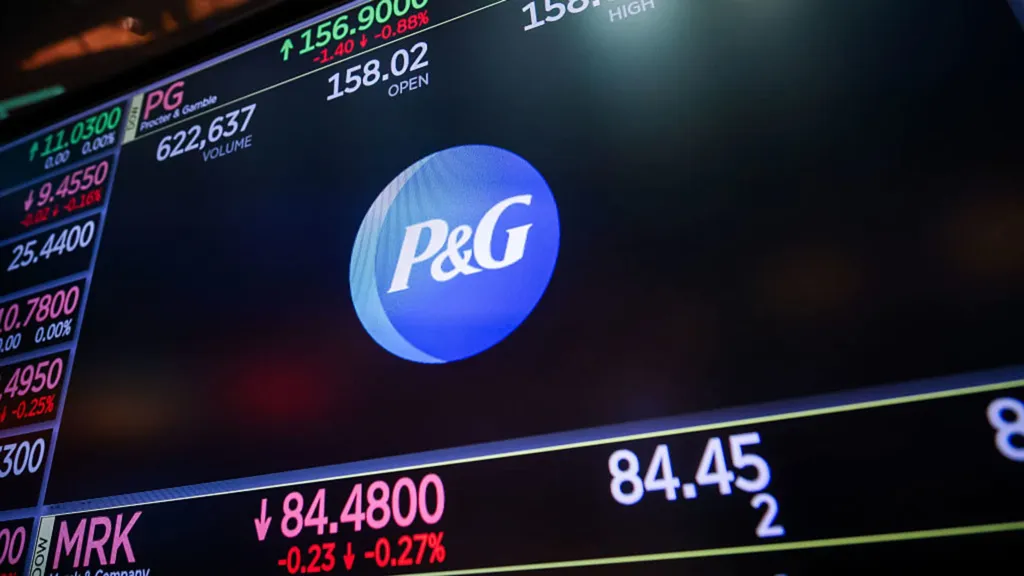
Procter & Gamble is riding this year's surge in the consumer staples sector -- and there are reasons to believe the rally is far from over. Shares of Procter & Gamble are up 10% so far this year, a sharp reversal from their 13% decline in 2025, when investors were concerned about soft consumer demand and rising tariffs. The consumer staples sector rose nearly 6% last week and is up more than 12% year to date, marking its best start to a year since 1997. Consumer staples stocks are typically viewed as defensive, attracting investor interest during periods of economic or market uncertainty. While part of the sector's recent strength reflects a broader rotation away from tech stocks, Bank of America argues the move is also underpinned by improving fundamentals.
This marks a notable shift from recent history. Consumer staples were largely out of favor throughout 2025, lagging the S & P 500 in both stock performance and earnings for the past several years, according to a Feb. 5 Bank of America note. That backdrop has changed meaningfully to start 2026. Investors are bowing out of high-growth technology stocks due to concerns about artificial intelligence's impact on traditional enterprise software and mounting capital expenditures by mega-cap companies to build out their own AI offerings. Over the past couple of weeks, the four largest hyperscalers -- Amazon , Microsoft , Meta , and Alphabet -- collectively forecast nearly $700 billion in capital spending this year, which will absorb most of their operating cash flow. Investors responded to those jaw-dropping estimates by selling. Those five stocks collectively lost more than $1 trillion in market value over the past week, according to FactSet data.
Instead, investors turned to traditional safe-haven names like Procter & Gamble, which has a long track record of adeptly managing its business during market and economic uncertainty. P & G's diversified portfolio of everyday household brands, combined with disciplined cost control and pricing power, has historically helped the company protect margins even when consumers pull back. The rotation thesis was a key reason we started a position in P & G on Nov. 18, and have been steadily adding to it as the stock became cheaper, on Nov. 25 , Dec. 2 , and Jan. 2 . Capital did indeed flow out of tech stocks into more economically resilient names, and has helped drive P & G's rebound. Given its recent run-up, we downgraded P & G to a 2 from a 1 last week, meaning we would wait for a meaningful pullback before adding to our position.
In the note, Bank of America pointed to "fundamental demand improvement" driven by strength in emerging markets, a weaker U.S. dollar, and weather-related benefits tied to winter storms. The bank said for multinationals like Procter & Gamble, a weaker dollar "has served as a tailwind for sales and EPS flexibility," by boosting the value of international sales. Procter does a lot of business abroad, with roughly 50% of sales coming from outside the U.S. Demand remains high in China, its second-largest market, as well as Western Europe and Latin America. Meanwhile, lower oil prices help the company reduce transportation and packaging costs, benefiting margins.
Those dynamics are already impacting the bottom line. When Procter reported its second quarter of fiscal 2026 last month, management noted that a weak dollar provided a foreign exchange tailwind of approximately $200 million after taxes to Procter & Gamble's earnings growth for fiscal year 2026. BoA also highlighted PG's "apparent inflection in U.S. fundamentals," suggesting the stock's setup is favorable from here. New CEO Shailesh Jejurikar - who took the helm on Jan.1 - said the company will double down on investing in its brands to drive market growth while looking to cut costs where possible. The company expects stronger growth in the first half of 2026.
We view P & G as a reliable name that balances the portfolio's many AI-themed stocks and also shows signs of improving growth. We maintain our 2 rating on the stock and a $165 price target.
(Jim Cramer's Charitable Trust is long PG. See here for a full list of the stocks.)
As a subscriber to the CNBC Investing Club with Jim Cramer, you will receive a trade alert before Jim makes a trade. Jim waits 45 minutes after sending a trade alert before buying or selling a stock in his charitable trust's portfolio. If Jim has talked about a stock on CNBC TV, he waits 72 hours after issuing the trade alert before executing the trade.
THE ABOVE INVESTING CLUB INFORMATION IS SUBJECT TO OUR TERMS AND CONDITIONS AND PRIVACY POLICY , TOGETHER WITH OUR DISCLAIMER . NO FIDUCIARY OBLIGATION OR DUTY EXISTS, OR IS CREATED, BY VIRTUE OF YOUR RECEIPT OF ANY INFORMATION PROVIDED IN CONNECTION WITH THE INVESTING CLUB . NO SPECIFIC OUTCOME OR PROFIT IS GUARANTEED .