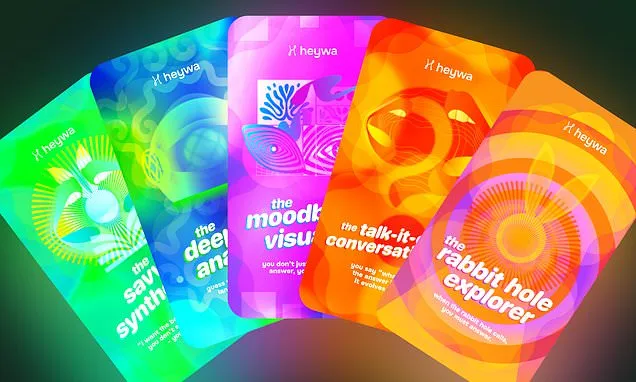
It's something most people do every day - but it turns out you might be using the internet differently from your friends.
Experts from Heywa say there are five distinct 'Online Languages'.
If you're a 'Rabbit Hole Explorer', you follow tangents wherever they lead, valuing discovery over direction.
But if you're more methodical and evidence-driven, you're probably a 'Deep Dive Analyser'.
'Just as love languages helped us understand relationships, our Online Languages reveal how we think, learn and connect,' said psychologist Kate Nightingale.
'The way you search online reflects your real-world personality - how you solve problems, process information and socialise.'
So, what's your online language?
Take the two-minute test to find out what type of internet user you are.
Most people know about the 'Five Love Languages' concept, created by Gary Chapman back in 1992.
This suggests that everyone has a preferred method of giving and receiving love -words of affirmation, quality time, gifts, acts of service, or physical touch.
Now, the team from Heywa have joined forces with Ms Nightingale to decode the UK's digital online language in a similar fashion.
The Online Language quiz includes seven multiple choice questions, and takes just two minutes to complete.
Questions include 'It's Friday night. You're looking for a cocktail bar. What's your move?', 'How many browser tabs do you have open right now?', and 'When you're planning a trip, what's your vibe?'
You'll also be quizzed on your search history, and how you prefer to search for something online.
At the end of the quiz, you'll be told which one of the five Online Languages you suit the most.
If you're a 'Savvy Synthesiser', you blend multiple styles and sources seamlessly, connecting insight, intuition, and creativity into one clear outcome.
The quiz comes shortly after experts from the University of Oxford uncovered four entirely new personality types that all ChatGPT users fall into.
5 Online Languages
- The Rabbit Hole Explorer: Curious and spontaneous, you follow fascinating tangents wherever they lead, valuing discovery over direction.
- The Deep Dive Analyser: Methodical and evidence-driven, you rigorously research and verify until you're confident you've found the right answer.
- The Moodboard Visualist: Visually wired and design-led, you understand and trust information best when you can see it mapped out.
- The Talk-It-Out Conversationalist: Dialogue-driven and iterative, you refine ideas through back-and-forth discussion rather than solitary searching.
- The Savvy Synthesiser: Adaptive and integrative, you blend multiple styles and sources seamlessly, connecting insight, intuition, and creativity into one clear outcome.
But if you prefer back-and-forth discussion over solitary searching, you're a 'Talk-It-Out Conversationalist.'
Other internet users are more visually wired and prefer to see information mapped out.
If this sounds like you, you're probably a 'Moodboard Visualist'.
Meanwhile, if you're constantly stumbling across new things online, you're a 'Rabbit Hole Explorer'.
Finally, internet users who enjoy rigorously researching and verifying information are deemed 'Deep Dive Analysers'.
The quiz comes shortly after experts from the University of Oxford and the Berline University Alliance uncovered four entirely new personality types that they say all ChatGPT users fall into.
Some truly tech-savvy users fall into the category of 'AI enthusiasts'.
However, at the very other end of the enthusiasm scale, someone just 'dipping a toe' into the world of artificial intelligence would be deemed a 'reserved explorer'.
If you constantly weigh up the potential benefits and drawbacks, you might just be a 'curious adopter'.
Meanwhile, if you care about results and convenience above all else, the experts say you are probably a 'naive pragmatist'.
Lead author Dr Christoph Gerling, of the Humboldt Institute for Internet and Society, says: 'Using AI feels intuitive, but mastering it requires exploration, prompting skills and learning through experimentation.'
'This makes the "task-technology fit" more dependent on the individual than ever before.'