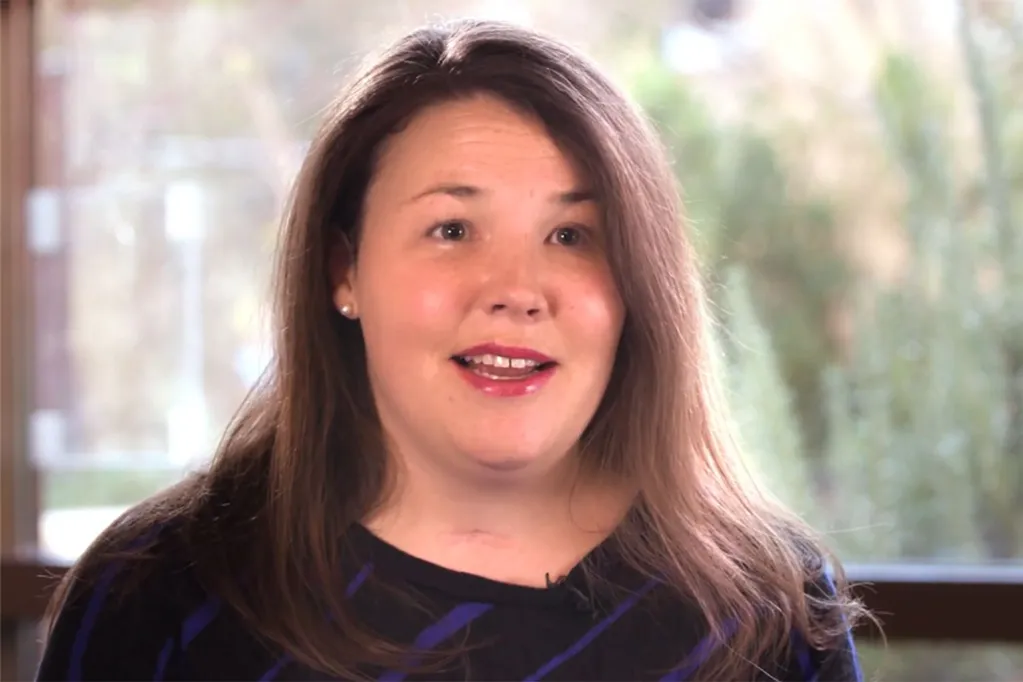
Jamie Hunter didn't see -- or hear -- it coming. She was hiking with 11 fellow students from the University of Portland in September 2003 when a falling, 500-foot boulder going 50 miles-per-hour hit her from behind.
Hunter, then 20 years old and an experienced mountaineer, flew 25 yards down a slope.
"I was without oxygen for eight minutes when I was brought in," she tells PEOPLE in a recent interview. "I was dead on arrival and resuscitated."
Her survival likely would not have been possible but for a series of fortunate coincidences courtesy her fellow hikers on Washington's Mt. Adams that day.
Speaking to PEOPLE in 2005, Hunter said she initially didn't even realize what was happening when she was first struck and began sliding down the slope while 10,000 feet up the mountain: "I remember thinking this was fun but very scary. I didn't hear a thing except the noise of me sliding. And then nothing."
As Hunter began suffering from massive internal injuries, fellow hikers sprang into action. The first climber to reach Hunter was Army Maj. Greg Nyberg, who quickly phoned the Washington Air National Guard and ordered that a helicopter to attempt a rescue.
Among the next to arrive was physician Kelly McGrath, followed by ICU nurse Susan Tyler, both of whom began working to stabilize Hunter.
When the helicopter arrived, Hunter -- with McGrath alongside her -- was airlifted to Portland's Legacy Emanuel Hospital
Then, her heart stopped.
But another coincidence would save her life, in the form of heart surgeon Jonathan Hill, who just happened to be in the ER when she arrived. Hill opened Hunter's chest and massaged her heart by hand until it began to beat again.
As Dr. William Long, who led the ICU team managing Hunter's case, told PEOPLE in 2005: "It took a series of miracles to bring her back."
In total, she would spend six months of her life in the hospital.
Now 42 years old, Hunter tells PEOPLE that following her stint in the hospital, she returned to school, even spending a summer abroad in Austria before graduating from the University of Portland, getting married, and moving to Utah.
The health challenges have persisted, with Hunter explaining that she also endured a traumatic brain injury that led doctors to discover a hole in her brain in October 2024.
She also suffers from arthritis on her left knee due to the boulder crash and broke her "good knee" (the right one) skiing in 2008, undergoing a total knee replacement in 2021 on her right leg. She broke her left shoulder in the crash and underwent a total shoulder replacement in spring of 2024.
The crash also lead to the loss of her left glute muscle, making the activities she enjoys -- hiking, skiing, mountain biking -- even more physically challenging than they already are.
"I try to always be rehabbing my body. I am trying to get strong enough still to downhill ski and I am working on my cognitive abilities; I've been feeling a lot of cognitive decline really since 2003 and 2004," she says, adding that she notices issues with things like "memory, organizing, recall, overwhelm."
One thing she doesn't struggle with, however, is fear.
"My life is sort of centered around my ability to function in the recreation world -- being able to ride my bike, going mountain biking, skiing, occasionally hiking," she says.
And the hike that's highest on her bucket list? Mt. Adams, the very hike that she took in 2003.
What's more, she adds, is that she wants to take the hike with Dr. Kelly McGrath, who just happened to be hiking the same day as the crash and served as part of her rescue team.
"He's the doctor that flew with me in the helicopter and went into the operating room with me," she says, adding that he and the others who happened to be on the mountain that day were crucial to her survival.
“I do look at that as sort of a fateful experience. I could not have had better people there to organize the rescue,” she says.
As for returning to the place where her life was changed, Hunter says, “It would be a physical challenge. There’s no mental fear.”
“I can get through it; it’s just piece by piece and conquering one thing at a time.”