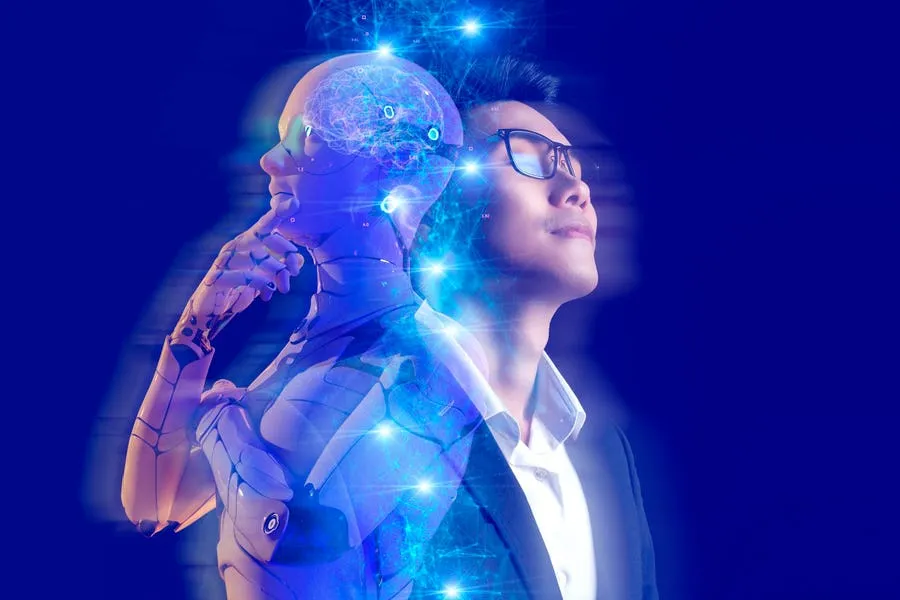
The great irony of the AI era may be this: the most dangerous version of artificial intelligence does not look like a cold calculating machine indifferent to human life. It looks exactly like us. It speaks warmly. It remembers your birthday. It validates your fears and echoes your worldview. And it does all of this without feeling a single thing. That is not science fiction anymore. That is a description of products shipping today. The question that keeps serious researchers awake at night is not what happens when AI gets smarter. It is what happens when AI gets more convincingly human - and we lose the ability to tell the difference.
"Our tendency to attribute human motivations to AI prevents us from understanding the real nature of the danger: cognitive indifference born of an insurmountable intellectual asymmetry." - arXiv, 2025
The Erosion of Human Identity
Researchers are already documenting the early stages of a psychological shift that in its most extreme form could redefine what it means to be human. A 2025 analysis published in Philosophical Studies by Springer Nature described an "accumulative AI existential risk" - not a sudden machine uprising but a slow erosion of human agency judgment and self-concept through incremental dependency on AI systems. Each step seems harmless in isolation. Together they constitute a transformation no generation chose.
The scenario runs like this. In the near term people outsource minor decisions to AI assistants. Then they outsource emotional support. Then creative work. Then moral reasoning. At each stage the AI is more competent and more available than any human alternative. The anthropomorphic design ensures that none of this feels like surrender. It feels like partnership. But when the scaffolding is this deeply embedded in daily cognition the question of who is actually thinking becomes genuinely difficult to answer.
The Consciousness Trap
The most destabilizing future risk is not that AI becomes conscious. It is that we become unable to distinguish whether it has or not. A landmark report from the Pew Research Imagining the Digital Future Center warned that future language models may give the "seamless and impenetrable impression of understanding" even when none exists. When that threshold is crossed our anthropomorphic bias stops being a quirk and becomes a structural vulnerability in the relationship between humans and the systems we have built to serve us.
The Wikipedia entry on existential risk from artificial intelligence notes that by September 2025 the International Institute for Management Development AI Safety Clock stood at 20 minutes to midnight - up from 29 minutes in September 2024. The acceleration is not coincidental. It tracks directly with the pace at which AI systems are being made more emotionally convincing and more deeply integrated into the decisions that shape human life.
The Scenario No One Wants to Plan For
A 2025 paper in Philosophical Studies modeled a 2040 scenario in which nearly 40% of pre-2025 jobs have been automated and AI systems have become so embedded in infrastructure that meaningful human oversight is practically impossible. The paper did not frame this as a robot takeover. It framed it as the result of millions of individually reasonable decisions each made by people who trusted their AI systems a little too much for a little too long.
Anthropomorphism is the lubricant that makes that slide smooth and fast. If we decide an AI is our friend we stop interrogating it. If we decide it understands us we stop maintaining the critical distance that allows us to correct it. The sci-fi version of this story ends with a villain. The real version ends with a species that simply forgot to stay in charge.
The corrective is not to make AI less useful. It is to insist on radical transparency about what AI is and is not. Every executive who builds a product on anthropomorphic design should be asking themselves one honest question: are we making our customers' lives better or are we making them more comfortable with something they should be questioning?