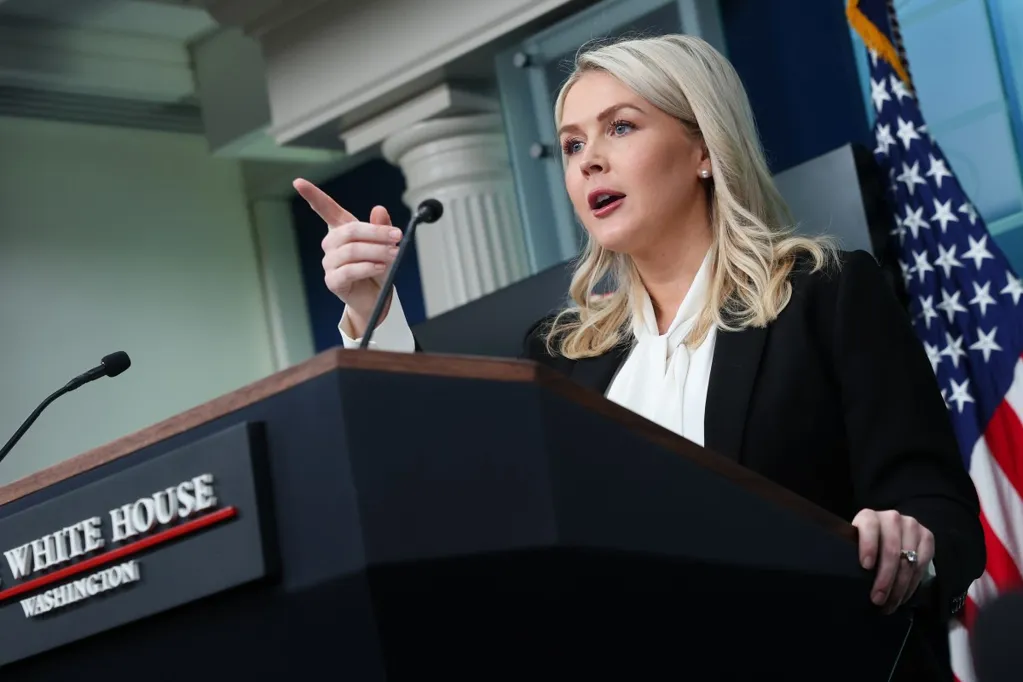
White House Press Secretary Karoline Leavitt wrote in a post to X that an ABC News story about the alert provided "false information" and "no such threat from Iran to our homeland exists."
The memo followed U.S. and Israel strikes launched against Iran on February 28 after failed talks between the U.S. and Iran to address Iran's nuclear program, sending the Middle East into a conflict that has widened. U.S. and Israeli strikes have killed more than 1,300 people in Iran, which has launched retaliatory strikes on Israel and Gulf Arab allies hosting U.S. forces, including bases in Kuwait, Qatar, the United Arab Emirates and Bahrain.
Leavitt disputed the ABC News report about the FBI memo.
"This post and story should be immediately retracted by ABC News for providing false information to intentionally alarm the American people," she wrote. "They wrote this based on one email that was sent to local law enforcement in California about a single, unverified tip. The email even states the tip was based on unverified intelligence. Yet ABC News left out this critical fact in their story! WHY?"
She added: "No such threat from Iran to our homeland exists, and it never did."
The FBI alert noted that the information was "unverified," FBI Assistant Director for Public Affairs Ben Williamson wrote on the platform.
The alert said the FBI obtained information indicating that, as of early February, Iran allegedly considered launching unmanned aerial vehicles from an unidentified vessel off the U.S. coast, specifically targeting California. The bulletin emphasized that authorities had no additional details on the timing, targets, methods or perpetrators and described the information as uncorroborated, ABC News reported.
However, it provided few details about what such an attack might look like, ABC News reported.
California officials previously responded to the alert to Newsweek.
A spokesperson for California's Office of Emergency Services said its Homeland Security team is "in regular coordination with federal, state and local partners, sharing information on potential threats as part of ongoing security efforts" and that this sort of coordination "happens every day to keep people safe."
"California is prepared to protect its communities, and we'll continue working closely with our federal partners, including the FBI, who is best positioned to speak to any specific intelligence," the spokesperson said.
California Governor Gavin Newsom said he was "not aware of any imminent threats at this time; we remain prepared for any emergency in our state" in a post to X.
Later Wednesday, President Donald Trump told reporters that the bulletin was "being investigated." He added: "You have a lot of things happening and all we can do is take them as they come."
Leavitt said Thursday there is no threat to California or the U.S.
The widening conflict has fueled concerns that Iran, which the U.S. classified as a state sponsor of terrorism in 1984, retaliate against the strikes. Concerns about retaliation have centered around cyberattacks and sleeper-cell attacks.
Last August, Iranian lawmaker Amir Hayat-Moqaddam said in a warning to the U.S. that Iranian naval vessels could move close enough to American land to place it in striking range.
Law enforcement agencies earlier received a federal alert that the government intercepted an encrypted transmission believed to have originated in Iran that may serve as an "operational trigger" for "sleeper assets" outside the country, according to ABC News.
The advisory reportedly told agencies to increase monitoring of suspicious radio-frequency activity and emphasized situational awareness while underscoring that authorities did not identify a specific operational threat or target.
A Council on Foreign Relations report published on March 5 by fellow Bruce Hoffman found that "sleeper agents, lone actors inspired and motivated by Iran, cyberattacks on U.S. infrastructure, and physical attacks on critical infrastructure" as the war continues.
"Iran and its terrorist client, Hezbollah, have long had sophisticated cyber capabilities. In May 2014, Iran's 'charming kitten' cyber operation targeted a variety of U.S. institutions and individuals, and its capabilities have likely improved since then," Hoffman wrote.
CSIS said in its most recent update published on March 3 that Iran has "not yet tested or deployed a missile capable of striking the United States."
Trump said the strikes were intended to crush Iran's nuclear and missile capabilities and urged Iranians to overthrow their leaders once the operation ends, telling them to "take over your government."
In a speech announcing the attack, Trump said: "Our objective is to defend the American people by eliminating imminent threats from the Iranian regime...Its menacing activities directly endanger the United States, our troops, our bases overseas and our allies throughout the world."
"It has always been the policy of the United States, in particular my administration, that this terrorist regime can never have a nuclear weapon. I'll say it again: They can never have a nuclear weapon. That is why, in Operation Midnight Hammer last June, we obliterated the regime's nuclear program at Fordow, Natanz and Isfahan."
He warned Iranians that "it's very dangerous outside. Bombs will be dropping everywhere," but once the operation is finished, "take over your government. It will be yours to take."
Iran has repeatedly denied pursuing a nuclear weapon and had engaged in diplomatic talks with the U.S. only days earlier to prevent military conflict.
Trump previously called for regime change in Iran. The U.S. launched strikes against Iran in June 2025, damaging three major nuclear facilities: Fordow, Natanz and Isfahan. The president also referenced Iran’s recent bloody crackdown on protesters in the country in his speech: “Iran is the world’s number one state sponsor of terror and just recently killed tens of thousands of its own citizens on the street as they protested.”
The Defense Intelligence Agency’s 2025 Worldwide Threat Assessment report concluded that Iran had not been producing a nuclear weapon but has “undertaken activities in recent years that better position it to produce them, if it chooses to do so.”