David E. Sanger has covered five American presidents in more than four decades at The New York Times. He has written about efforts to destroy or contain Iran's nuclear program for more than twenty years.
When the cease-fire in the war with Iran went into effect a month ago, President Trump was pretty direct that if the Iranians failed to end their nuclear program, or to reopen the Strait of Hormuz, the bombers would be back in the air. "If there's no deal, fighting resumes," he said, making it very clear this was just a pause.
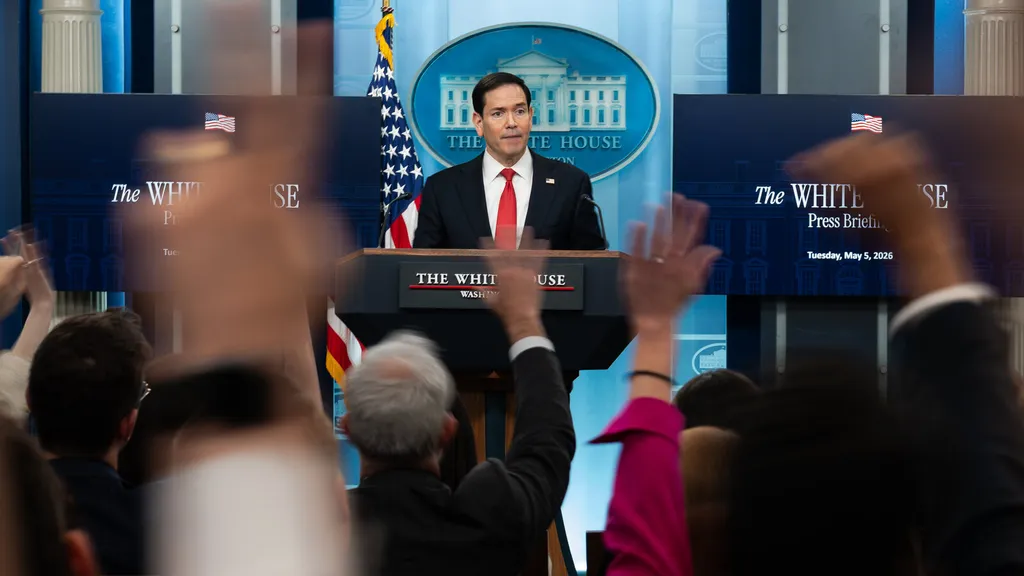
But it turns out, according to Secretary of State Marco Rubio, that the war actually ended at some point after the cease-fire took hold, or so he told reporters at a news conference at the White House on Tuesday. "The Operation Epic Fury is concluded," he said. "We achieved the objective of that operation." The effort to reopen the strait, Mr. Rubio said, is entirely a defensive and humanitarian operation that would result in direct military exchanges with the Iranians only if U.S. ships came under fire.
Later on Tuesday, Mr. Trump announced that he was pausing even that effort -- which was only one day old and had succeeded in getting just a few ships freed -- "for a short period of time," citing what he said was "great progress" toward an agreement with Iran. But that seemed to contradict the administration's stated position that it was forcing open the strait to establish that no nation has the right to block an international waterway.
For the White House, these were the latest rhetorical leaps in an effort to put a war that has created the greatest political crisis of Mr. Trump's presidency in the rearview mirror. But the mere proclamation does not make it true. Missiles were still flying as the United States tried to "guide" ships out of the strait. Both sides insist they control traffic in the waterway.
And despite Mr. Rubio's declaration that the objectives of the war have been accomplished, they clearly have not. In the 38 days of intensive combat operations, the United States hit, by the Pentagon's count, about 13,000 targets. But destroying targets was not the only point. Mr. Trump himself described his objectives in the early hours of Feb. 28 when he told the country, in a video he had recorded earlier, that he had five major goals.
The first, of course, was to ensure that Iran can "never have a nuclear weapon." But he went on to add that the United States had to destroy Iran's ballistic missiles and their launchers, sink its navy, end its support of terrorist groups like Hezbollah and Hamas and, finally, create the conditions for the Iranian people to topple their government.
"Your hour of your freedom is at hand," he said at the time.
The Iranian Navy is clearly gone, as Mr. Trump often notes. But that is the only one checked off the list. So far, Iran’s nuclear stockpile has not been touched and there is no agreement, at least yet, to ship it out of the country or to dilute it so that it cannot easily be used to manufacture weapons. While intelligence estimates differ, the U.S. assessments suggest that more than half of Iran’s missiles and launchers survived. It is too early to tell about support of the proxy groups, which were shredded by Israeli attacks.
And Mr. Trump has abandoned talk of changing the country's leadership, suggesting at one point that he never called for it. At other moments he has maintained that regime change already happened, citing the emergence of a new supreme leader and other officials replacing those who were killed. To most Iran experts -- and many in American intelligence agencies -- that is a change of personnel.
Nonetheless, both Mr. Trump and Mr. Rubio have many reasons to declare that Epic Fury ended at some undefined date in the recent past. Congress was getting increasingly restive about the War Powers Act, which demands a vote of approval by Congress after American troops are involved in combat for more than 60 days. His political base has fractured on the question of whether Mr. Trump has dispensed with his own promise to get America out of lengthy wars. And Mr. Trump delayed his trip to China once to make sure that the war was over, that the United States was victorious and that the strait was open before he touched down in Beijing. That trip is now scheduled for next Wednesday.
Mr. Trump's language has changed, too, though even he has not gone so far as to declare that the operation is ended. He cannot quite seem to keep himself from describing the current situation as a war, even if he has begun to back away. "Our country is booming now, despite the fact that we're in a -- I call it a miniwar," he said at a White House event for small businesses on Monday.
In other speeches, he has interspersed the word "war" with other, more benign descriptions: Attacking Iran was an "excursion," he said. At another point he described it as a "detour," making it sound more like a weekend drive across the Middle East that hit some traffic.
While it all sounds like politically convenient wordplay, any real declaration that the battle is over represents a fundamental change in strategy, even for a war in which the White House seemed to be making up its next move day by day. For the past nine weeks American military power—and the prospect that it could resume—was the leverage Mr. Trump celebrated as the steel behind negotiations. Nothing would focus Iranian minds, he suggested, like the prospect of further destruction.
Indeed, when negotiations over the future of the nuclear program broke down in late February, the American bombing was designed to force Iran to make concessions.
But the bombing campaign, while deadly and destructive, did not alter Iran's fundamental positions, at least yet. And the Islamic Revolutionary Guard Corps' success at sealing off the strait -- bottling up tankers and cargo ships and sending oil and fertilizer markets into a frenzy -- changed the dynamic. Mr. Trump's frustration was clear: He threatened even heavier strikes -- and attacks on power plants -- if Iran refused to relent, lashing out with expletives on social media.
The Iranians ignored it; then a few days later Mr. Trump warned, "A whole civilization will die tonight, never to be brought back again." Then came the cease-fire.
But Iran's restraint fell apart after Mr. Trump on Sunday announced a new operation to guide ships through the narrow strait, on a pathway that had been declared free of mines. Iranian forces shot at two ships the following day, but the missiles were intercepted by American forces. Gen. Dan Caine, the chairman of the Joint Chiefs of Staff, said on Tuesday that since the cease-fire took effect, Iran had attacked U.S. forces more than 10 times but that the attacks were "all below the threshold of restarting major combat operations at this point."
General Caine added that defining that threshold was "a political decision," meaning it was Mr. Trump's decision. And Mr. Trump, pressed a few hours later to explain where he put that threshold, told reporters, "You'll find out because I'll let you know."
"They know what to do," he said of the Iranians."They know what not to do."
Defense Secretary Pete Hegseth said on Tuesday morning that the new military effort to guide merchant vessels through the Strait of Hormuz should be understood as a completely separate enterprise and a temporary defensive effort.
"We're not looking for a fight," said Mr.Hegseth,w ho only a few weeks ago was celebrating American firepower against Iran and urging "maximum lethality." But he noted that U.S.warships shot down cruise missiles and drones that Iran fired at ships and commercial vessels,and that Army Apache helicopter gunships also sank six Iranian military speedboats that threatened vessels.
(Mr.Rubio compared boats to Boston Whalers; small ubiquitous speedboats.He said those struck "sit bottom sea along rest Iran's navy.")
Now administration has moved from declaring military strikes would change Iran’s leaders to insisting really economic cutoffs will do trick.Mr.Rubio said United States cutting off revenue keeps together “whatever remains frail economy.”
And he called Iranians pirates.“You can’t have situation which straits closed everyone else,but they benefit piracy—that can’t happen,”he said.Only United States,he said,having power open Strait Hormuz “as favor world.”
“Frankly,we are only ones that can,”he said.“If we live world rogue state like this Iranian regime allowed claim new normal control international shipping lane,”he added,“it will not long multiple shipping lanes around world.”