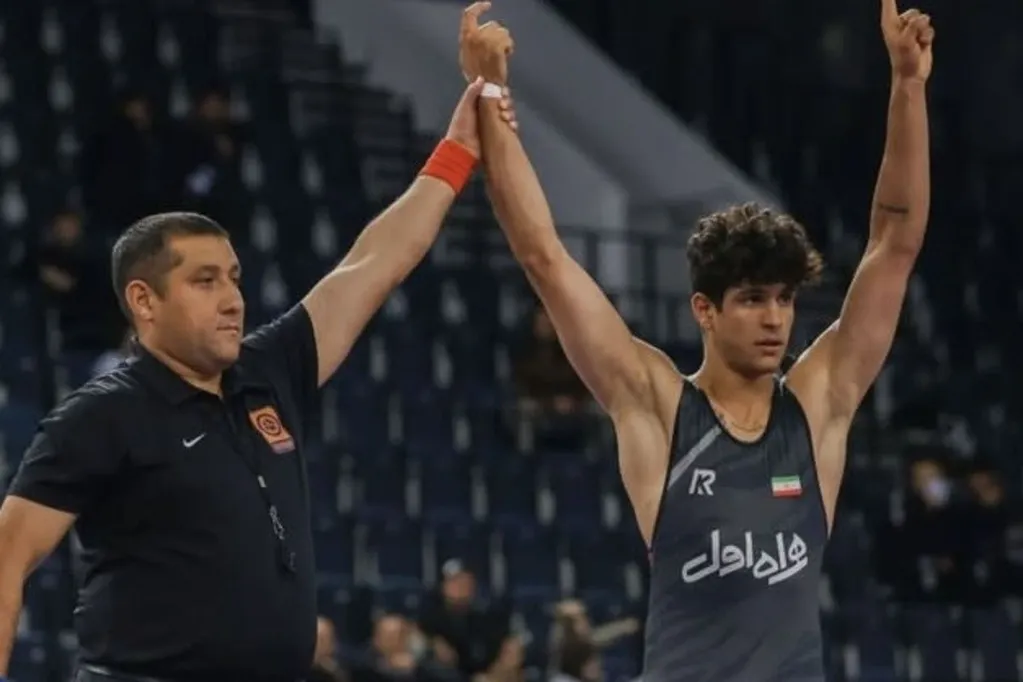
Iran executed 19-year-old national wrestling team member Saleh Mohammadi on Thursday, along with two other men, in the regime's first announced executions tied to January protests.
Mohammadi, Mehdi Ghasemi and Saeed Davoudi were executed in Qom after being found guilty of killing two police officers during unrest in Nabut Square on January 8. They were convicted of the capital crime of waging war against God, known as moharebeh under Iran's Sharia law.
The three men arrested that night in Qom were part of a wave of detentions following Iran's deadliest crackdown in decades. Protests had erupted on December 28 after Iran's currency collapsed to a record low, with food prices 72 percent higher than the previous year and inflation around 40 percent.
On January 8, security forces responded with unprecedented force. The crackdown was so severe that observers described it as "Iran's Babi Yar," marking the deadliest repression since the 1979 revolution.
Mohammadi had represented Iran at the Saitiev Cup in Russia in September 2024, winning a bronze medal in freestyle wrestling. His final Instagram post, uploaded three months before his arrest, showed him returning to training after injury recovery. He wrote: "And we held on beyond what we ever imagined for ourselves."
The case against him rested on shaky ground. The court record said that officer Mohammad Qasemi Hompour suffered 29 stab wounds during the protest, but security cameras did not capture Mohammadi's face. According to testimony from his family, teammates and coaches, he was not at the scene but rather at his uncle's home. Mohammadi maintained his innocence, denying the charges in court and saying his confession had been obtained under torture.
When his family sought independent legal representation, the court refused and appointed state counsel instead. The conviction relied on coerced confessions and anonymous witness testimony. Rights groups immediately challenged the proceedings.
Norway-based non-governmental organization Iran Human Rights said that Mohammadi, alongside the other two men, "had been sentenced to death following an unfair trial, based on confessions obtained under torture." Amnesty International also said Mohammadi was denied "adequate defence and forced to make 'confessions'...in fast-tracked proceedings that bore no resemblance to a meaningful trial."
The U.S. State Department had warned Iran against the execution, and President Donald Trump initially said he would attack if the regime executed protesters, but subsequently focused on Iran's nuclear program.
The case has drawn comparisons to wrestler Navid Afkari, whose 2020 execution became a symbol of the regime's use of capital punishment following protests.
Sardar Pashaei, a Greco-Roman wrestling world championship title winner and former coach of Iran's elite Greco-Roman team, to Fox Digital on Thursday: "My heart is broken for this young wrestler. Anyone who still shows sympathy for the Islamic Republic should understand -- this is only a small glimpse of its brutality."
Mahmood Amiry-Moghaddam, director of Iran Human Rights, to ITV News on Thursday: "The protesters executed today were sentenced to death following grossly unfair trials, based on confessions extracted under torture and coercion. We consider these executions to constitute extrajudicial killings, carried out with the intent of creating terror to suppress political dissent."
Iran is embroiled in the third week of war following the death of Supreme Leader Ali Khamenei in U.S.-Israeli airstrikes on February 28. The future of the government remains unclear with the U.S. and Israel pushing for regime change while the Iranian government attempts to consolidate power under new leadership.