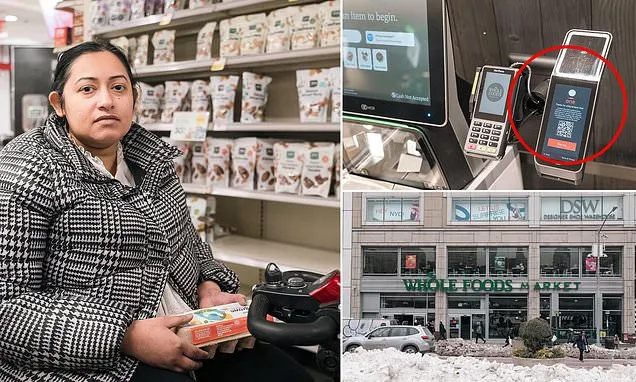
Every Whole Foods in the US is ripping out its biometric payment method that allows people to pay with their palms after it was shunned by customers.
By June 3, the more than 500 Whole Foods grocery stores across the country, all of which are owned by Amazon, will remove palm scanners from their checkout lines.
The payment method, dubbed Amazon One biometric authentication services, allowed customers to link their Amazon accounts to their palm print. They could then use their hands to pay for groceries or access other services offered by the company.
Although Amazon states that it 'processes more than one million biometric authentications each month,' a company spokesperson told the Daily Mail that a lack of widespread adoption was the main reason for nixing the program.
Customers had expressed fury on Reddit when the machines were first introduced, declaring 'fk no. Not giving Big Brother my biometrics' as they expressed fear over the company having their data.
The Daily Mail visited a Whole Foods location in New York City's Union Square this week to ask customers whether they have ever used the biometric payment method and what they thought of it.
Of the dozen shoppers who were interviewed, none said they had ever paid with their palms, and only a few said they had ever seen others do so. Some said they had never even heard of the program.
The shoppers said that the system seemed redundant, as people always carry their phones, and digital wallets that allow for tap payments are already widely used.
By June 3, every Whole Foods location in the US will discontinue a system that allows customers to pay with their palms.
Almost all of the customers who spoke with the Daily Mail also said they were uncomfortable with the idea of giving Amazon, a company with a more than $2trillion market cap, their biometric data.
'I think that pay with your palm is kind of scary because, like, what the heck,' Santiago Tieguec, a young man from Argentina who said he has never used the biometric payment method, told the Daily Mail.
'I don't want to give my biometric data to nobody,' Tieguec added. 'Nowadays we have our cards in our phones. So I think it's kind of unnecessary.'
Whole Foods shopper, Gavin McGinn, said he had never used his palm to pay and told the Daily Mail: 'I wouldn't trust them to have that kind of information about people, because who would they sell it to?'
McGinn added that the payment method felt 'science fiction-y,' and said he thought it was redundant. Despite frequently visiting Whole Foods, he thought the palm scanners in the self-checkout lines were just another terminal to pay with cards.
Although McGinn's discomfort with Amazon having customers' biometric data is not uncommon, the company's website states that 'Amazon One data is not shared with third parties.'
Amazon also states that customer 'data is not stored on any device. Instead, palm and vein images are immediately encrypted and sent to highly secure storage in the AWS cloud. Palm data is used to provide and improve the Amazon One service.'
Neil Saunders, a retail analyst and the managing director at GlobalData Retail, told the Daily Mail: 'Amazon may have kept pay by palm around if consumer adoption was stronger and if more retailers were interested in purchasing the technology.'
'However, it never really took off, and Amazon is becoming stricter about ensuring its ventures can generate a return.'
'As far as consumers are concerned, many did not see the point of it given that contactless payments and paying by phone is already so quick and easy. Some people also have concerns about sharing biometric data.'
Saunders' explanation was supported by what customers told the Daily Mail.
'I haven't [used palm payment], and I haven't seen anyone use it before,' Whole Foods shopper Priscilla Flete said.
She did not know how the system worked. After the Daily Mail explained that customers can link their palm prints to their Amazon accounts to pay for their groceries, she said: 'It's a bit invasive.'
Nusrat Abdullah, who said she had never even heard about palm payment, told the Daily Mail: 'It might be convenient, but I think your information is sensitive... I don't think paying with your hands is very safe.'
An Amazon spokesperson told the Daily Mail that once the company has finished rolling back its biometric payment method, 'All customer data associated with Amazon One will be securely deleted.'
But some customers interviewed by the Daily Mail were not buying it.
Brayden Stephenson said he does not believe that Amazon will delete customers' biometric data after the palm payment program is rolled back.
Brayden Stephenson, a Brooklyn resident who said he shops at Whole Foods when he is in Manhattan, said he once tried scanning his palm to see what would happen.
'I think I tried once, just because I was curious,' Stephenson told the Daily Mail. 'And then it tried to make me fill out stuff, and I was like, no.'
He said he didn't believe that Amazon would actually delete users' biometric data. 'A lot of the time, "delete" is just archive and sell off to somebody else,' Stephenson said.
The Amazon spokesperson emphasized that the company will securely delete all data associated with biometric payment after June 3, including names, phone numbers, emails, palm data, and any associated credit card or ID information.
Other customers said they were not as uncomfortable with the idea of Amazon having their biometric data because many large companies already have that information. Most iPhone owners, for instance, use their faces to unlock their smartphones.
Ali Price, yet another shopper who said she has never used palm payment, told the Daily Mail: ‘It’s okay. Everyone has our data somewhere.’
She also said that people likely did not sign up for the program because they did not want to take the time to fill out their information, especially considering how digital wallets already offer a convenient payment method.
Despite not trusting Amazon to delete biometric data, Stephenson also did not mind the idea of the company having it. ‘Everybody already has your stuff anyway, so I don’t really care about that as much,’ he said.
None of the shoppers interviewed by the Daily Mail said they had ever used their palms to pay.
But the incentive to share that information wasn't strong enough, Stephenson added.
'I already have a card. I'm not getting anything out of that,' he told the Daily Mail. 'There's not even a trade-off there. If I'm going to give my data or anything, it might as well be for a trade-off.'