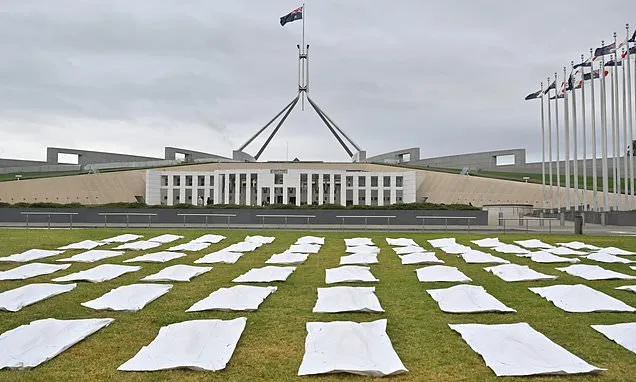
The lawns of Parliament House have been strewn with 66 body bags as health advocates call for urgent action to prevent Australians dying from tobacco use.
A senate inquiry into Australia's illegal tobacco crisis has held its first hearing today, hearing from Australian Border Force officials, medical experts and representatives from the Cancer Council.
The body bags will represent the 66 Australians who die every day from tobacco.
While tobacco lobbyists have called for the excise to be lowered to disrupt illegal traders, Australian Council on Smoking and Health chief executive Laura Hunter said this proposal was a 'self-serving red herring'.
'If you're comfortable making all cigarettes cheaper, you're comfortable with more people dying from smoking,' Ms Hunter said.
'You don't tackle a public health crisis by engaging in a race to the bottom with criminals, making Australia's deadliest product cheaper and more accessible.
'When cigarettes are cheaper, more people take them up, people already addicted smoke more and fewer people quit.'
Instead, the council is advocating for stronger legislation and enforcement mechanisms to make it harder for illegal tobacco products to be sold.
Health advocates placed 66 body bags on the lawns of Parliament House on Monday (pictured)
'There are over 40,000 outlets selling tobacco in Australia, far more than essential services like supermarkets, petrol stations, and pharmacies,' Ms Hunter said.
'When cigarettes are this widely available, it normalises them and makes enforcement much more challenging.'
Smoking is known to cause at least 16 types of cancer, including cancer of the lung, mouth, liver, bladder, bowel, kidney and other organs.
'Australia's world-leading tobacco control measures, including plain packaging, tobacco excise and advertising bans, have seen the number of Australians who smoke cut by more than half since 2001,' Cancer Council Australia chief executive Jacinta Reddan said.
'Cancer Council Australia is calling for stronger licensing and enforcement and for governments to work together to tackle illicit tobacco.'
ABF chief economist Justin Douglas said even halving the excise would still leave a sizeable price differential in favour of the black market.
'Illicit trade can always be cheaper. There is cheap, abundant supply. That means illicit traders can continue to reduce their price to maintain a price differential,' he said.
'Until there is some evidence on the table that suggests different, my advice to government won't necessarily be focused on excise as a priority.'