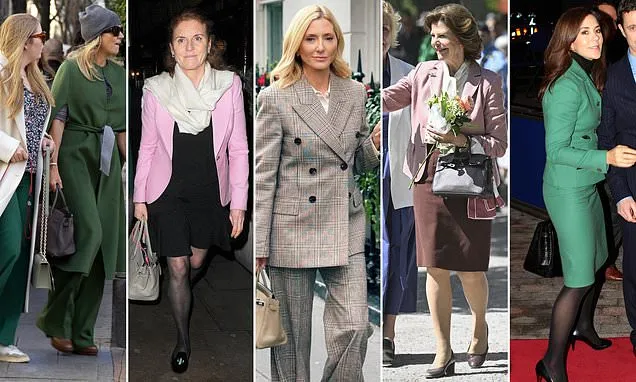
The Birkin has always been sold as a handbag, but in practice it behaves more like a passport, a document that proves you belong.
It is not simply expensive, it is difficult. It is not merely scarce, it is withheld.
Not just because of its eye-watering price tag and resale value of nearly 200 percent, but because the brand has made a kind of theatre out of who gets to buy one, when, and under what conditions.
This month, Hermès found itself facing renewed scrutiny after a French publication reported that staff may be Googling customers' home addresses.
The publication also mentions scanning social media to decide whether a client is prestigious enough to be offered the right to purchase a Birkin, a quiet background check for a not-so-quiet status symbol.
From humble beginnings the Birkin was born, making its official debut in 1984. And yet, for all the tiaras and titles in Europe and beyond, the Birkin's royal fan club is curiously patchy.
If there is one British royal-adjacent figure who has never seemed remotely intimidated by the Birkin's velvet-rope mystique, it is Sarah Ferguson.
Renowned as the 'Duchess of Greed', Fergie has spent money on an epic and often mindless scale, with money that more often than not she did not have.
Dining out at one of her favourite London hotspots in 2018, private member's club Lou Lou's in Mayfair, the former duchess carried a taupe Birkin with palladium hardware.
Fergie was once again partying at members club Lou Lou's, although this time her outfit was accessorised with a Birkin in a new colour, fuchsia pink.
And while most of the Windsor women have kept the Birkin at arm's length, Fergie, who has been stripped of her title, has been the exception.
She didn't just buck the British no Birkin pattern; she doubled down, swinging a Birkin on her arm with the breezy confidence of someone who has always treated luxury as a day-to-day language.
In today's Hermès universe, the old-fashioned waiting list has largely been replaced by something far more elusive: the wish list, where clients are typically invited to express a preference for size, leather and colour without any guarantee of when or even whether it will be fulfilled.
In other words, the queue has not vanished; it has simply stopped being visible.
In the Low Countries, the bag has been linked to Queen Máxima of the Netherlands, a woman whose taste has never been timid.
Travel north, and the Birkin's trail continues through Scandinavia. Sweden's Crown Princess Victoria has carried an orange Birkin; Queen Silvia has one in dark brown; Princess Madeleine of Sweden owns a taupe style. Continuing on to Denmark, Queen Mary has toted the most exotic iteration of the royals: a black crocodile skin Birkin.
Then comes a particularly cosmopolitan pocket of royal Birkin ownership.
Marie-Chantal, Crown Princess of Greece has been repeatedly connected to Birkin sightings, including a Birkin 25 in Sauge.
Princess Marie-Chantal of Greece has a collection of Birkin's and was most recently spotted in London carrying her Birkin 25 in Sauge.
Sweden’s Queen Silvia of Sweden visited Kronoberg County in 2023 and on her arm was a Birkin in chocolate brown accessorized with a colourful twilly ties to the handle.
Princess Tatiana of Greece and Denmark has been linked to a tan Birkin 30, a classic choice that sits comfortably in the old money palette of camel leather and discreet hardware.
Put those sightings on a map and a pattern appears. The Birkin, among royals, is less a Buckingham Palace staple and more a continental calling card.
So perhaps the question is not why certain royal women carry Birkin's, but why others do not.
In northern Europe the bag can read as immaculate, controlled luxury, a discreet badge among the discreet. In the globe-trotting Greek royal circle, it fits a lifestyle that is already fluent in international fashion codes.
But for Britain and Jordan, the Birkin's modern reputation, part craft object, part social sorting, may simply be more trouble than it is worth.
Because when a handbag is whispered to come with a postcode check, it stops being just a beautiful piece of leatherwork and starts looking like a test. And not everyone, not even a royal, wants to be seen taking it.
Hermès has long insisted that scarcity is a by-product of craft as each bag takes between 12 and 18 hours to create, at the hands of master craftspeople who have to undergo between two and six years of training before starting work in Hermès' leather workshop.
Additionally, the majority of the Birkin is sewn by hand using the brand's signature saddle-stitching technique.
Out and about in Madrid in 2023, Queen Máxima paired her bold emerald Natan cape with a discreet grey Birkin.
Arriving at an event in Stockholm before the wedding of Crown Princess Victoria of Sweden, Princess Tatiana wore a nude trench coat with tan ankle boots and a matching tan Birkin.
Then there are the numbers which make the Birkin's exclusivity feel less like a whim and more like a financial ecosystem. They retail at a starting point of £8,800; for those who can't secure one in-store they will often pay hefty premiums on secondary market for immediate availability.
The bag, however, wasn't always so hard to get; it was originally sold on shelf at Hermès boutiques in early 90s. The drastic economic shift arrived between 2008 and 2009 during financial crisis when limited-edition versions started having much higher price tags.
In today's Hermès universe, the old-fashioned waiting list has largely been replaced by something far more elusive: the wish list, where clients are typically invited to express a preference for size, leather and colour without any guarantee of when or even whether it will be fulfilled.
This is why the postcode allegation has cut through so sharply. If you already believe the Birkin is awarded rather than sold, the idea that an address might tip the scales feels like the logical endpoint.
Perhaps it is because the Birkin has never really been just a bag, and its hard-to-get reputation is part of its allure. It is a test of patience, of access, and, if recent allegations are to be believed, of postcode as well.