Just a couple of junctions on the M1 separate Milton Keynes and Luton - but their recycling rates are far apart.
In 2023-24, Milton Keynes recycled more than twice as much of its waste as Luton.
As the government pushes councils to increase recycling, why did the two places perform so differently?
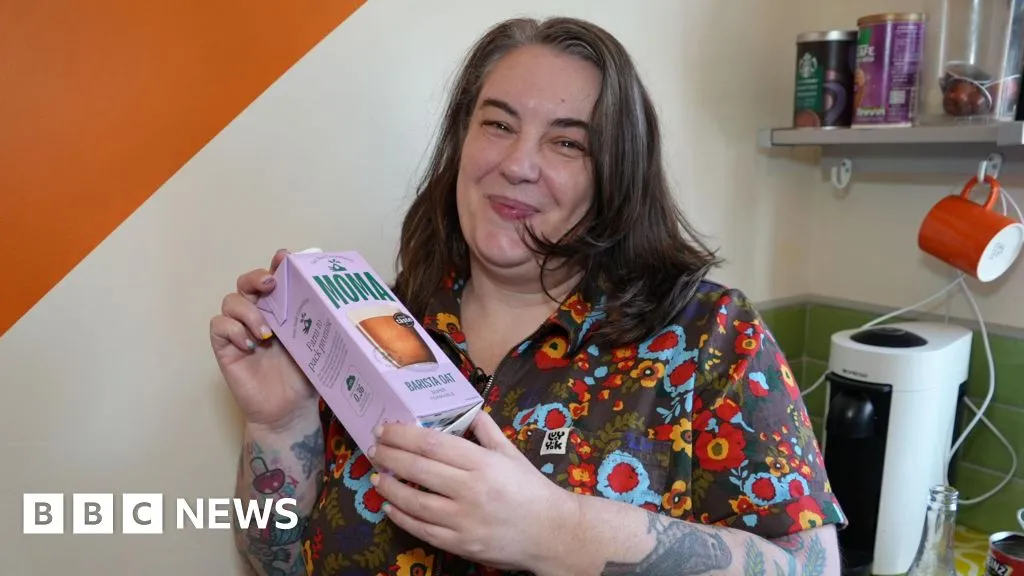
Louise Brown, 47, says she thinks about recycling "all the time".
"I could not put this in a landfill bin - I just physically couldn't," she says, holding an empty oat milk carton.
But opening the shared bin store near her Luton flat, she despairs.
"If you look in here, all of this stuff could be recycled - there's plastic boxes, there's cardboard, there's cans and plastic - so it's a real shame."
When she moved in about three years ago, the stores had separate containers for recycling and general waste.
But she says there was so much contamination - landfill waste being mixed with the recycling - that the recycling bins were taken away.
Brown, a member of Luton Friends of the Earth, says she was "gutted" by the decision.
"If it wasn't so gross, I'd be getting in there with my gloves," she adds, looking at the overflowing shared bin.
"I have done before - I have literally taken stuff out, going, 'Oh God, that could be recycled.'
Now Brown rinses and stores her recycling before giving it to her mum Janet Brown, 71, who lives about 20 minutes' walk away.
According to the Department for the Environment, Food and Rural Affairs (Defra), in 2023-24 Luton sent 27.7% of its waste for "reuse, recycling or composting".
Milton Keynes's figure was 60.2%.
What does Brown put Luton's lower rate down to?
"We need convenience," she says. "It's very difficult for me to rinse this out [and] give it to someone else - it takes effort.
"If I've got a bin a couple of metres away where I can put this, I will use it. If you take that bin away, people aren't going to make the effort."
Luton Borough Council confirmed that recycling bins had been removed from the flats.
A spokesperson added: "Residents who wish to recycle can still do so by requesting clear recycling sacks from the council's refuse service.
"These can be put out on the designated recycling collection day and will be collected."
Like many authorities, Luton council is introducing food waste collections.
The weekly service is due to start on 31 March, to meet a government deadline under its "Simpler Recycling" policy.
The council says about 35% of household rubbish is food waste and hopes the service will boost its overall recycling rate.
Food waste will be turned into biogas and fertiliser.
David and Hannah Weller are also keen recyclers.
Graphic designer David, 37, says he is "hyper-aware of the environmental cost" of waste so tries to avoid sending items to landfill wherever possible.
Luton residents will receive a small kitchen caddy and a larger bucket-sized bin, designed to sit outside.
David says their kitchen is "fairly small", and that fitting the bins in a tight row of terraced housing could be "a struggle".
"We'll make it work somehow," he adds. "We might need to put some things under the sink.
"Hopefully it's going to make our black bins less smelly."
Hannah Weller, who works for the Veganuary campaign, says she is "very interested to see how it goes" and wonders if weekly collections could better fit into people's lives.
What can be done to boost recycling in Luton?
"Education, isn't it? You know, ultimately it is down to education," she says.
Ghulam Abbas, the Labour councillor responsible for waste in Luton, says the borough is planning a "whole educational programme" to encourage recycling and reduce waste.
Food waste collections will "help to make Luton a cleaner, greener, more sustainable town", he adds.
Under "Simpler Recycling", the government is asking councils in England to provide four waste containers for:
- non-recyclables
- food waste
- paper and cardboard
- all other dry recyclables, such as paper, metal and glass
Abbas says Luton plans to introduce a paper and cardboard collection in April 2027.
But he admits: "We know our rate isn't where it should be - we know it needs to improve and what we're doing with the food waste and what we've got coming down the line will improve that."
He says the challenges for the borough include it being "disadvantaged and deprived" with a significant "transient" population.
"It's equivalent to London, so you really need to be comparing Luton to London, rather than Milton Keynes," he adds.
Luton council's opposition leader, Liberal Democrat Amjid Ali, says it was "quite unfortunate" that the authority started charging for green garden waste collections in 2021.
"That's probably driven up a lot of the general waste," he says.
Ali agrees more education is needed, particularly targeting estate agents and landlords, because "a good chunk of our population is in the private rented sector and I think that's where the majority of our recycling issues are".
In Milton Keynes, the council introduced a four-wheelie bin system in 2023.
Some residents feared "bin-mageddon", but the council says it helped increase its recycling rate by 12 percentage points - a bigger rise than any other area in England.
Previously, much of Milton Keynes' rubbish went into black or clear plastic sacks.
Nicholas Hannon, Milton Keynes City Council's assistant director for environment, waste and commissioning, says the authority has had a "proud history of recycling" and that in 1993 it offered one of the country's first kerbside recycling collection services.
While he credits the new wheelie bins with helping boost recycling rates, the city had posted a rate of 59.1% in 2018-19 five years before the new bins arrived.
But that subsequently slipped, which Hannon puts down to contamination, or "more of the wrong materials going into the recycling sack".
He explains: "Our recycling quantity was stable but the quality was deteriorating."
The new wheelie bins, Hannon adds, have given "a very clear offer to our residents".
The city is seeing "more and more paper and more card" put into them, which has "really driven up our recycling rates".
Milton Keynes now says it wants to be the "number one recycling city in the country".
Recycling data for 2024-25 is due out towards the end of March.