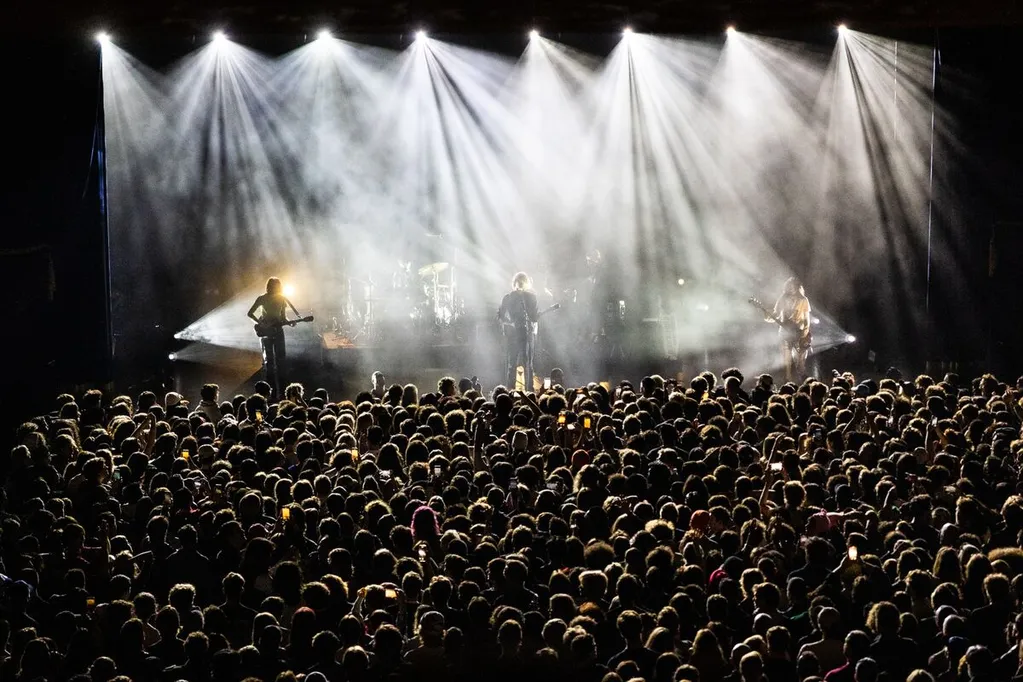
Within the indie rock world, the Brooklyn, New York, band Geese was undoubtedly the breakout success story of the past year. After releasing their critically acclaimed record Getting Killed, the precocious zoomers embarked on a national tour of midsize venues across the US, each show to a sold-out crowd.
Thanks to the success of Getting Killed -- and mounting fascination with the band's frontman, Cameron Winter -- ticket demand went through the roof, pushing resale prices on sites such as StubHub and SeatGeek to $2,000 in some cities. Given how far in advance tours are planned, that kind of secondary market action would have been hard to predict when booking venues, just as it's hard to know which band will blow up next. That it was almost immediately prohibitively expensive to see the hottest band in the US live, though, has itself become part of the Geese narrative. While it's impossible to intentionally replicate the group's mainstream breakthrough -- the discourse around which has now entered conspiracy theory territory -- the music industry does have some leeway when it comes to lining up a string of sold-out dates.
Enter the underplay. Within the industry, the term is shorthand for booking an artist to play at a venue whose capacity is lower than the number of tickets the artist can be reasonably expected to sell. Historically underplays were used to perform under the radar for a number of reasons. They can help artists circumvent radius clauses that certain venues (often festivals) impose, or test out new music in front of an intimate crowd.
But lately the underplay has emerged as a key tool available to artists and the teams behind them. "When you put the ceiling really low on the capacity of a show, it kind of becomes speculative," says Ric Leichtung, a longtime Brooklyn music promoter who describes it as creating an idea of perpetual demand and growth. Today's sold-out tour is tomorrow's festival slot, or placement in an au courant film or TV show, which then becomes the foundation for a platinum record or high-grossing stadium tour.
The pandemic also changed the dynamics of booking live events. When artists resumed performing after lockdowns, there was industrywide uncertainty over how quickly the market could recover. In October 2022, high-profile indie acts Santigold and Animal Collective canceled tours meant to promote their respective albums, citing the inflation-induced increased costs of touring as well as uncertainty about the health of both performers and audience members.
Others opted to play it safe, picking venues they'd filled in the past even if demand for larger shows might have existed. A cohort of new musicians, many of them in their teens, emerged from isolation having blown up online but without the sort of live performance experience that gives an artist an understanding of how to command the stage in a big room. And with even the most seasoned performers needing to shake off rust, the only reasonable thing to do was to proceed with caution. Leichtung says the industrywide thinking became "the right venue is the one that sells out."
There are also practical reasons to shoot for sellouts in smaller rooms. "When bands have a bunch of sold-out shows on their Instagram, it drives sales for other markets," says Zachary Cepin, a booking agent at High Road Touring. Creating a sense of urgency certainly helps, as does playing a small, packed room with a rabid crowd, filming it and disseminating the footage on social media.
It wasn't always this way, says Dylan Baldi, a Philadelphia-based musician best known as the singer and guitarist of the band Cloud Nothings. When Baldi, now in his 30s, began touring in his late teens, he says, "we'd just go out and play a bunch of shows. Some of them were sold out, which was great, but it was never like, 'If this doesn't sell out, the tour's ruined.'"
Baldi is also of a generation of indie musicians for whom industry-focused events such as South by Southwest, in Austin, and CMJ Music Marathon, in New York City, functioned almost like the NFL Scouting Combine for emerging acts. Artists hoping to get noticed would pack absurd numbers of sets into the dayslong, multivenue affairs, tacitly betting that, in the aggregate, they’d perform in front of enough label people, publicists, agents, managers, tastemakers and journalists that someone with sway would help make something happen. Today, SXSW is vastly more integral to the film and tech industries, and CMJ no longer exists.
In lieu of centralized industry showcases, says Leichtung, up-and-coming artists and their teams often pick key shows meant to present the artist in the most flattering light, regardless of size. "The flagship shows of an artist's narrative typically happen in New York or Los Angeles," they say.
That these shows just so happen to occur in the markets where much of the music industry and press live only further serves to illustrate the power of the underplay: Rather than taking advantage of these cities' vast populations of culture-savvy young people to sell as many tickets as possible today, artists opt to pack a smaller room with the right crowd to maximize the hype -- increasing the likelihood of big opportunities tomorrow.
On a certain level, all of this seems a bit sneaky. And it gets sneakier. Leichtung notes that venues including East Williamsburg's Brooklyn Steel and Union Transfer in Philadelphia have installed retractable stages to manipulate their capacity. "You can go from a room that could sell out about 1,800 tickets down to 1,200," they say. Venues can cut capacity even further through canny placement of curtains, restricting access to balconies, and other visual tricks to make the room seem smaller than it is -- with the aim of being able to declare a show "sold out" if ticket sales surpass a certain threshold but interest has stalled.
But this focus on filling rooms over maxing out ticket sales has the potential to create a misalignment of incentives between artists and venues, especially ones owned by behemoths such as Live Nation Entertainment Inc. that also operate ticketing platforms. While Live Nation Chief Executive Officer Michael Rapino argued last fall that concert tickets are "underpriced" compared with sporting events, a federal jury this week found Live Nation illegally monopolized the live-events industry, opening the door to a potential breakup of its Ticketmaster business.
Similarly, there's an argument to be made that when a venue futzes with its layout to lower its capacity, it's placing an artificial cap on alcohol sales as well as ticket sales. And when an artist books too small a show, the uncaptured value leaks onto the secondary market, where fans face high prices or miss out altogether.
Manufacturing sold-out shows, however, can also help counter the risk of leaving money on the table while ensuring both artist and audience have the best possible experience at the gig, says Cepin of High Road Touring. He cites a string of dates he booked for the legendary and idiosyncratic singer-songwriter Jonathan Richman, formerly of the Modern Lovers, at Baby's All Right in Brooklyn.
Although Richman, now in his 70s, likely could have played a much larger venue than the 330-capacity hipster mainstay, Cepin felt that putting him there was a statement of his continued relevance with younger audiences. "It makes him look really cool," he says. "There's probably not a lot of other people his age playing Baby's."
To make sure Richman wasn't taking a haircut on potential earnings, Cepin booked eight performances at the venue, initially announced four, then waited for each to sell out before revealing the rest. "It's not necessarily set up to even be an underplay," he explains. "You don't announce all eight shows at once because you want to make sure the demand is there."
In the age of easily faked view and stream counts, armies of artificial intelligence agents and bots in comment sections, as well as paid playlist placements, it's hard to discern an artist's true popularity -- or even potential -- from data alone. The real-life experience of seeing an artist live, meanwhile, is harder to fake. Sure, the conditions can be optimized, to put it charitably, but the appearance of a packed room can help both performer and audience have the best possible time.
"It's a weird system," says Cloud Nothings' Baldi, noting with a laugh that he'd recently been told his band was doing an underplay at a venue that,"to us, was kind of just a play." He adds: "The whole thing is fake in a way. But at the heart of it, people are playing music and other people are enjoying it."