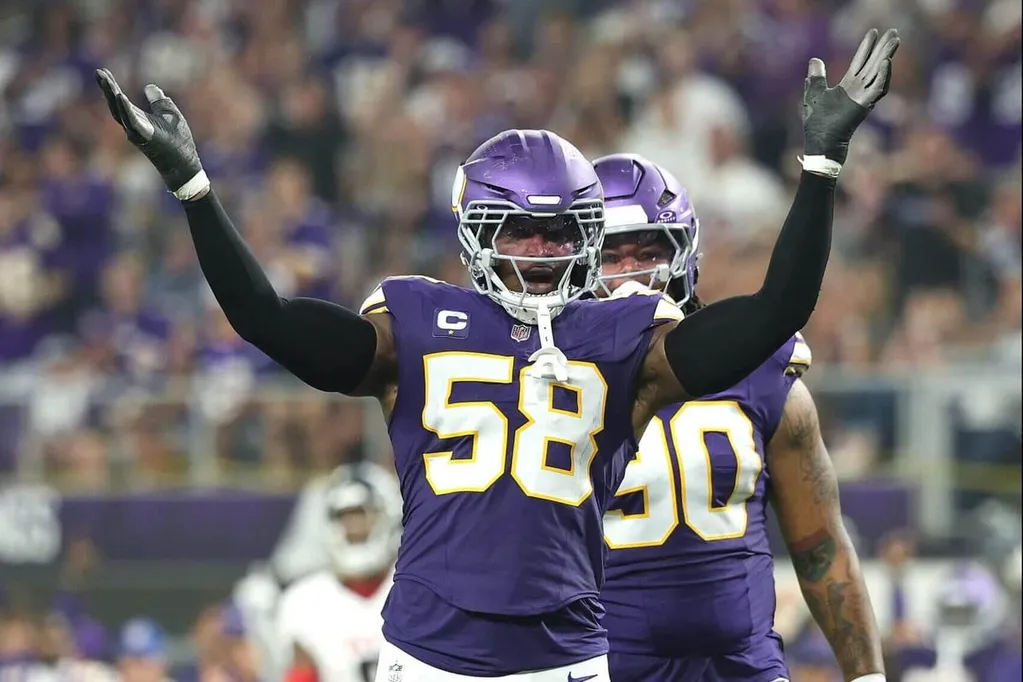
EAGAN, Minn. -- The phone records aren't readily available, but it's fair to guess that few Minnesotans have spent as much time talking to Philadelphians in recent months as Rob Brzezinski has with Howie Roseman.
These two longtime NFL executives had been talking about a potential trade. Specifically, the Eagles wanted the Vikings to trade them Pro Bowl edge rusher Jonathan Greenard.
For a while, Minnesota held off. Then Friday arrived, a deal was reached and Vikings coach Kevin O'Connell informed Greenard of the news. In exchange for two third-round picks, the Vikings would be sending him to Philadelphia, his third NFL stop.
They said a swift sayonara to a key cog of their dominant defense over the last two seasons.
"Very difficult decision for our organization," Brzezinski, the Vikings' interim general manager, told reporters Friday night. "It's something that we understand is not making (us) a better team today."
Why, then, would the organization make this move? Why would the team brass part with such a critical component of a unit that has been the team's backbone? Why do it for an underwhelming package of picks in return?
Most of the answers concern finances.
When the 2025 season ended, the Vikings faced a steep salary-cap overage. They had spent mountains of cash in recent seasons on free agents, mostly because they needed external additions to cover for misses in the draft. No longer could they operate with millions of dollars in contracts scheduled to come due in the future. For lack of a better way to say it, the Vikings decided they could no longer refuse to pay their credit card bill.
Simultaneously, Greenard, who will turn 29 next month, believed he deserved a bigger payday. He had initially signed a four-year deal worth up to $76 million. Assessing his production and the future, he and his agent, Drew Rosenhaus, thought he had performed well enough during the last two seasons to get more.
But that clashed with the team's offseason strategy. Working together, they set out to find a solution.
"Jonathan had two years left on his contract," Brzezinski said. "That's not an easy situation to navigate, either."
Multiple teams explored the possibility of acquiring Greenard from Minnesota and giving him a new deal. Some loved the idea of adding a player of his caliber; others weren't sure he was worth the money. "The contract he wants is crazy," one high-ranking NFC official whose team explored trading for Greenard said in March.
Philadelphia needed an edge rusher, especially after Jaelen Phillips inked a massive free-agent deal with the Carolina Panthers. The Eagles contacted the Vikings and kept in touch. Their persistence -- and eventually their agreement with Greenard on a new four-year, $100 million deal with $50 million guaranteed -- pushed the trade over the top.
The Vikings had coveted a premium return. Landing two Day 2 picks (one in 2026 and another next year) fell well short of the return the New York Giants netted for defensive tackle Dexter Lawrence. Lawrence, though, is widely regarded as a top-five player at his position, whereas Greenard falls around 15th among edge rushers in most meaningful metrics.
In what is perhaps a better comparison, however, last month the Green Bay Packers traded edge rusher Rashan Gary—another 28-year-old—to the Dallas Cowboys for a 2027 fourth-round draft pick.
So how did Brzezinski and Roseman settle on the final value?
"The value ends up being what the market will pay," Brzezinski said. "Obviously, JG is a great player. I'm sure people have a lot of opinions about what the appropriate value should be for him. All I can say is that considering everything we thought it was in the best interests of all parties. People can judge whether or not it was fair for a player of that caliber and we understand that. But it's what the market would pay."
Moving forward, this move places major responsibility on two men: third-year edge rusher Dallas Turner and defensive coordinator Brian Flores. Turner, who began to ascend in the back half of 2026 playing Greenard's primary position, must progress into a consistent winner in one-on-one pass-rushing opportunities.
Meanwhile, Flores must continue to utilize deception to apply pressure on the opposing quarterback.
The Vikings saved almost $34 million in salary-cap space with this decision. Perhaps just as important, they now have the financial flexibility to maneuver through a bevy of future decisions, be it the quarterback position, a potential extension for right tackle Brian O'Neill and Jordan Addison's future.
"There are a lot of factors involved," Brzezinski said Friday night."And particularly,the economics."
This was yet another example of how it often comes down to money,both in life and in professional football.