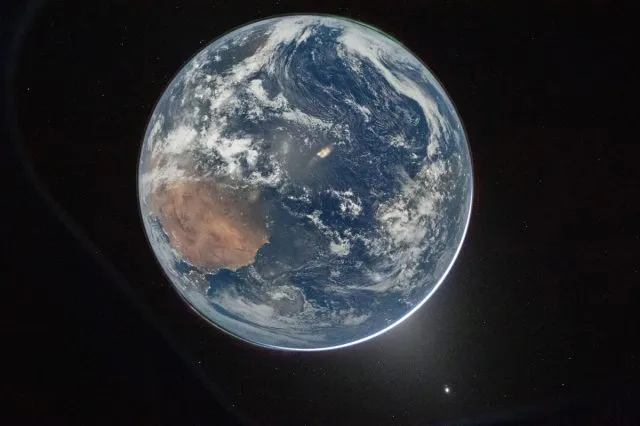
(NEXSTAR) - Looking up into the night sky, you're bound to see the moon and stars (and maybe a planet or some satellites). The photos being shared by the crew of Artemis II, however, haven't shown you all of that.
The astronauts within the Orion capsule have shared photos of Earth and the moon, giving us earthlings insights into what they're seeing on their historic lunar fly-around. That includes shots of the Orientale basin, a part of the moon that human eyes have never seen in its entirety, taken by Nikon cameras. They also have iPhone 17 Pro Maxes on board for photos and videos.
What you won't see in the pictures are any stars.
It's primarily because the stars are pretty dim, and camera settings are keeping them at bay. To capture them, the cameras of the Artemis crew would need to have a higher shutter speed and low-light sensitivity.
Another reason? The crew isn't trying to take photos of the stars.
In addition to unseen parts of the backside of the moon, NASA officials say they'll be able to view Mercury, Venus, Mars, and Saturn, as well as the solar corona when the Sun passes behind the moon in an eclipse.
Even though the photos coming in from space have black backgrounds, they're being taken in periods of direct sunlight. The sun is shining on the spacecraft or the moon, making it quite bright. The cameras' exposure settings have to be adjusted for that brightness, meaning the far-away, dim stars "remain invisible," astrophotographer Andrew McCarthy told Reuters in 2022 during the Artemis I mission.
It's like trying to take a photo of someone standing next to a very bright, sun-lit window, Emily Lakdawalla explained in a 2019 article for The Planetary Society. You may only be able to see that person's silhouette since they aren't brighter than the window.
To see the faint light of the stars, the astronauts would have to use longer exposure times, a step that's recommended when trying to capture weak but present northern lights. They could also adjust the aperture, a setting that controls how much light enters the camera, Astronomy explains.
However, that doesn't work as well when there is a bright object - the sun reflecting off the spacecraft, the surface of the moon, or something else - in frame. Like taking a photo next to a bright window, a washed-out effect may happen, keeping the stars from view.
While the Artemis astronauts aren't capturing photos of stars in space, other NASA spacecraft are hard at work doing so. Take, for example, the James Webb Space Telescope.
In 2025, it and NASA's Chandra X-ray Observatory captured the below photo of two massive galaxy clusters. The Webb telescope has also taken stunning photos of the Horsehead Nebula, a star birth in the Rho Ophiuchi cloud complex (our closest star-forming region), the Pillars of Creation, and the Tarantula Nebula and Carina Nebula star-forming regions.
Even more photos from the Artemis II mission are expected after they splash down in the Pacific Ocean later this week. NASA officials said during a Sunday press conference that while photos are sent back to Earth when bandwidth allows, there are more on the cameras' flashcards that will be recovered upon the crew's return.