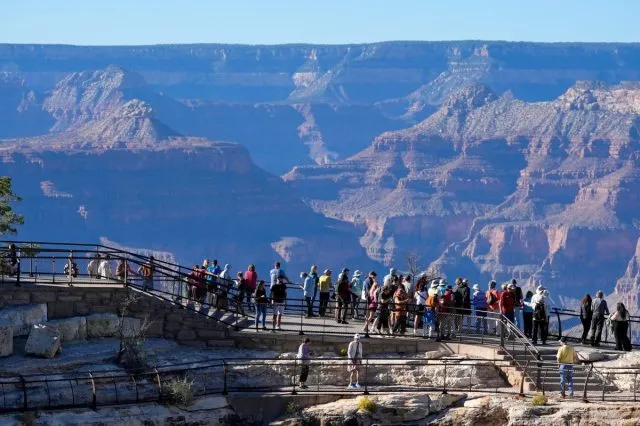
(NEXSTAR) - Spring is nearly in the air, which may have you rushing to your nearest national park to take in a once-in-a-lifetime super bloom or, if you're lucky, some volcanic activity. You may first, however, be asked if you're a U.S. citizen or risk paying a surcharge.
Last fall, the Interior Department announced a slew of changes that may impact how you visit a national park this year. Among them was a rule, months in the making, to impose an extra fee on certain visitors at specific parks.
Following a directive from President Trump, the Interior Department -- which oversees the National Park Service -- included in its budget proposal for fiscal year 2026 that it would impose a surcharge on international visitors. At the time, the proposal projected the move would bring in more than $90 million.
While Americans will find higher fees at international attractions, like the Louvre, out-of-country guests were not charged more to visit national parks in the U.S.
That changed in January when the new policy took effect.
Now, international visitors are charged $250 for an America the Beautiful pass, which "covers entrance fees and standard amenity (day-use) fees at thousands of recreation locations, managed by six federal agencies." The same pass costs $80 for Americans.
At 11 parks, listed below, international guests will be charged a $100 per-person fee at the entrance gate, unless they already have the America the Beautiful pass:
- Acadia
- Bryce Canyon
- Everglades
- Glacier
- Grand Canyon
- Grand Teton
- Rocky Mountain
- Sequoia & Kings Canyon
- Yellowstone
- Yosemite
- Zion
Many of these rank among the most visited NPS sites. It's estimated that of the record-setting 331.8 million visits tracked at national parks last year, 14.6 million were international tourists.
Visitors to these parks are asked at the gate if they have a pass. If they do not, they are then asked if everyone in the vehicle is a U.S. citizen or resident.
"If not, they can either pay the entrance fee plus a $100 non-resident fee for each non-resident, or someone in the vehicle can purchase the new America the Beautiful annual pass," an NPS spokesperson told Nexstar via email.
To purchase a pass, regardless of whether the guest is an American or not, the spokesperson said the visitor must show their ID. If you are using a new digital pass, you'll be asked to show a photo ID when you use it.
Park staff who spoke with The Washington Post anonymously earlier this year said the process was slowing down the entry process at their parks. They also reported that some foreign visitors were opting not to enter the parks after being asked about their citizenship and informed of the higher entrance fee.
International visitors hoping to avoid the surcharge on any of the fee-free admission days are out of luck as well. Now dubbed "resident-only patriotic fee-free days," U.S. residents get into fee-charging parks for free on nine remaining days this year.
- Memorial Day, May 25
- Flag Day, June 14 (Also Trump's birthday)
- Independence Day weekend, July 3-5
- The 110th birthday of the National Park Service, Aug. 25
- Constitution Day, Sept. 17
- Theodore Roosevelt's birthday, Oct. 27
- Veterans Day, Nov. 11
Free admission was also in effect on February 16 in honor of Presidents' Day.
Previously, fee-free days were also observed on Martin Luther King, Jr. Day; the first day of National Park Week in April; Juneteenth National Independence Day; the anniversary of the Great American Outdoors Act; and National Public Lands Day. Those are not listed among the fee-free dates on the NPS website.
Currently, 106 of the 475 sites managed by the National Park Service charge an entrance fee. The most expensive among them -- like Yellowstone, Yosemite, and Zion -- charge $35 per private vehicle. Entrance fees are used to "enhance visitor experience" under the Federal Lands Recreation Enhancement Act.