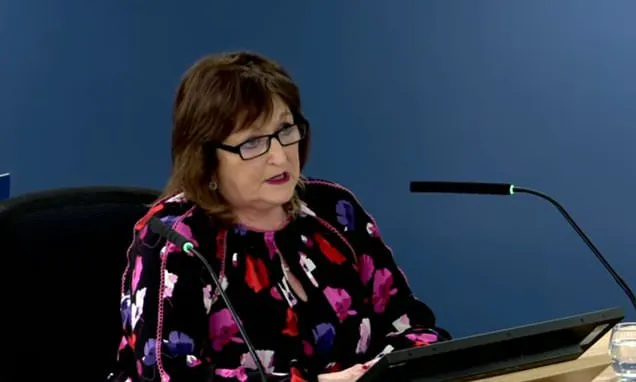
A widow whose husband died in hospital during the Covid-19 pandemic said she feels "completely betrayed" by the authorities over rule breaks.
Julie McMurray described feeling guilty over the fact she could not be with her husband Robert in hospital and never being able to forget seeing how upset he was during video calls, desperate to come home to his family.
She said not being able to bring his body home for a wake after his death and having to choose between friends to keep the number at his funeral to below 25 was horrible, and described feeling betrayed by seeing high profile Covid rule breaks.
When I saw Robert on the calls he was distraught, confusion had really escalated, he told me he would rather be dead which was completely out of character. He asked why we had left him, he thought that he must have done something wrong
Mrs McMurray was among a number of witnesses from the Northern Ireland Covid-19 Bereaved Families for Justice group who gave evidence to the UK Covid-19 Inquiry on Tuesday.
Mr McMurray, 64, a former bank worker, died on January 30 2021 in hospital after contracting Covid-19.
He had been diagnosed with dementia in his 50s, and in December 2020 went into hospital for an operation to remove a cancerous tumour.
Mrs McMurray said their nightmare started when her husband was moved to another ward which was very noisy, and moved another three times, which she described as "chaotic" and "unsettling" for him.
She said January 14 was the last time she got to speak to him face to face before visiting was suspended.
"I couldn't believe I wasn't allowed in to him, he was terrified, he didn't want to be left, for the next period we had video calls, but as a dementia patient Robert had lost the ability to text and phone, he needed help, but it was haphazard," she said.
"When I saw Robert on the calls he was distraught, confusion had really escalated, he told me he would rather be dead which was completely out of character.
“He asked why we had left him, he thought that he must have done something wrong.”
Julie McMurray was among a number of witnesses from the Northern Ireland Covid-19 Bereaved Families for Justice group who gave evidence to the UK Covid-19 Inquiry (UK Covid-19 Public Inquiry/PA)
While Mr McMurray had been due to be discharged on January 20, he contracted Covid-19 on January 19.
“It was very difficult to get through to the hospital to find out how he was”, she said, adding that after learning he had had a fall, she was so worried but could not get through to the hospital and even considered calling the police.
She told the inquiry she got a call to say she could visit on January 29, but said her husband was unconscious and unresponsive.
“I know that Robert would have squeezed my hand or responded in some way if he’d been able, but he was completely unresponsive,” she said.
“I find that visit really futile. When he was pleading with us, when he just needed a bit of comfort, why were we not allowed in before then?”
Mrs McMurray caught Covid-19 herself just after her husband died, and said she believed she got it from going into the hospital.
She also described not being able to have a wake for her husband as devastating for her and their two children.
“In Northern Ireland, and particularly in country areas, that’s what you do,” she said.
“It’s very important to have the body home, very important and for family to get together... and that being missed is horrible.”
She added: “I felt completely powerless, when you promise to look after somebody in sickness and in health, or promise to look after them in the hospital.
“You don’t do that with a caveat, unless somebody decides you’re not allowed to do that.
“I feel that I failed him. It doesn’t matter how many people say you’ve done your best. You know you make a promise, you intend to keep it.
“I’ll never forget particular scenes in my head, Robert lying on the floor. I will never forget his video calls, feeling he’d done something wrong, and he was terrified.
“Nobody should die alone.
“I feel completely betrayed by the authorities breaking the rules whenever I wasn’t even allowed to hold Robert’s hand when he was terrified and sick and confused.”