That means Trump would face fewer legal barriers if he were to invoke it, and the military would have heightened authority to carry out law enforcement actions.
It's still unclear the scope of any military action he could take in sending troops to Minnesota if he invokes the act. The Insurrection Act says only that presidents should use the military "as necessary" and doesn't give any limits on how long the military can be used domestically.
Invoking the Insurrection Act creates an exception to the rule typically banning the military from performing domestic law enforcement actions. Most notably, that would mean the military would be able to arrest people for any perceived violations of federal law, along with other actions -- like setting up blockades or apprehending protesters -- that are typically done by law enforcement.
Though the Insurrection Act gives presidents broad authority to use the military on U.S. soil, "that discretion is not infinite," Joseph Nunn, a counsel in the Brennan Center's Liberty and National Security Program who studies domestic use of the U.S. military, told Forbes in August. Troops are allowed to enforce federal laws, but "there is no circumstance in which the President can deploy the military into a city and a state like New York or Chicago and direct the military to enforce state and local law," Nunn said.
The Supreme Court has given the president wide latitude to deploy federal troops under the Insurrection Act, ruling in the 1827 case Martin v. Mott that the decision on deploying troops to suppress insurrections "belongs exclusively to the President." Justices have since said there are instances where courts can second guess the president's actions, Nunn noted for the Brennan Center, such as if the president deploys troops in bad faith or deploys troops in a way that's clearly unlawful. "What are the allowable limits of military discretion, and whether or not they have been overstepped in a particular case, are judicial questions," the Supreme Court wrote in a 1932 ruling, arguing "there is a permitted range of honest judgment as to the measures to be taken in meeting force with force." The Supreme Court also said in 1932 that courts can consider what the military does once it's deployed. That means even if Trump was lawfully able to send the military into Minnesota or any Democratic-led city, if those troops did something that violated the law, the courts could still step in. Trump officials have been concerned in the past that invoking the Insurrection Act could lead to the invocation being struck down at the Supreme Court, NBC reports, due to not being sufficiently justified, and had been "focused on charting a legal pathway" for using the law that could withstand a court challenge.
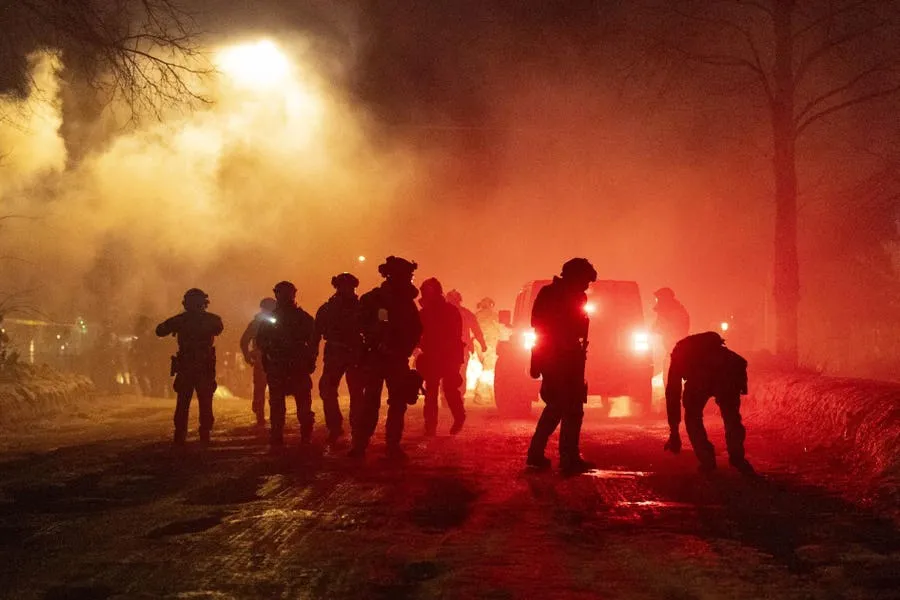
Good, a U.S. citizen, was shot and killed by ICE agent Jonathan Ross last week in Minneapolis, sparking national controversy and further inflaming criticism of Trump's immigration agenda and harsh enforcement measures. Protests in Minnesota have continued since Good's killing, leading to clashes between ICE agents and protesters, and the Trump administration has sent 3,000 ICE agents to Minnesota as tensions have ramped up. Trump's threat of using the law in Minnesota comes as the president has heightened his attacks on Democratic-led cities in his second term, sending National Guard troops into cities including Los Angeles, Washington, D.C., Portland and Chicago. Some of those deployments were later blocked in court, but Trump never invoked the Insurrection Act, despite reporting from NBC in October suggesting administration officials had held "increasingly serious discussions" about using the law. The president reportedly considered invoking the Insurrection Act in his first term to quell racial justice protests after the 2020 murder of George Floyd, but never did so. NBC reports Trump went on to regret that decision, perhaps making him more inclined to now use the law in his second term.