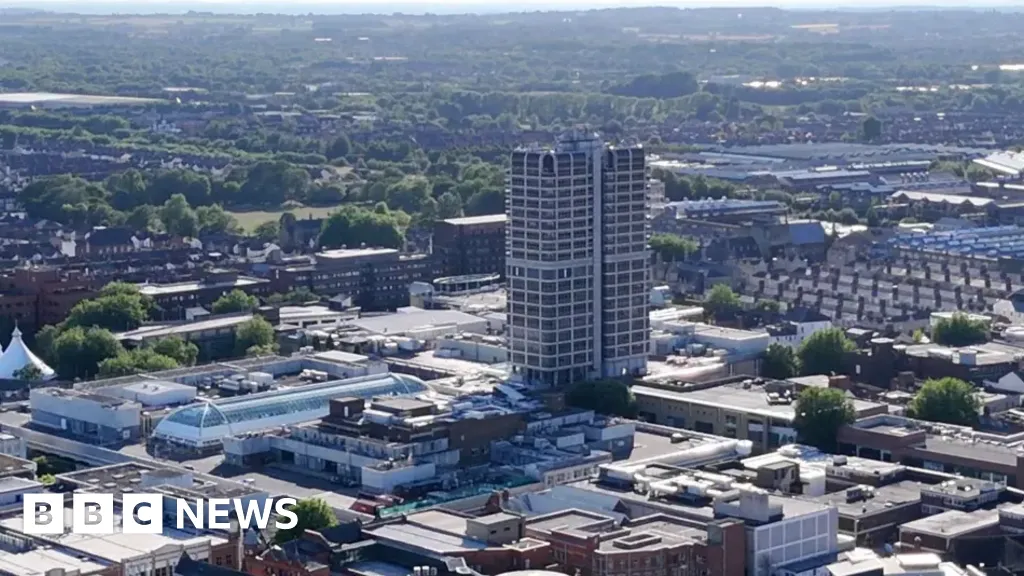
As we head into 2026, we thought we would run you through six of the biggest stories expected to happen this year in Wiltshire.
From bus depots being demolished to controversial solar farms and new housing developments, here is a round-up of the year ahead in the county.
A decision will be made on whether one of the UK's largest solar farms can be built in Wiltshire.
Island Green Power wants to build a 500 megawatt solar farm to the north of the M4 near Malmesbury.
The farm, Lime Down Solar Park, would encompass villages including Hullavington, Stanton St Quintin, Sherston, Luckington and Upper Seagry.
Island Green Power has said its farm will provide enough energy to power 115,000 homes a year.
Lime Down Solar Park would be four miles (6.4km) wide and two miles (3.2km) long, with solar panels that would stand at 14.7ft (4.5m) tall, roughly the height of a double decker bus.
An application was submitted to the Planning Inspectorate in September. Due to the scale of the plans, permission will be decided by Secretary of State for Energy Security and Net Zero, Ed Miliband.
Many residents have formed the Stop Lime Down campaign group against the project, with concerns about the impact on the countryside and farmland.
It was a major employer for Swindon, with more than 3,000 people losing their jobs when it closed down, but soon there will be a workforce back at the former Honda site, now Panattoni Park.
The car factory opened at the South Marston site in 1985 and made more than 3.7 million cars before it closed five years ago.
Before that the site was home to an airfield and the Vickers-Armstrong factory, where Spitfires were built in the 1940s.
Building work on the site began in 2025, with developers Panattoni planning to spend more than £900m on the project.
The newly developed manufacturing and warehousing facility is due to be ready to welcome its first businesses by the end of the month, with more expected in the spring.
James Watson, from Panattoni, had previously told the BBC that the company was talking to household names for the new units too.
He said: "Both buildings are fully available and on the market. We've got a number of really exciting conversations with a number of potential occupiers."
Work is due to begin on the biggest new housing development in the Wiltshire authority area.
Planning permission was granted for 2,500 new homes southeast of Trowbridge in the new Ashton Park, with a quarter of the homes designated as affordable.
The scheme includes two primary schools, a country park and a relief road on the outskirts of the town.
The developers, Ashton Park Trowbridge and Persimmon Homes, have agreed to pay £60m towards the amenities.
Councillor Adrian Foster, cabinet member for housing, described the development as a "significant step forward" for Trowbridge and Wiltshire.
The development will be built in four phases, with phase one, the part closest to Trowbridge, consisting of 350 homes; 375 in phase two; 725 in phase three; and 750 in phase four.
Demolition of Swindon's former bus station, which has been branded an eyesore, is to begin.
The town's new Fleming Way bus station, known as the Bus Boulevard, opened in August at a cost of £33m after a three-year wait.
The site, described by Swindon Borough Council as a transport hub, includes new bus shelters, digital screens and more than 180 trees.
The council said it hoped the hub will be the first step in regenerating the much-criticised town centre.
Under council plans, the old bus station in New Bridge Close could become an entertainment venue to attract the kind of shows people travel to Bath or Bristol to see.
Decisions are expected on if Swindon and Wiltshire councils could buddy up with neighbouring local authorities.
Wiltshire Council hopes to join forces with the "Wessex Partnership" - comprising Dorset, Somerset, Wiltshire and Bournemouth, Christchurch & Poole Councils (BCP) - to unlock funding opportunities.
Nick Ireland (Dorset), Bill Revans (Somerset), Ian Thorn (Wiltshire) and Millie Earl (BCP) said in a joint statement in December: "We are calling on government to act now and not miss out on the opportunities that Wessex has to offer - we are ready to go now with a deal and any delay by government risks holding our region back."
Meanwhile Swindon Borough Council's leader, Jim Robbins, said the town will be part of a "new economic powerhouse" if it joins the Thames Valley Mayoral Strategic Authority (MSA).
The proposed devolution deal with Swindon, Oxfordshire and Berkshire could see Swindon benefit from billions of pounds in future economic growth, he said.
If agreed by government, the Thames Valley MSA group say devolution has the potential to unlock up to £18.7bn by 2040, generating £7bn in additional annual tax revenue and create new opportunities for residents and businesses.
There will be 57 seats in Swindon's council chamber up for grabs this year, which will be the first time since 2015.
If one party gains overall control, it will be able to govern for a full four years.
Labour, headed up by Jim Robbins, is currently in power, but the Conservatives led by Gary Sumner will be keen to get back around the cabinet table where they once held power for 20 years.
There has also been some big changes in Swindon's political make-up in the lead-up to the elections - which could prove interesting.
In November, Rob Heath became the fourth Labour councillor to defect to the Green Party.
Mr Robbins said he was "disappointed" by the decision while Mr Heath said his values simply no longer aligned with the party.
He followed colleagues Tom Butcher, Ian Edwards and Repi Begum who made the same move from Labour to the Greens in October.