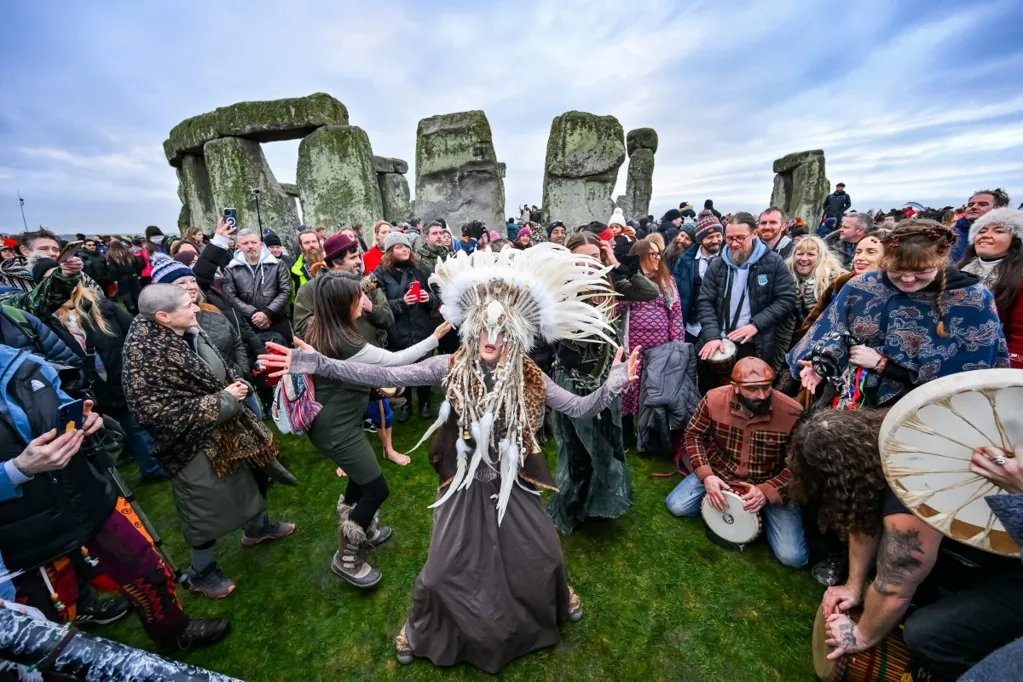
Nearly 8,500 people gathered at Stonehenge on Sunday to celebrate the winter solstice as the sun rose over the ancient monument in southwest England.
The crowds, including many dressed as druids and pagans, assembled before dawn on Salisbury Plain to mark the shortest day of the year in the Northern Hemisphere.
English Heritage, which manages the prehistoric site, reported that the event's livestream attracted over 242,000 views from audiences worldwide.
The word solstice comes from the Latin term solstitium, meaning "Sun stands still." This name reflects the apparent pause in the sun's movement across the sky before it changes direction.
Around the winter solstice, the sun seems to rise and set at the same point on the horizon for a few days before it begins to climb higher again, heralding longer days.
In the Northern Hemisphere, it's called the winter solstice because it coincides with the start of astronomical winter. However, for those in the Southern Hemisphere, December 21 is the summer solstice, marking the longest day of the year.
The Earth's axis is tilted at an angle of 23.4 degrees, and this tilt is responsible for the changing length of daylight throughout the year.
During summer in the Northern Hemisphere, the North Pole is tilted towards the sun, resulting in longer days. In winter, however, the North Pole is tilted away, causing shorter daylight hours.
At the winter solstice, the sun appears at its lowest point in the sky, leading to the fewest hours of daylight for the year.
For example, New York will have just 9 hours and 15 seconds of sunlight, while Los Angeles, being farther south, will enjoy slightly more at 9 hours and 53 minutes, according to Time and Date, the world's top site for time, time zones, and astronomy.
This phenomenon occurs because the Earth's tilt determines how much sunlight different parts of the globe receive. On December 21, the tilt reaches its maximum angle away from the sun in the Northern Hemisphere, giving us the shortest day and longest night.
Not always.
While the winter solstice usually falls on December 21 or 22, it can occasionally occur on December 20 or 23. These variations happen because of the Earth's elliptical orbit around the sun and the way we measure time through the Gregorian calendar.
The rarest winter solstice dates are December 20 and 23. For instance, the last December 23 solstice was in 1903, and the next won't occur until 2303. A December 20 solstice is also rare, with the next one expected in 2080.
Stonehenge was erected between 5,000 and 3,500 years ago, specifically designed to mark the winter and summer solstices through its alignment with the sun. The monument stands approximately 75 miles southwest of London on Salisbury Plain.
Celebrants gathered in the cold, dark field before sunrise, with some singing and beating drums while others took moments for quiet reflection among the massive stone pillars. Many attendees consider the pilgrimage a spiritual experience and return for both summer and winter solstice celebrations.
Despite being the darkest day of the year, the winter solstice is celebrated by many as a time of renewal and hope.