A conflict may still be raging, at least with Hezbollah in Lebanon. But Israel seized on the relative quiet with Iran to do something on Wednesday that it hadn't been able to do in a good while, what with all the wartime unity and rallying behind the military.
It returned to the bitter political infighting that had been tearing the country apart way back before the war in Gaza began in 2023.
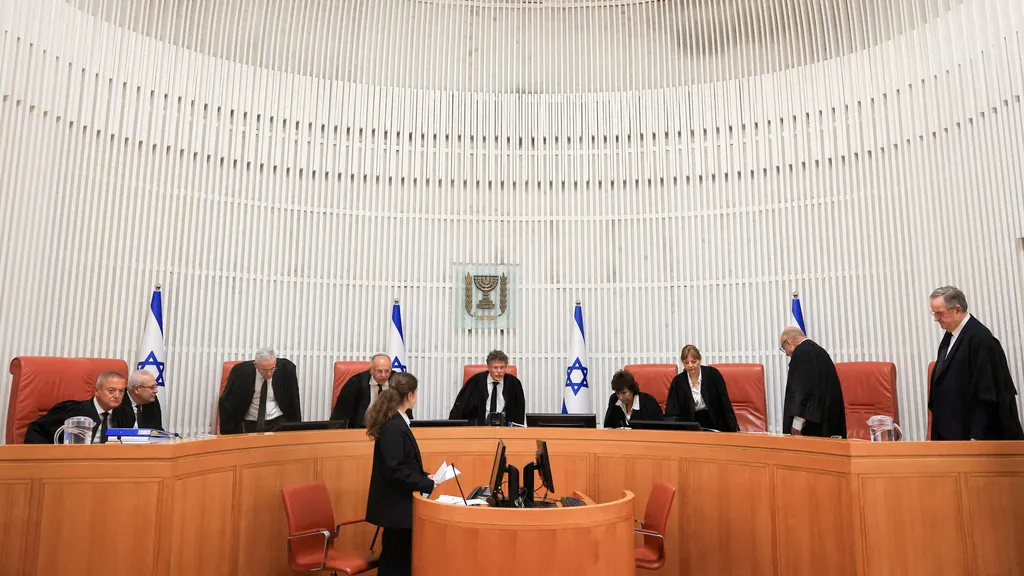
In an often raucous daylong hearing before the Israeli Supreme Court in Jerusalem, lawyers representing officials who included the prime minister as well as some of his critics resumed a deeply divisive debate over the nature of the country's system of government, and how clashes between the executive branch and the justice system should be resolved.
Specifically, the justices were weighing whether the rule of law as interpreted by unelected, and sometimes leftward-tilting, government lawyers and judges should continue to hold sway, when push comes to shove, over a democratically elected but often extremist government.
More specifically, the argument concerned whether Itamar Ben-Gvir, the national security minister who oversees the police, should be allowed to remain in his job, in the face of a pile of evidence that he has been misusing the force to pursue a right-wing political agenda.
Among other things, he has been accused of overstepping his role -- which is to set policy for and administer the police force -- and undermining its independence. Mr. Ben-Gvir, his opponents say, has encouraged officers to crack down hard on left-wing anti-government protests, expressed support for an officer accused of shooting an Arab citizen immediately after it happened (and before an investigation could be conducted into whether the shooting was justified), and let it be known that officers who advance his political agenda will be rewarded.
Mr. Ben-Gvir, who heads the Jewish Power party, was named by Prime Minister Benjamin Netanyahu to oversee the police and prison service in 2022 despite his having long espoused racist views and having numerous criminal convictions.
He survived early legal challenges by insisting that he had changed his ways. But Israel's attorney general, Gali Baharav-Miara, who tried early last year to lay down guidelines to ensure the independence of the police under Mr. Ben-Gvir, gave up months later and wrote to Mr. Netanyahu in December that it was no use.
Ms. Baharav-Miara could not have been optimistic that this argument would move Mr. Netanyahu, however, since his hold on power depends on Mr. Ben-Gvir's support. Indeed, their government -- the most right-wing and religious in Israel's history -- tried to fire Ms. Baharav-Miara last year but was blocked by the Supreme Court.
So the attorney general went back to the Supreme Court in January, asking it, effectively, to order Mr. Netanyahu to remove Mr. Ben-Gvir from overseeing the police.
On Wednesday, the date set for oral argument, the acrimony was right back up at full blast. Before the hearing had even opened, the justice minister, Yariv Levin, announced that he would disregard the high court if it dared to order Mr. Ben-Gvir's removal. The foreign minister, Gideon Saar, warned that ousting Mr. Ben-Gvir would only strengthen him at the polls in this year's elections.
Mr. Ben-Gvir, who did not stick around, issued a statement outside the courthouse beforehand saying he was "not a potted plant" and was keeping his campaign promises. "The time has come that those who voted right wing receive right wing," he said.
The hearing, which continued into the night, often looked more like a noisy reality show than a staid juridical proceeding, with frequent overtalking, interrupting and displays of disrespect. The justices quickly removed from the courtroom a string of lawmakers and politicians from Mr. Ben-Gvir's and Mr. Netanyahu's parties -- they left shouting almost in unison that the "entire nation sees this outrageous farce" -- after which the court's president, Yitzhak Amit, let out an audible sigh.
Several justices tried to forge a compromise. But when they tried to engage Mr. Ben-Gvir's lawyer, David Peter, by asking what should be done if the police began to represent the government instead of the people, Mr. Peter feigned ignorance, dismissing the word "politicization" as a "media headline term."
The judges did not buy that. "The claim is the politicization of the police, and this is a particular danger -- a danger to democracy," said Justice Ofer Grosskopf.
Shosh Shmueli, who was representing the attorney general's office, urged the justices to act quickly, or at a minimum issue court orders barring Mr. Ben-Gvir from making any sensitive appointments to senior posts, joining police operations involving interactions with citizens or commenting on police deployments, including ongoing investigations.
But Justice Noam Sohlberg suggested the court would look skeptically at demands to remove Mr. Ben-Gvir from his post given that elections are fast approaching.