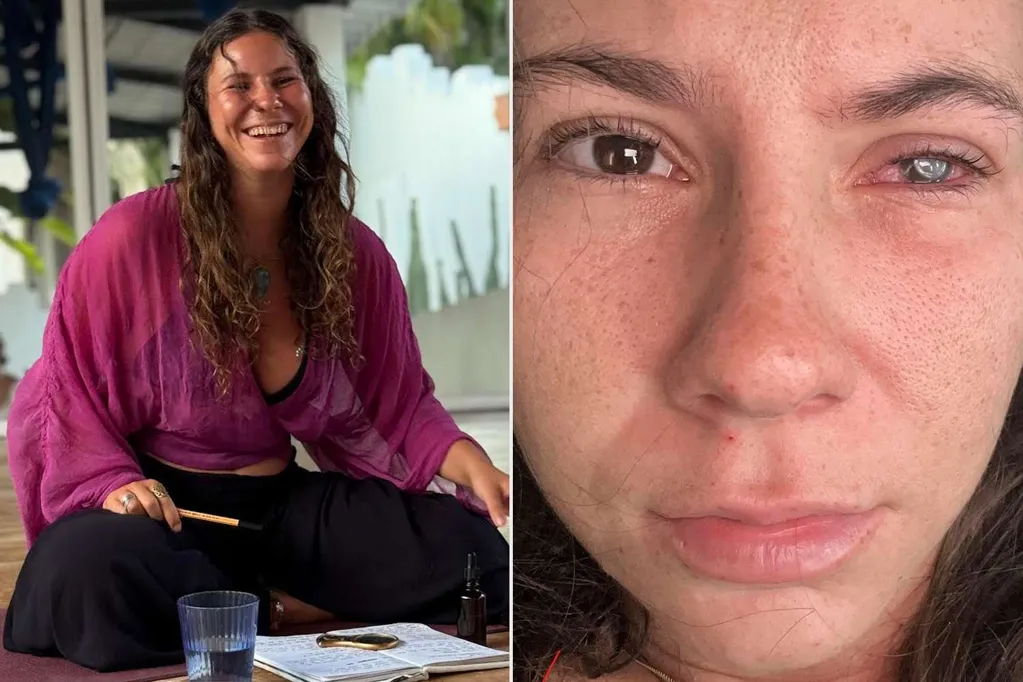
She turned to TikTok to document the ordeal, raising awareness about eye health and finding support through an outpouring of online and real-life community.
Vivian Nosovitsky had just finished another year of traveling abroad -- and for the first time in a long while, she felt settled.
After hosting retreats across Mexico, Sri Lanka and Peru, Nosovitsky, 21, had recently returned to a tiny beach town in Mexico she'd fallen in love with three years earlier. It had become her home base -- the place she kept returning to between travels -- and she was finally easing into a routine.
Her days were slow and intentional. She'd start her mornings with yoga and a nourishing breakfast before riding her motorcycle to the beach, where she'd walk along the shore and lie in the sun. Later, she'd head home to edit videos or work with clients, squeeze in a gym session, then return to the beach once more for sunset -- a daily ritual she rarely missed.
"It was perfect," she tells PEOPLE exclusively. "I was finally building a routine and a sense of stability that felt really good."
She was also building something else: community. Nosovitsky had grown close to the people around town and always looked forward to seeing familiar faces. Free-spirited and open to new opportunities, she was just about to launch a new coaching offer when everything changed.
One morning around 2 a.m., Nosovitsky woke up with intense pain in her eye.
"It was watering, swollen and extremely uncomfortable," she recalls. "I thought it might go away if I slept it off -- but I never fell back asleep. The pain just kept getting worse."
Light sensitivity quickly became unbearable. She put on sunglasses immediately, unable to tolerate even minimal brightness. After a few days with no improvement -- and no relief from the drops prescribed at a small urgent care clinic -- she knew something was seriously wrong.
She traveled 40 minutes to a larger hospital, where doctors told her she had an ulcer in her eye and prescribed additional medication. But her condition rapidly worsened.
"My eye was turning gray," she says. "I knew something was extremely off."
When she returned the next day, doctors urged her to seek urgent, intensive care in another city three hours away. Unwilling to go through it alone, Nosovitsky instead flew to Querétaro to stay with a friend, who helped care for her and took her to a specialized eye hospital.
There, doctors performed a corneal scraping. Days later, lab results confirmed the diagnosis: acanthamoeba keratitis, a rare and aggressive eye infection caused by a parasite.
"I honestly didn't even know what that meant at first," Nosovitsky says. "I had never heard of it."
She soon learned the parasite likely entered her eye through tap water and an opening caused by contact lens use, and that it was, quite literally, eating away at her cornea.
The pain was excruciating. Light became intolerable. She was forced to stay in complete darkness, stripped of everything she loved: movement, the beach, working out and running her online business.
"I've had very low energy," she says. "Physically, mentally, it's affected every part of me. There were days I didn't want to do anything but lie there and wish it would be over."
Treatment required medicated eye drops every single hour, around the clock. Even at night, she had to wake herself to administer them.
"I haven't slept properly in weeks," she says.
The experience pushed her to some of the lowest points she'd ever known. Even hospital appointments were overwhelming, with bright lights leaving her drained and overstimulated.
"When I realized I couldn't see out of my right eye, that was terrifying," she says.
Throughout it all, Nosovitsky chose to share her journey online. Vulnerability, she says, has always mattered to her.
"We're so drowned in fake content and filtered lives," she says. "I wanted to be real."
She posted on TikTok -- the platform where her social media career first took off -- and felt a strong intuition that the videos would resonate. They did. Her story quickly went viral, amassing millions of views and drawing an outpouring of support to her GoFundMe.
People also flooded her comments and DMs with prayers, encouragement and stories of their own.
"I didn't expect this level of kindness," she says. "People just want to connect."
Ironically, she says, even as she lost her vision, she gained visibility.
"Even though I can't see, I'm being seen more than ever," she says. "It stripped away all the masks and brought me back to myself."
Looking ahead, Nosovitsky holds onto hope, both for healing and awareness. She believes mindset and surrender will carry her through whatever comes next, whether that means avoiding surgery or accepting a longer road to recovery.
Above all, she hopes people take away a renewed sense of gratitude and a warning.
"You don't realize how much you should've appreciated something until it's gone," she says, urging others to take eye health and contact lens hygiene seriously.
And she credits one thing above all else for getting her through the darkest moments: community.
"I wouldn't have survived this without it," she says. "The women who cared for me in Mexico, the people cooking for me, supporting me -- and even the online community praying and visualizing my healing. The power of community is stronger than anything."