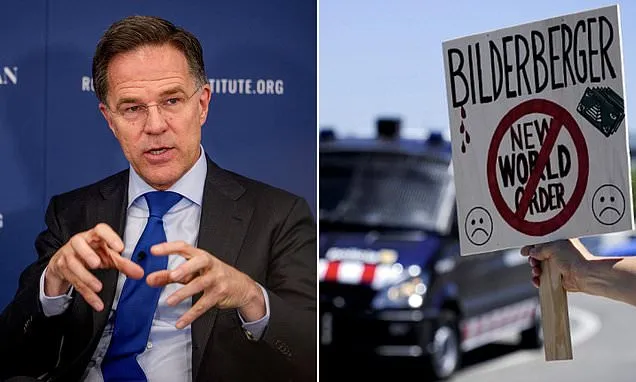
World leaders and billionaires gathered in Washington this weekend for the notoriously top-secret annual Bilderberg meeting.
With no minutes recorded, press reports published or interviews given to the media, the infamous conference is shrouded in mystery and has been the longtime subject of countless conspiracy theories.
Critics have accused it of being a basis for the creation of a secret government, or a mysterious new world order.
The high-level networking event was formed in 1954 to foster dialogue between the US and Europe in order to prevent another war, but now the aim is purportedly to allow Western leaders to share innovatory ideas.
Now in its 72nd year, the global elite congregated between April 9-12 to discuss a number of topics, from the future of AI and modern warfare to cryptocurrency.
Attendees included a number of billionaires, such as Palantir's CEO Alex Karp, who is working on Donald Trump's $185 billion 'Golden Dome' project, Spotify founder Daniel Ek, and the former CEO of Google Eric Schmidt.
King Charles III, David Cameron, Barack Obama, Bill Clinton and Peter Mandelson have all taken part in previous meetings.
Ahead of this year's gathering, a security cordon was put up surrounding the luxury Salamander hotel, as 128 military leaders, tech moguls and politicians prepared for days of covert talks.
The head of NATO and Bilderberg regular Mark Rutte arrived at the conference following a 'very frank' conversation at the White House.
Attendees included a number of billionaires, such as Palantir's CEO Alex Karp, who is collaborating on Donald Trump's $185 billion 'Golden Dome' project.
Daniel Ek, CEO of Swedish music streaming service Spotify, was also listed as an attendee.
NATO Secretary General Mark Rutte arrived at the meeting following a 'very frank' conversation with the US President at the White House, amid a time of immense crisis and uncertainty for the trans-Atlantic alliance.
Trump has in recent weeks repeatedly attacked NATO as nothing more than a 'paper tiger', threatening to ditch the 32-country organisation over a lack of support for his war against Iran.
One item listed on the agenda was the 'Trans-Atlantic Defence-Industrial Relationship', implying that the shaky future of the alliance is an urgent problem gripping the leaders of the Western world.
The conference brought together giants of Wall Street, such as the CEOs of KKR and Lazard, as well as the chiefs of huge corporations like Pfizer. In Washington, business titans had the opportunity to swap notes with members of Trump's inner circle.
From the White House, Secretary of the Interior Doug Burgum paid a visit, as did the architect of American trade policy during Trump's first presidency, Robert Lighthizer, and secretary of the Army Daniel Driscoll - often dubbed the President's 'drone guy' for his embrace of emerging battlefield technologies.
Earlier this year, former head of Google Schmidt told the FT that 'future wars are going to be defined by unmanned weapons', with 'swarms of drones operated remotely and increasingly automated with AI targeting'.
At this year's Bilderberg, he would have been able to discuss the future of warfare alongside four-star admiral Samuel Paparo, the 27th commander of the US Indo-Pacific Command, and Brian Schimpf, co-founder and CEO of defence technology company Anduril Industries.
It is notable that venture capitalist Peter Thiel, the co-founder of PayPal, was absent from the gathering; despite being a member of the group's steering committee since 2008 and partly funding its extravagant Washington-based meetings.
Blaise Metreweli, the first female chief of MI6, was in attendance alongside John Sawers—who previously held the top position between 2009-2014—former UK National Security Adviser Mark Sedwill; and Justice Secretary David Lammy.
Other topics listed for discussion included the West, China, the US, Ukraine, Russia, the Middle East, global trade, Europe, energy diversification, and Arctic security.
Notably, this year's Bilderberg was the first to include a Greenlander - Vivian Motzfeldt, former foreign minister and ex-speaker of the Inatsisartut.
Her presence at the clandestine gathering was a clear signal to Trump that Greenland has notable allies within the West, despite the US President's eagerness to seize the territory and his disparaging remarks on X, most recently dubbing it a 'BIG, POORLY RUN, PIECE OF ICE!!!'.
Discussions are held under the Chatham House Rule, meaning participants are free to use the information received, but neither the identity nor the affiliation of the speaker(s), nor any other attendee, may be revealed.
The Daily Mail infiltrated the 2018 meeting, the first time an undercover journalist ever managed to do so, gaining insights about the gathering's inner workings.
That year's meeting took place at the NH Lingotto hotel in Turin, Italy. The reporter watched as military police guarded the hotel perimeter and sniffer dogs checked for bombs outside.
How much impact groups like Bilderberg actually have is hard to judge according to Christina Garsten, professor at the Swedish Collegium for Advanced Study who studies transnational think tanks.
They aim to shape broad political and corporate agendas but if seen as having too much influence can be accused of being anti-democratic.
'It's there that conspiracy theories can flower,' she said.
She dismissed the belief held by some that groups like Bilderberg make up a shadowy world government. 'I think it's very much exaggerated,' she said.