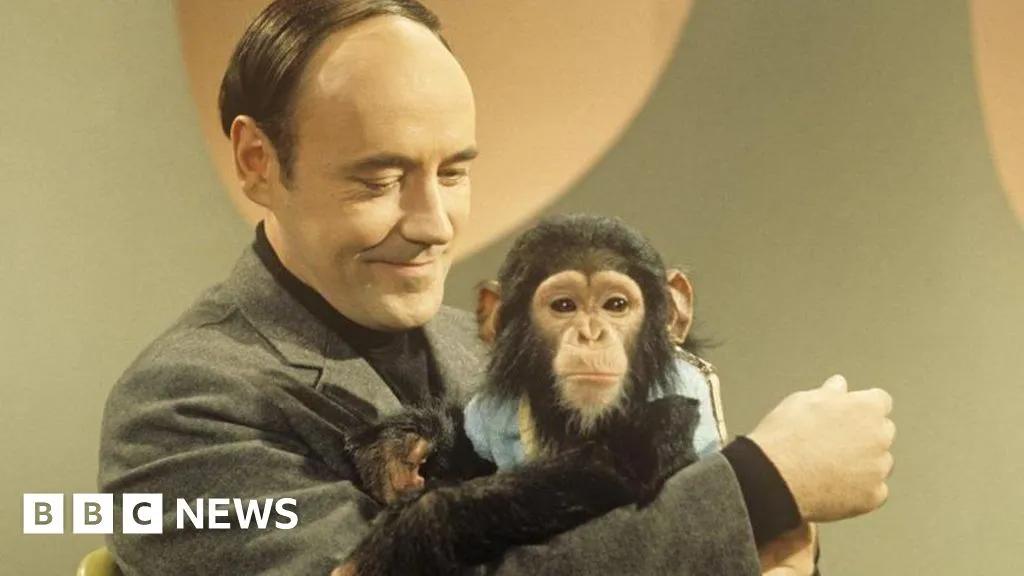
Desmond Morris, the zoologist, author, artist and television presenter, has died aged 98.
Morris was best known for his book, The Naked Ape, which was published in 1967. It framed modern humans as still being fundamentally ape-like despite our technological advances and evolution.
He was also a surrealist painter and exhibited his work around the world alongside artists such as Joan Miró.
Morris's son Jason confirmed his death on 20 April, calling his father "a great man and an even better father and grandfather", who lived "a lifetime of exploration, curiosity and creativity".
"Sexual intercourse began," wrote Philip Larkin, "in 1963... between the end of the [Lady] Chatterley['s Lover] ban and the Beatles' first LP."
In the years that followed the sexual revolution, a slew of books - in their different ways - found eager readers among the freshly liberated.
There was Germaine Greer's The Female Eunuch, Alex Comfort's The Joy of Sex and - in the Summer of Love of 1967 itself - Desmond Morris' The Naked Ape.
He wrote it in four frenetic weeks. It explained our habits and rituals, with the naughtiness of "naked" and the Darwinian thrill of "ape".
It was mankind seen through the eyes of a zoologist - not an anthropologist. It framed our behaviour in the context of evolution - not culture.
As a thesis, it was hotly contested, but it was wildly popular and had lasting influence.
It was a bible of human actions for the Age of Aquarius, and plumbed for insight into the practice of modern sex.
Desmond John Morris was born on 24 January 1928 in the village of Purton, near Swindon. As a child, he watched his father die slowly of wounds received in World War One.
It filled the young Desmond with hatred for what humans did to each other.
He cut himself off from mankind at the family lake, carefully observing the animals, fish and waterfowl.
At Birmingham University, he studied zoology but refused to do animal experiments. He discovered a new approach - called "ethology" - which prized objective study of their behaviour instead.
His doctoral thesis involved years watching the aggressive mating dance of the 10-spined stickleback.
Granada found in him a natural broadcaster - the man to take on the mighty David Attenborough's natural history shows on the BBC.
A studio was built inside London Zoo itself, which irritated Attenborough, who thought he had a relationship with the zoo.
But feelings soon thawed and the two great TV interpreters of animal behaviour eventually became friends.
Morris became the zoo's curator of mammals.
He launched an attempt to breed pandas in captivity but, to his despair, London's Chi Chi repeatedly spurned the attentions of Moscow's An An.
Reared in isolation, she saw herself as human and was not interested in a bear.
A talented artist, the young Morris had spent his national service lecturing soldiers in fine arts and had exhibited surrealist paintings alongside Joan Miró.
Now, he experimented with animal concepts of aesthetics, giving a paintbrush to a chimp called Congo.
It proved, he said, artistic expression was not exclusively human in origin.
It delighted Picasso, who thereafter took delight in biting those who came to see him. The paintings later sold for thousands.
At a party, Morris then met publisher Tom Maschler, and pitched him the book that would change his life.
It would explain, said Morris:
- why humans were the only hairless ape in the world
- why man was proud of having the largest brain but hid his relatively huge penis
- why women's breasts were biologically designed as much for attracting partners as producing milk
Maschler was transfixed.
He sent Morris a monthly telegram for years, begging him to write it. It was finally done in a month of frantic scribbling and, when complete, caused eyes to pop.
The Naked Ape was an overnight sensation, eventually selling 20 million copies.
It applied Darwinian logic to human activity - including fighting, feeding, comfort and sex.
Copulation, Morris claimed, was not mainly about producing children. It was, he insisted, more to do with cementing the pair bond "by providing mutual reward for sexual partners".
We were, he said, "a very sexy ape".
He had taken a job running the Institute of Contemporary Arts but, now fabulously wealthy, he quit.
He ignored his mother's advice to bank the money; bought a 27-room villa in the Mediterranean; thoroughly enjoyed himself - sailing in summer; writing in winter.
Back home, his book was proving controversial.
Some disliked his dismissal of religion as a biological tendency to submit to an alpha male.
Feminists were furious with his portrayal of men as "risk-taking" hunter-gatherers who drove human evolution while women sat at home in caves.
For many, human beings have self-consciousness and language which elevates Homo sapiens.
There was more to us, they said, than you could tell by watching other 192 species ape.
But Morris was undeterred.
He wrote The Human Zoo and Intimate Behaviour, Malta; then became fascinated expressive body language people Mediterranean.
He decided to write about meanings hidden way people waved arms gesticulated make point.
"You look at people way bird-watcher looks birds," said friend. "Yes," said Morris,"you could call me man-watcher."
It took him three years do research new book TV programme subject.
Having done best spend fortune,Morris returned Oxford research fellow travelled world applying techniques.
Dragged football matches son,Morris became fascinated passion fans terraces.
He wrote about rituals chanting synchronised clapping customary scientific insight.This more than just sport,he felt;form male arena display.
He continued paint too,filling cottage surrealist depictions life-forms called "biomorphs".
Many appeared engaged complex rituals sexual motives—the abstract expression primeval desires he was convinced had shaped mankind.
Morris branched out light entertainment with The Animal Roadshow and Animal Country ,alongside Sarah Kennedy .
He exhibited paintings London ,Amsterdam Brussels ,and wrote popular books watching everything babies cats .
The TV production company Endemol approached him with an idea for a new reality series ,Big Brother .
Morris was initially attracted to watching captive human interaction on such an industrial scale but ,put off by the game-show element ,he turned them down .
"Silly me," he later said .
In 1994 - nearly 30 years after The Naked Ape was published - Morris made the TV series he should have made to accompany it.
The Human Animal was lavishly filmed in exotic locations, showing diverse customs and suggesting their common biological roots.
In deference to his many critics, the BBC added a rider to the title - implying that this was not scientific mainstream thinking but, instead, "a personal view".
At the end of the first episode, Morris spoke directly to them. "I've sometimes been accused of degrading mankind, or insulting human dignity, of making man beastly," he said.
"This surprised me because I like animals and I feel proud to call myself one. I've never looked down upon them so to call human beings animals is not to me degrading."
In truth,the objections went further than that.
Many disputed his claim that only man had left ancient cave hunt animals leaving him with "risk-taking" genes made men better business art than women.
And for every fellow scientist found him inspiring others—in words writer Adam Rutherford—saw his work "salacious guesswork erotic fantasy".
Men might find breasts attractive,rutherford complained,but that did not mean that was their purpose.
Science moves on.A great deal more is now known about genes genetics than anyone could guess 1967.
Although,when he was invited update naked ape,morris stubbornly updated population earth three billion six billion—and left at that.
For all these objections,Desmond Morris will be remembered tremendous populariser science—a man who helped place humans scheme nature planet earth.