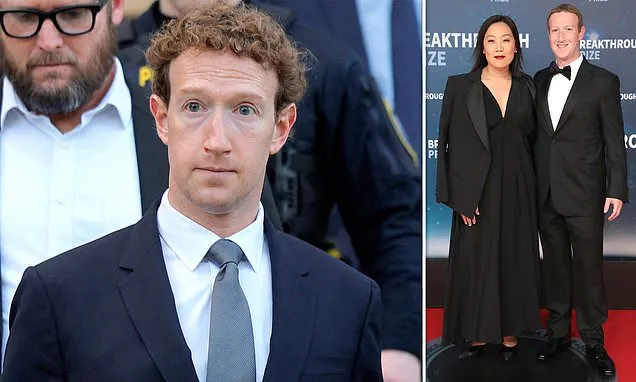
During a landmark trial about social media addiction on Wednesday, Meta CEO Mark Zuckerberg was questioned about acting 'robotic.' Over the course of the CEO's testimony, which was part of a trial brought forward by a plaintiff identified by the initials KGM, he was also asked whether Meta's platforms, which include Facebook and Instagram, are designed to be deliberately addictive. KGM, who is now 20 years old, filed the lawsuit in 2023 and claimed her early use of social media addicted her to the technology and exacerbated depression and [self-murder] thoughts. Zuckerberg said he still agrees with a previous statement he made that the existing body of scientific work has not proved that social media causes mental health harms.
Zuckerberg rejects coaching claims with self-deprecation
After the CEO deftly answered several questions posed by KGM's attorney, Mark Lanier, the lawyer characterized Zuckerberg's responses as media-trained. Lanier pointed to an internal document about feedback on Zuckerberg's tone of voice on his own social media, imploring him to come off as 'authentic, direct, human, insightful and real.' The document instructed him to not 'try hard,' or be 'fake, robotic, corporate or cheesy' in his communication. Zuckerberg pushed back against the idea that he's been coached on how to respond to questions or present himself and said those offering the advice were 'just giving feedback.' The Meta CEO then said, 'I think I'm actually well known to be sort of bad at this,' referencing several media appearances where people perceived him as awkward and mocked his appearance or speech patterns. In a 2010 live, on-stage interview with tech journalists Kara Swisher and Walt Mossberg at the eighth D: All Things Digital conference, Zuckerberg was sweating so profusely that Swisher asked him if he wanted to take off his sweater.
Confronting the viral awkwardness
Although he initially said, 'I never take off the hoodie,' after wiping his forehead with his sleeve and looking at it, he said 'whoa' and soon did take it off. And in 2017, Zuckerberg did an infamous Facebook live stream in his backyard where he repeatedly talked about 'smoking meats' and using Sweet Baby Ray's barbecue sauce. The livestream was relentlessly mocked, with many people online calling Zuckerberg's behavior awkward and robotic, and it was cut into clips that spawned a litany of memes at the time. Other than the aside about media training, Lanier's questions were primarily focused on social media addiction. The lawyer asked Zuckerberg if people tend to use something more if it's addictive. 'I'm not sure what to say to that,' the Meta CEO replied. 'I don't think that applies here.' Lanier also laid out three options of what people can do regarding others who are vulnerable: help them, ignore them, or 'prey upon them and use them for our own ends.'
The shift in Meta's performance metrics
Zuckerberg said he agrees the last option is not what a reasonable company should do, and said: 'I think a reasonable company should try to help the people that use its services.' Lanier extensively questioned the Meta CEO about a comment he made during a past congressional hearing, where he said Instagram employees are not given goals to increase the amount of time people spend on the platform. The lawyer presented internal documents that seemed to contradict that statement. Zuckerberg replied that Instagram previously had goals associated with time, but said he and the company made the conscious decision to move away from those goals to focus on utility instead. He said he believes in the 'basic assumption' that 'if something is valuable, people will use it more because it's useful to them.' Lanier then spent a significant amount of time asking Zuckerberg about Instagram's age verification policies. 'I don't see why this is so complicated,' the Meta CEO said after a lengthy back-and-forth, reiterating that the company's policy restricts users under the age of 13 and that they work to detect users who have lied about their ages to bypass restrictions.
Throughout the hearing, Zuckerberg mostly stuck to his talking points, referencing his goal of building a platform that is valuable to users. On multiple occasions, he also said that he disagreed with Lanier's 'characterization' of his questions or of Zuckerberg's own comments. The Meta CEO was grilled about policies relating to cosmetic beauty filters on Instagram. Zuckerberg said he didn't believe there was enough evidence pointing to harm the filters could cause and said he has a 'high bar' for blocking tools or features that would limit people's expression. Lanier pointed to external experts Meta consulted to assess the filters and their potential impacts, saying that all 18 of them raised concerns. Children's advocates slammed Zuckerberg's testimony as disingenuous. 'All Mark Zuckerberg accomplished with his testimony today was to prove yet again that he cannot be trusted, especially when it comes to kids' safety,' said Josh Golin, executive director of Fairplay. 'Under oath, Meta's CEO testified that his company does not have an objective to increase users' time spent on Instagram. 'But we know Zuckerberg and his fellow executives prevented Instagram from getting rid of features like visible like counts and plastic surgery filters - features that are by their very nature addictive.'
Zuckerberg has testified in other trials and answered questions from Congress about youth safety on Meta's platforms. During his 2024 congressional testimony, he apologized to families whose lives had been upended by tragedies they believed were caused by social media. But while he told parents he was 'sorry for everything you have all been through,' he stopped short of taking direct responsibility for it. This trial marks the first time Zuckerberg stands before a jury. Once again, bereaved parents were sitting in the courtroom audience. The case, along with two others, has been selected as a bellwether trial, meaning its outcome could impact how thousands of similar lawsuits against social media companies are likely to play out.
KGM's case was also filed against other social media sites. Meta Platforms and Google's YouTube are the two remaining defendants in the case which TikTok and Snap have settled. One of Meta's attorneys, Paul Schmidt, said in his opening statement that the company is not disputing that KGM experienced mental health struggles but rather disputing that Instagram played a substantial factor in those struggles. He pointed to medical records that showed a turbulent home life and both he and an attorney representing YouTube argue she turned to their platforms as a coping mechanism or a means of escaping her mental health struggles.