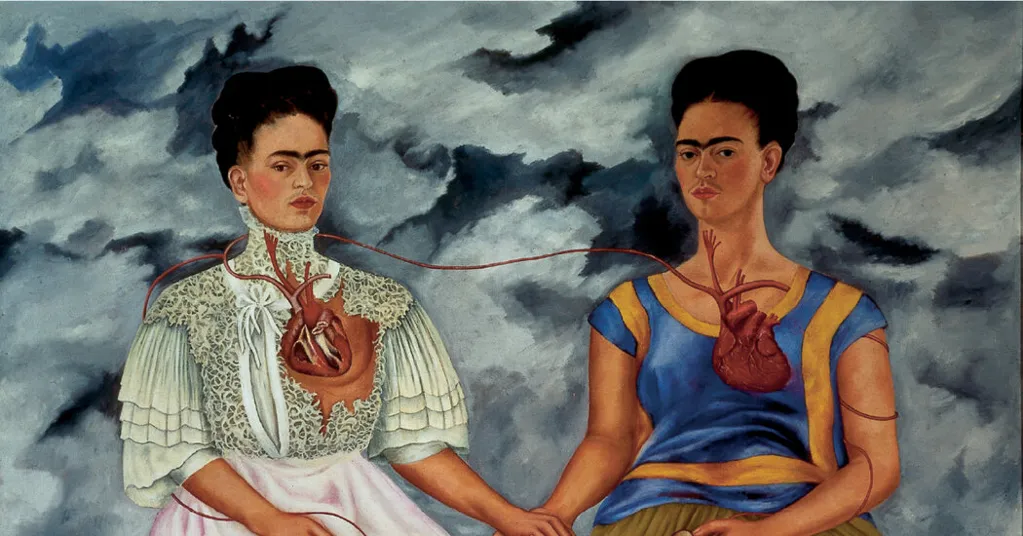
Kahlo created this huge double portrait in 1939 around the time of her divorce from the artist Diego Rivera. One of her best-known works, it hangs in the Museum of Modern Art in Mexico City.
I have no words to tell you how much I been suffering and knowing how much I love Diego you must understand that these troubles will never end in my life. ... Now I feel so rotten and lonely that it seems to me that nobody in the world has suffer the way I do, but of course it will be different, I hope, in a few months.
So wrote Kahlo in a 1939 letter to the photographer Nickolas Muray, a longtime friend and lover, who took this photo of the three Fridas as the painting was in progress:
She painted "The Two Fridas" months after visiting Paris, where she didn't love the group of Surrealist artists she met: "They make me vomit," she wrote to Muray. "They are so damn 'intellectual' and rotten that I can't stand them anymore."
But she was inspired by two paintings in the Louvre. One was this 1843 portrait called "The Two Sisters" by Theodore Chasseriau:
The other, a 16th-century French portrait called "Gabrielle d'Estrées and One of Her Sisters," according to Valentina García Burgos, director of the Diego Rivera and Frida Kahlo House Studio Museum:
Ms. García Burgos said Kahlo also loved the work of the Spanish artist Julio Romero de Torres, who painted this 30 years prior:
Note the medallion with the miniature portrait that the woman on the left (in a lace dress!) is holding; it's echoed by Kahlo's miniature portrait here:
You can see where she may have drawn inspiration: the inscrutable expressions, the twinned poses that convey a mix of intimacy and distance.
But Kahlo pours out her own personal story in paint.
"When you understand her life, then you understand what she's talking about through her paintings," said Cristina Kahlo, Frida's great-niece and an artist and photographer herself, who has curated shows about her great-aunt.
Zoom into the eyes, and the stoicism might not match what you would expect if your heart were bleeding outside your body:
The Frida on the right appears younger, wearing a traditional Indigenous Mexican dress, her face a bit darker. This is the Frida whom Diego loves; her heart is whole.
The Frida on the left is older, in a wedding dress, with a more European look. This is the Frida that Diego no longer loves. Her heart is quite literally ripped open:
"It is an anatomical real heart presented to the viewer," Cristina Kahlo said. "It's like exposing your heart."
Kahlo's life was dramatic and visceral -- miscarriages, affairs, accidents, operations and blood. It was also a life of dualities: She was Mexican and European, with a religious Catholic mother and German-born father; she slept with women and men; she loved Rivera, but he cheated on her (with, among others, her sister), and she cheated on him (with, among others, the Communist leader Leon Trotsky); they separated; they divorced; they remarried a year later.
Before a bus accident in adolescence in which she was impaled by a metal rod, Kahlo studied anatomy and wanted to be a doctor. In her personal library, there's a book showing a baby born with a condition called ectopia cordis, or a heart outside the chest cavity.
By opening her heart to us, Kahlo is inviting us into her world.
"In some ways, people feel really like a confidant of the life of Frida Kahlo," Cristina Kahlo said.
The two Fridas are linked by an artery that snakes around them:
On the right, it's connected to that miniature portrait in the hands of younger Frida. The miniature is a copy of a photograph of Diego Rivera as boy:
In Wedding Frida's hands, a surgical clamp attempts to stop the blood flow:
The blood begins to form some of the flower patterns on the hem of the dress.
According to the biographer Hayden Herrera, Kahlo wrote about this painting:
The fact that I have painted myself twice, I think, is nothing but the representation of my loneliness. What I mean to say is I resorted to myself. I sought my own help. This is the reason why the two figures are holding hands.
Amid her heartbreak, Frida comforts Frida.
Over the course of her life, Kahlo became her own best subject, painting more than 50 self-portraits. As a teenager, she lay bedridden for months after her bus accident. Her family gave her art supplies and a makeshift easel so she could paint during her recovery. They put a mirror on the ceiling so she could see herself.
Kahlo's father Guillermo was a photographer who specialized in architecture but also took self-portraits. Kahlo saw her father making these self-portraits when she was young, Cristina Kahlo said.
Now this face has become one of the most recognizable in the world:
Kahlo's work sells for huge sums (last month one of her self-portraits went for $55 million at auction). The lasting image she made of herself over time -- her unibrow; her mustache; a lifetime of operations; colorful dresses; the crowns; the many outward signs of her suffering -- all of it has captured modern imagination.
"Frida was very aware of creating her own iconography and dress codes," Ms. García Burgos said. "She created a character."
Cristina Kahlo said she thought almost everyone could identify with her great-aunt in some way because she had such a varied life. She started to list: "If you are someone who has a physical handicap, or if you have been unfaithful to your husband, or if your husband has been unfaithful to you, or if you are an artist, or if you are involved in political matters ..."
We could add more to that list: if you feel different or you've felt pain. If you've hurt someone or you've been hurt. If you know obsessive love or deep heartbreak; suffering or hope. If you ever feel like two people -- you can probably relate to Kahlo.
Both of her.