With a retail price of up to £1,999, the iPhone 17 Pro Max is one of the most expensive smartphones on the market.
But this price tag pales in comparison to a new version of Apple's flagship smartphone, which has gone on sale this week.
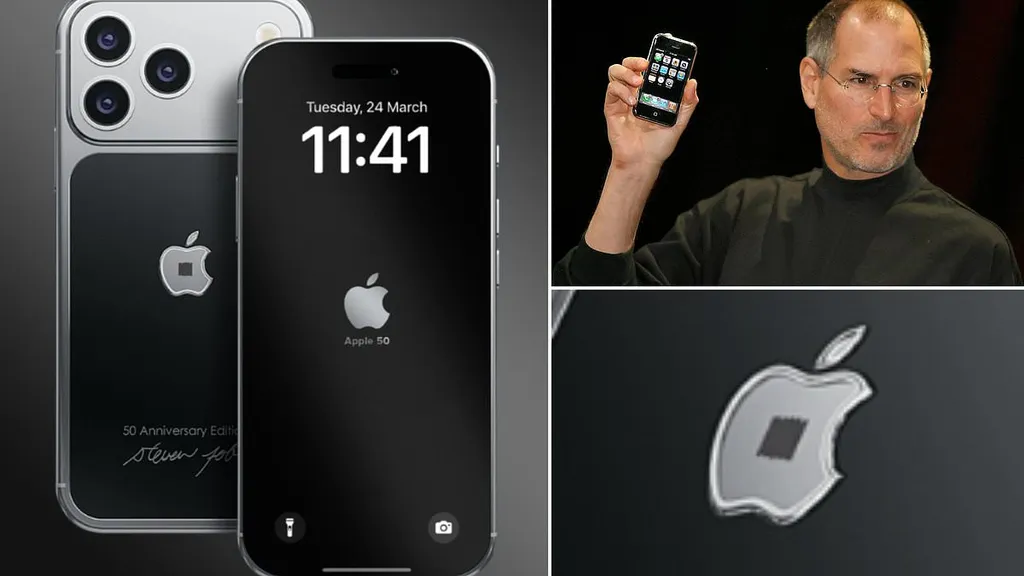
Designers from Caviar have created a luxury version of the iPhone 17 Pro Max dubbed the 'Jobs'.
As the name suggests, the device is an homage to Apple's late co-founder Steve Jobs - and even features a piece of his beloved black turtleneck in the back.
'Set into the decorative Apple emblem is a fragment of Jobs' turtleneck from the presentation of the NeXT computer, authenticated by certificate,' Caviar explains in the description.
'This detail elevates the smartphone into a museum-worthy collector's piece, where Apple's technological legacy meets a tangible trace of the man who shaped its destiny.
'A tribute to the beginning of a great story and a rare homage to the era from which a modern legend was born.'
Unsurprisingly, the Jobs isn't cheap. If you want to get your hands on one, you'll face a bill of $9,630-$11,560 (£7,235-£8,685)!
Caviar created the device to celebrate Apple's 50th anniversary on April 1.
'This model returns to the very beginning of the Apple legend, reinterpreting the aesthetic of the first iPhone 2G as an object of contemporary luxury,' the company explained.
'Its image carries the spirit of the first great breakthrough, the moment that transformed the mobile industry and opened a new era of personal technology.'
The iPhone is crafted using a titanium frame, finished with a PVD coating.
In the back of the device, you'll find a small piece of Jobs' turtleneck embedded in the Apple, alongside his signature.
Meanwhile, when you turn the device on, you'll find a customer wallpaper, reading 'Apple 50'.
The Jobs is just one of three special edition iPhones released by Caviar to celebrate the anniversary.
As the name suggests, the 'Gold Apple' features a 3D Apple logo, crafted entirely from 18-karat gold.
Meanwhile, the 'Black Apple' is made from marble carbon, with a black Apple logo on the back, made from aerospace-grade titanium.
Again, these luxury devices come with luxury price tags.
The Gold Apple will set you back $8,200-$10,130 (£6,160-£7,610), while the Black Apple costs $6,770-$8,770 (£5,085-£7,610).
If you do decide to splash out, you'll need to be quick - as they're limited edition.
Caviar has developed just nine Jobs iPhones, 50 Gold Apples, and 50 Black Apples.
If the Apple-themed range doesn't tickle your fancy, you'll be happy to hear that Caviar has hundreds of other options on its website.
Fans of The Untouchables might prefer the Capone - a $11,560 version of the iPhone 17 Pro Max with 'Never stop fighting until the battle is over' emblazoned on the back.
Or if dinosaurs are more your bag (and you've got a hefty budget), you might prefer the Tyrannophone - a £6,830 version of the iPhone 13 Pro Max with a fragment of a real 80 million-year-old T.Rex tooth embedded in the back!
THE TRILLION DOLLAR RISE OF APPLE
- 1976: Founders Steve Jobs, Steve Wozniak and Ronald Wayne created the company on April 1, 1976, as they set about selling computer kits to hobbyists, each of which was built by Wozniak. The first product was the Apple I.
- 1977: Apple released the Apple II in June, which was the first PC made for the mass market.
- 1981: Jobs became chairman.
- 1984: The Macintosh was introduced during an ad break for the Super Bowl and later officially unveiled during a launch event. It was discontinued a year later and Jobs left the firm.
- 1987: Apple released the Macintosh II, the first colour Mac.
- 1997: Apple announces it will acquire NeXT software in a $400 million deal that involves Jobs returning to Apple as interim CEO. He officially took the role in 2000.
- 2001: Apple introduced iTunes, OS X and the first-generation iPod. The first iPod MP3 music player was released on October 23, 2001, at an event in Cupertino and was able to hold up to 1,000 songs.
- 2007: Apple unveils the iPhone.
- 2010: The first iPad was unveiled.
- 2011: Jobs resigned in 2011 due to illness, handing the CEO title to Tim Cook. Jobs died in October from pancreatic cancer.
- 2014: Apple unveiled the Apple Watch. It also unveiled its first larger iPhones - the 6 and 6 Plus.
- 2015: After purchasing Beats from Dr Dre, Apple launched Apple Music to compete with Spotify and other music streaming services.
- 2016: Apple returned to its roots and announced the 4-inch iPhone SE. Meanwhile, the firm is embroiled in a legal battle with the FBI, involving the agency demanding access to the locked phone used by Syed Farook, who died in a shootout after carrying out a deadly December attack in San Bernardino, California, with his wife. The court order was dropped on March 28 after the FBI said a third party was able to unlock the device.
- 2017: Apple introduces the iPhone X, which removes the home button to make way for a futuristic edge-to-edge screen design and a new FaceID system that uses advanced sensors and lasers to unlock phones with just the owner's face.
- 2018: In a first for the company, Apple introduces new features in its latest operating system, iOS 12, that encourage users to manage and spend less time on their devices. The move was spawned by a strongly worded letter from shareholders that urged the firm to address the growing problem of smartphone addiction among kids and teenagers.
- 2019: In January, Apple reports its first decline in revenues and profits in a decade. CEO Tim Cook partly blamed steep declines in revenue from China.
- 2020: In March, Apple closes all its brick-and-mortar retail stores outside of China in response to coronavirus.
- 2021: In an online virtual event in April, CEO Tim Cook declares Apple's goal of becoming carbon neutral for Earth Day. Later in the year, the iPhone 13 was announced.
- 2022: In September, the iPhone 14 was announced. One of the new features included a new sensor to detect if a user had been in a car crash, as well as an improved camera system.
- 2023: Apple brings back its 'Home Pod' after the first generation was discontinued. The 'Home Pod' can be seen as an alternative to Amazon's Alexa or Google Home, as it is powered by voice commands.
- 2024: Apple makes its first steps into artificial intelligence with the release of Apple Intelligence. The features are not all released at once, with many delayed until the following year.