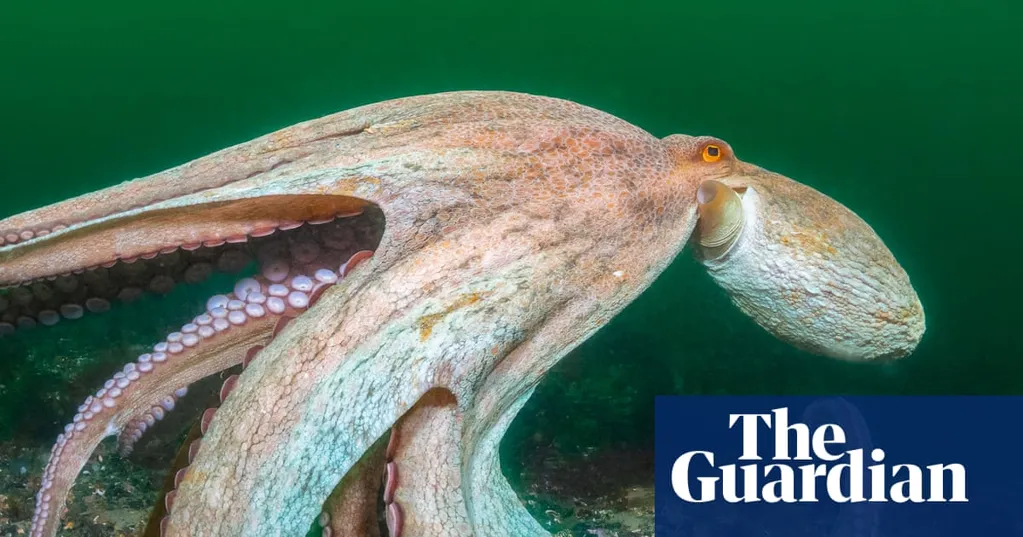
Record numbers of sightings of one of the world's most intelligent invertebrates over the summer have led the Wildlife Trusts to declare 2025 "the year of the octopus" in its annual review of Britain's seas.
A mild winter followed by an exceptionally warm spring prompted unprecedented numbers of Mediterranean octopuses to take up residence along England's south coast, from Penzance in Cornwall to south Devon.
"The scale of the catch [recorded by local fishers] was of the order of about 13 times what we would normally expect in Cornish waters," said Matt Slater, a marine conservation officer at Cornwall Wildlife Trust. "When we added up the numbers, approximately 233,000 octopuses were caught in UK waters this year - that's a huge increase from what you would normally expect."
The common or Mediterranean octopus, Octopus vulgaris, is native to UK waters but ordinarily in such small numbers it is rarely seen. A sudden increase in the population - a bloom - is caused by a combination of a mild winter followed by a warm breeding season in the spring. The ideal conditions meant that more of the larvae of the common octopus were likely to survive, said Slater, possibly in part fuelled by the large numbers of spider crabs that have also been recorded along the south coast in recent years.
The last time an octopus bloom of the size observed in 2025 was recorded was 1950, with records from the UK's Marine Biological Association showing the last bloom recorded prior to that was in 1900.
The huge numbers of octopuses along the south coast meant they could be easily spotted in shallow waters for the first time in recent history. Video footage from divers shows octopuses gathering in groups - they are usually solitary - as well as "walking" along the seabed on the tips of their limbs. One was even filmed grabbing at an underwater camera.
"The first time I dived off the Lizard peninsula this year I saw five octopuses," said Slater. "And these are big. There are two types of octopus in UK waters. There is the curled octopus, which is quite small, only getting to about the size of a football, but these common octopuses can be up to a metre and a half wide."
Another mild winter going into 2026 meant it was possible there could be a second bloom next year, said Slater, because historically, under these conditions, the blooms have repeated themselves for two consecutive years.
"However, it is unlikely, based on past events, that it will go on for a long time," he said. "But the sea keeps giving us surprises at the moment so it's quite an unpredictable situation."
The Wildlife Trusts noted some of the other "surprises, successes and joyful moments" around the UK coastline included a record number of grey seals observed by the Cumbria Wildlife Trust, as well as record numbers of puffins on Skomer, an island off the coast of Wales famed for the birds.
Other wildlife was recorded in unusual places. A volunteer with Shoresearch, the Wildlife Trusts' national citizen science survey programme, recorded the first Capellinia fustifera sea slug in Yorkshire, a 12mm mollusc that resembles a gnarly root vegetable and is usually found in the south-west. In addition, a variable blenny, a Mediterranean fish, was discovered off the coast of Sussex for the first time. Populations had previously been limited to the West Country.
Not everything was good news, though. "The year was bookended by environmental disasters," said Ruth Williams, head of marine conservation at the Wildlife Trusts. "[There was] the North Sea tanker collision in March and in November the release of tonnes of biobeads off the Sussex coast. Our Wildlife Trusts staff and volunteers are making huge efforts to protect and restore our shorelines."