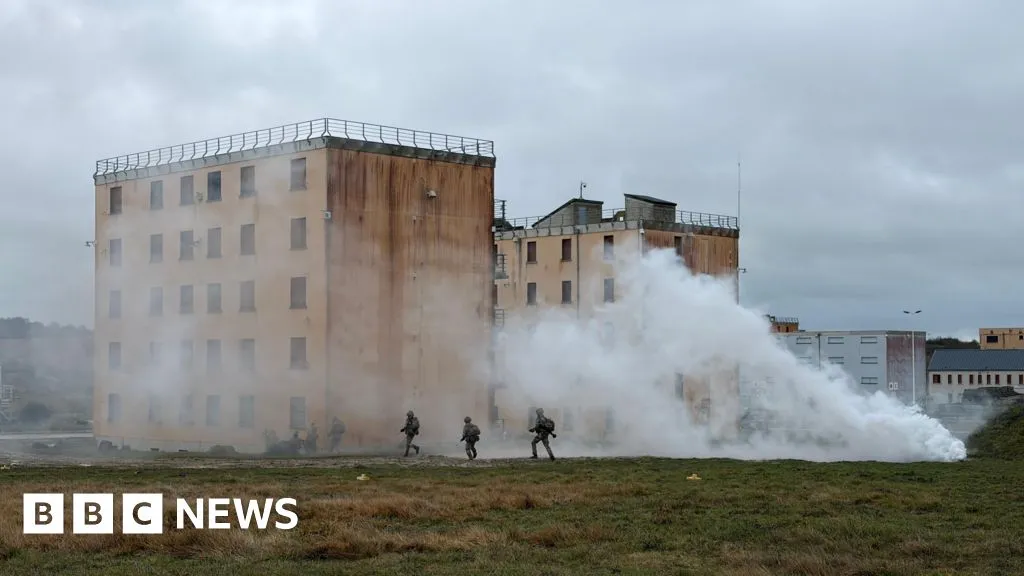
It's eerily quiet as I stand above a town centre. But it's not real because it's a simulation used to train soldiers.
Dotted with industrial districts, the narrow roads connect houses, schools and shops. A waterway weaves behind a disused railway. There's a derelict supermarket in the distance.
"That's our main defensive area," Colour Sgt Lewis Young tells us as he points to the central square.
"That's where we're going to hold and stay."
A handful of journalists including myself have been invited to CENZUB, Nato's most sophisticated urban combat training centre near Paris.
We're here to watch some 120 Lancashire-based soldiers train alongside the French military.
Once the exercise is complete, the first battalion of the Duke of Lancaster's (1Lancs) regiment will be on high alert, ready to be deployed to the eastern flank in the event of Russian aggression.
As an observer, it's easy to see why troops want to come here. The entire village is full of challenging high-rise buildings. It's as close as it gets to the real thing.
Young is our chaperone and points to a residential area to the west.
"I call that the council estate," he tells us. "That's the direction the enemy is coming from."
For 1Lancs, today's training is about defence. Soldiers serving in the 152nd French Infantry Division are on the offensive. All are following French tactics.
The plan is to slow the enemy down.
"Imagine a rush of water. They're the barricade that's going to initially stop that water from coming in," Young says.
"From there they will retreat, and what they're trying to do is to get the French to over expand - take too much so they can't really look after it and from there we attack into them. We then pull back."
"It's a bit like boxing," he explains.
"I'm going to wait for someone to attack me, I’m going to hold and shield, and then once they’re tired I’m going to give them a couple of punches and then I’m going to return to the defensive posture."
As we walk down the hill and into the town, the streets look empty but they never feel safe.
Platoons peer out of windows, ready to "play".
I get chatting to Kingsman Tyler Pilling. He's 23 and from Wigan.
"It's like a massive game of laser quest," he grins.
He's referring to the tactical engagement simulation (TES) kit as he points to his harness.
It's fitted to the brim with GPS, communication units and laser sensors. All of the regiment are fitted with a helmet harness with 360-degree coverage of an incident.
If they're hit by a mock weapon, the sensor is activated and they have to withdraw before being reinstated.
"When you're peeping around windows, you don't realise how open you are to the enemy," says Pilling.
"TES has made me open my eyes. I need to be a lot more careful. I need to look in all directions when the enemy might not be there. It's helped me out massively."
We see a French armoured tank moving in the distance and, without any warning, it’s there.
The sound of gunfire. Soldiers are firing blanks but the noise is deafening.
I hear shouting in French and English. Plumes of white smoke appear as soldiers use hand grenades to cause confusion.
The first platoon have lost a couple of soldiers and retreat in a hold position in a slow-burning game of cat and mouse.
"It's buying the regiment time," explains Young. "We know they're going to gain ground. What we're doing is delaying the advance of battle."
As stillness ensues, I look above to an unmistakable whirring sound in the sky. The propelling drones overhead are constant. Every soldier has to be drone-qualified.
I walk 100 yards down a dirt track and I pop my head inside another simulated building. It's three storeys high and from the outside looks like a pub.
To my right, Kingsman Dominic is holding a console as if he was gaming. “At the moment we’re using a parrot anafi drone, which we use for reconnaissance.”
I look down at the digital aerial view and locate sensors and movement.
“We no longer have to see our comrades for ourselves. It’s all here.
“It puts a bit of fear into the enemy, hopefully to know they’re being watched.”
I ask him if it can still be a deterrent even if it’s not being used.
“Even if I’m not using it. If I wanted to quickly run to another building, I could then afford a little while.”
The sensors feed into a data digitalised system worn by each soldier. Everyone knows where troops are at any one time.
I return to the open town square and head to what could be a town hall.
I climb over a defensive barricade of tractor-sized wheels and razor sharp wires.
As I reach the top of the spiral staircase, I enter what can only be described as a war room.
All the senior ranking officers are here discussing strategy. There's even a cardboard model plan of the outside village laid out on the concrete floor.
"This is a rarity where we can have a model here, but because of the defensive location we can track the battle far better than we would do on an assault," says Capt Connor Patterson.
"Usually myself and a light role company would be on the back of a Land Rover trying to track it on my map board, whereas here we can bring it to life.
"The Major and the commanders can come in at any time and track it."
We're told the battle is imminent.
We rush outside to the sound of armoured tanks wheeling closer. Horns are beeping. There is shouting and firing as soldiers swarm residential roads.
The smoke is back and it feels like a warzone.
I see a Brit open a shutter and peer out of a window. A French instructor spots him and shoots him with a handgun. Tag. He's out.
"The adrenaline kicks in," says Kingsman Sarkodie."You follow instructions and you know what you have to do.We love it."
It's clearly mentally draining. Young says: "It's all about being one step ahead of the enemy. It's about the element of surprise.
"You have to make it impossible for them to take the advantage."
Camera crews are capturing each moment - ducking, diving and they're pushed away from danger.
At first I'm terrified. It's only training but your body doesn't know that.
It soon unnerves me how quickly I get used to it.
As the battle reaches the town square, French instructors advise the Brits on how to respond. This is their exercise and they want them to adapt to their strategy. Bangs, blanks, rapid fire.
As quickly as it intensifies, it stops without warning. I see a French and British soldier shake hands. It's over. All the French soldiers are "out". The British have won this round.