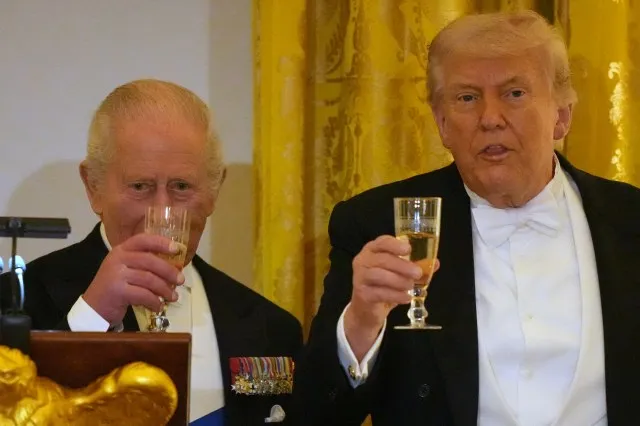
The White House yesterday -- prior to President Trump's state dinner for King Charles III -- posted on X a picture of the two heads of state and captioned it as "TWO KINGS." Clearly, Trump was trolling his domestic political opponents -- especially the organizers of the "No Kings" protests.
Charles' visit, like that of his grandfather King George VI with President Franklin Roosevelt in June 1939, comes at a time of global peril.
Peace was hanging in the balance in 1939 as the King and Queen of England lunched on hot dogs at Hyde Park -- Roosevelt's Springwood estate in upstate New York. Democracy itself was under threat from Nazi Germany and Imperial Japan.
The Old World needed the New World. Plus, as Roosevelt fully understood, the New World needed the old if it were to endure.
Survive it did -- and arguably, the U.S. became king of the world, especially after the end of the Cold War in 1991. And the U.S. has since learned what all monarchs soon discover: Heavy is the head that wears the crown.
Fast-forward to today, and global peace is once more at stake. The Old World is under threat from Russian President Vladimir Putin. The Kremlin's Axis of Evil allies -- China, Iran and North Korea -- are threatening the New World.
The dangers now are just as great as they were during World War II. Charles underscored that point masterfully and on multiple levels during his speech Tuesday when he presented Trump with the bell from the HMS Trump.
Beyond the ship's name, the symbolism of the T-class submarine was at the heart of Charles's messaging to Team Trump. First, it was a World War II vessel, representing the origins of the special relationship between the U.S. and the United Kingdom. Secondly, he reminded Trump that the U.K.—a founding member of the AUKUS security group that includes the U.S. and Australia—still has America's back in the Indo-Pacific.
King Charles was urgently calling Trump to action, much like Prime Minister Winston Churchill once called Roosevelt. And he is calling his attention not just to the Indo-Pacific, given the growing threat China represents to Taiwan, but also to Ukraine.
Earlier in the day, addressing a joint session of Congress, Charles reminded Capitol Hill that the U.K. and NATO were there for the U.S. on 9/11. Likewise, during the Cold War and Afghanistan. He then called for the same "unyielding resolve" to defend Ukraine and its "most courageous people."
Later, during his speech at the State Dinner, Charles returned to this point in context of World War—which he described as "the darkest days of the 20th century"—by warning that "freedom is again under attack following Russia's invasion of Ukraine."
Poignantly, Charles reminded Capitol Hill— and Trump in particular—during the close of his address to Congress that the true powers of a U.S. president do not stem from titles, gilded gold, or monuments. They derive instead from the reality that "America's words carry weight and meaning as they have since Independence [Day]." Yet those words, Charles added, only have meaning if "the actions of this great Nation matter even more."
Abraham Lincoln understood this. He made that clear—as the British monarch reminded Congress—when at Gettysburg, Lincoln said, "The world will little note, nor long remember what we say here, but it can never forget what they did here."
This is an intriguing tale of two very different kinds of kings. One is real royalty and brings messages of humility as the conduit to true power. The other's trollish flirtations with monarchy are contrived, exploited for political expediency and showmanship.
In the end, crowns—real or otherwise—matter far less than actions. Prevailing in Ukraine is the modern-day fight for American liberty. Lose there and it will be harder to stop Chinese President Xi Jinping in the Indo-Pacific.
Renewed unity and resolve, which King Charles rightly called for, is now what is needed on both sides of the Atlantic, especially when it comes to NATO.
That means concrete actions, such as sustaining Ukraine's war effort through steady munitions deliveries to Kyiv. It means Europe stepping it up on burden-sharing and confronting Iran's nuclear ambitions in the Middle East. Europe cannot keep playing it safe as it did in 1938 at Munich.
The West is facing a global threat—not merely regional threats in eastern Europe, Taiwan and the Middle East. They are all interconnected. Eliminating those threats is all that matters.
Trump's ill-advised "TWO KINGS" trolling aside, the only would-be foreign kings Washington and its allies need fear are Putin and Xi.