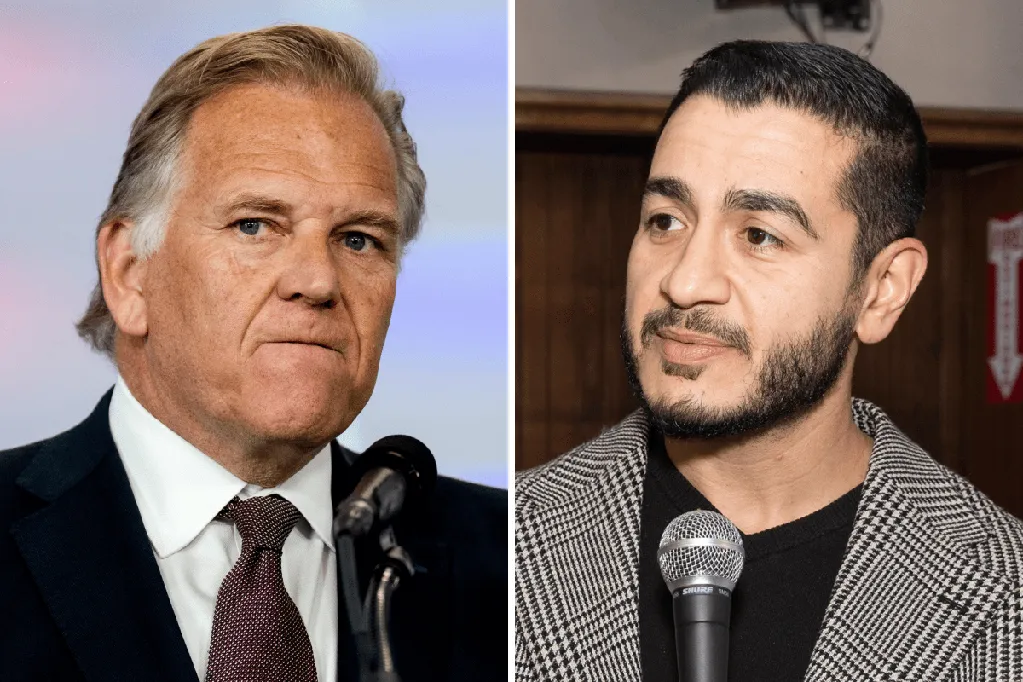
Abdul El-Sayed, a Democrat, predicted he would defeat Republican Mike Rogers by seven points in Michigan's Senate race, as polls point to a competitive election in the critical battleground for the 2026 midterms.
The prediction by El-Sayed, the former Wayne County health director and a favorite among progressives, comes as he faces questions about whether he would make a strong candidate for Democrats in a swing state that narrowly backed President Donald Trump in 2024.
Polling has shown him facing a tighter race against Rogers, a former congressman, compared to other candidates in the race, including Representative Haley Stevens and state Senator Mallory McMorrow. His ability to quell electability concerns could be key to his chances of winning over undecided voters in the Democratic primary.
Newsweek reached out to the El-Sayed, McMorrow, Rogers and Stevens campaigns for comment via email.
El-Sayed is running in the primary to replace Senator Gary Peters, a Democrat who opted to retire ahead of the midterms. The race is seen as a toss-up, with both Democrats and Republicans hoping to win it in November.
Republicans believe Trump's victory two years earlier and a messy Democratic primary could bolster their chances. However, Republicans have not won a Senate race in Michigan in more than 30 years, and they are facing a challenging national environment amid Trump's declining approval ratings. Historically, the party in the White House loses seats in the midterms.
El-Sayed addressed electability concerns on X Sunday evening in response to a poll average showing him trailing Rogers in the general election.
"Gimme three months and his golf buddies in Florida wouldn't even vote for him. I'll smoke him by 7," El-Sayed wrote. "Bet on it."
El-Sayed's supporters believe he would drive turnout from the Democratic base and more progressive corners of the electorate, but some in the Democratic establishment believe he would struggle to garner support among more moderate and centrist voters. Ideological divides are on display in the Democratic primary.
The latest poll of the race does show McMorrow and Stevens in a stronger position than El-Sayed.
The Emerson College survey showed Stevens with the strongest lead against Rogers. She received 47 percent support, compared with Rogers' 42 percent, in a general election matchup. McMorrow received 46 percent, compared to 43 percent for Rogers. El-Sayed and Rogers were tied, each receiving 43 percent of the vote.
The poll surveyed 1,000 likely voters from January 24-25, 2026, with a margin of error of plus or minus 3 percentage points.
A Glengariff Group poll, reported by The Detroit News, gave Rogers a lead over each Democratic candidate. He led Stevens by less than a half a percentage point (44.1 percent to 43.7 percent), McMorrow by about 3 points (45.7 percent to 42.4 percent) and El-Sayed by just over 6 points (48 percent to 41.6 percent). Glengariff Group is well known for its polling in Michigan politics.
The poll surveyed 600 likely voters from January 2-6, with a margin of error of plus or minus 4 percentage points.
The Cook Political Report classifies the race as a toss-up.
"Michigan is the GOP's best opportunity to flip a seat and throw a serious wrench into Democrats' majority math," the forecaster says.
Joetta Appiah, a spokesperson for Stevens' campaign, told Newsweek she is "the only candidate in this race who consistently beats Mike Rogers in poll after poll."
"She outperforms the other candidates because she has earned strong support in Detroit and among Black voters, and stands out as the Democrat who can win over independents. It's why she's leading in the primary, and why she'll beat Mike Rogers and send him packing back to Florida," she said.
El-Sayed told Newsweek about his economic message in a 2025 interview.
"We have to see people's pain, understand it, and then help them to believe that it can get better and then make it better," he said.
A recent Glengariff Group poll with the Detroit Regional Chamber gave Stevens a lead in the Democratic primary. That poll showed Stevens with 25 percent, El-Sayed with 23 percent and McMorrow with 16 percent support.
Thirty-six percent said they were still undecided about who they would support in the primary. Winning over those undecided voters will be crucial for whichever candidate wins the primary.
It surveyed 500 likely voters from April 17-19, 2026, with a margin of error of plus or minus 4.4 percentage points.
A Data for Progress poll of 515 likely voters from April 2-8 also showed Stevens with a slight lead. She received 23 percent support in that poll, while El-Sayed and McMorrow each received 22 percent.
A Global Strategy Group poll, sponsored by McMorrow, showed her up 5 points with 30 percent support, compared to El-Sayed's 25 percent and Stevens' 23 percent. It surveyed 800 likely voters from March 19-22 and was first reported by Politico.
Prediction markets favor Democrats. Kalshi gave Democrats a 78 percent chance of winning in November, while Polymarket gave Democrats a 77 percent chance as of Monday morning. Prediction markets measure trader sentiment about current events but are not always accurate.
Democrats cannot afford to lose Michigan if they want to reclaim control of the Senate in November. Republicans hold a 53-47 majority so Democrats must flip four seats to win control. The vice president serves as the tiebreaking vote.
In addition to Michigan, Democrats are defending a seat in another Trump-won state. Senator John Ossoff is running for reelection in Georgia, a race deemed Lean Democrat by the Cook Political Report.
Democrats view GOP-held seats in Maine, which backed former Vice President Kamala Harris by about 7 points in 2024, and North Carolina, which backed Trump by about 3 points, as top pick-up opportunities.
In North Carolina, Republican Senator Thom Tillis is not running for reelection. Senator Susan Collins is running for reelection in Maine and is likely to face Graham Platner after Democratic Governor Janet Mills ended her campaign last week in another toss-up. Despite the state's Democratic lean, Collins has won in tough environments in the past due to her moderate image.
There are no other Harris-won or single-digit Trump states up for grabs, meaning Democrats must compete in double-digit Trump states to win a majority. They're investing in states such as Alaska, Iowa, Ohio and Texas to make those races competitive -- and polls show those races are close.
Michigan is roughly evenly divided between Democrats and Republicans and has swung between both parties in recent elections.
Former President Barack Obama carried the state easily in both of his runs -- by more than 16 points in 2008 and by just under 10 points in 2012. But Trump flipped it in 2016, carrying it by less than half a percentage point.
Trump lost the state in 2020, when former President Joe Biden carried it by just under 2 points. But Michigan flipped back to the Republican Party in 2024, with Trump winning it by about 1.4 points -- the strongest showing for a Republican presidential candidate since 1988.
At the same time, Democratic Senator Elissa Slotkin managed to win an open seat by less than half a percentage point.
The state has become more competitive for Republicans due to a Democratic collapse in more rural areas that once leaned Democratic. Trump's inroads with white working-class voters helped carry him to victory in the state. Harris' collapse with Muslim and Arab American voters in 2024 also contributed to Trump's victory in Michigan. Those voter groups will be crucial to the Senate race this year.
At the same time, Democrats have made gains in suburbs of cities like Detroit and Grand Rapids, helping to offset those losses.
Michigan's Senate primary is scheduled for August 4, 2026.