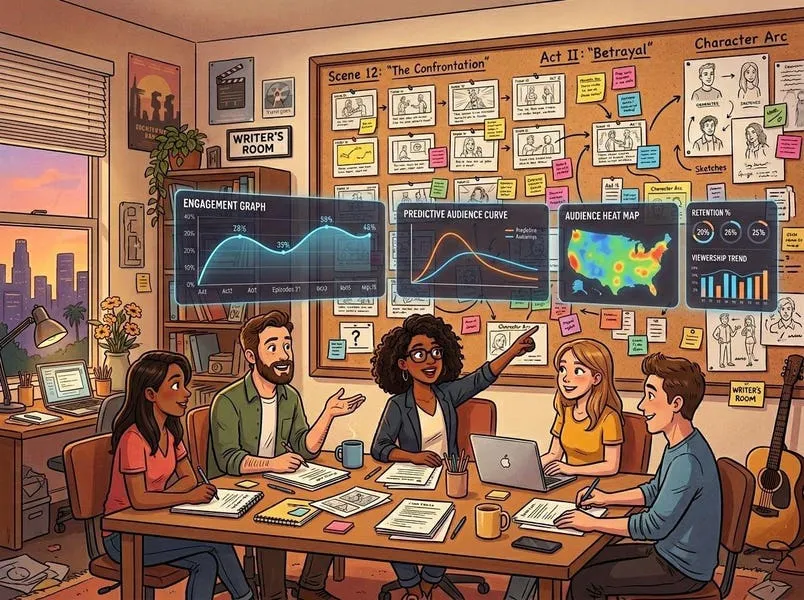
Microdramas, predictive modeling and generative AI are moving audience data upstream -- reshaping how stories are imagined, financed and greenlit across Hollywood and the global creative economy.
The Billion-Dollar Microdrama Model Tests Storytelling In Real Time
In Los Angeles, a vertical drama can move from script to screen in roughly four months. According to executives operating in the space, a full season -- often 60 to 90 one-to-three-minute episodes totaling roughly feature length -- is typically produced for well under $200,000, with production costs averaging around a few thousand dollars per finished minute. Engagement is measured immediately. Platforms often know within days whether a series scales -- or stalls.
What began as experimentation in mobile-first storytelling is now signaling something larger about AI in Hollywood: audience data is beginning to influence development before projects are fully financed.
Monetization is freemium: hook viewers with high-emotion cliffhangers, then convert them through micropayments to unlock remaining episodes.
This is not simply short-form entertainment. It is a measurable system: emotion → hook → binge → paywall → conversion → optimize → repeat.
For Bill Block -- a veteran producer who has led major independent studios and now works in the vertical space as founder of GammaTime -- predictive modeling restructures risk rather than replacing creativity. Data, he argues, reveals where audiences are standing, but instinct still determines "where they want to go next." By reducing development waste through early audience testing, creators gain room to take imaginative leaps. As Block puts it, an algorithm may "optimize a beat to keep a thumb from swiping," but only a storyteller can make a viewer feel something.
Distribution economics shift as well. In traditional Hollywood, marketing often dominates budgets because attention must be purchased upfront. In the vertical ecosystem, distribution is increasingly AI-driven and performance-based. If a series resonates, "the system scales it." If it doesn't, paid spend won't fundamentally change its trajectory. In that sense, marketing becomes "partially embedded in the product" -- the creative either activates the algorithm or it doesn't.
Rather than betting everything on a single launch, operators build portfolios and let audience response guide capital allocation. The structure, Block suggests, is "closer to a venture model than a studio model" -- test quickly, scale what works and redeploy resources based on performance.
Yet the system itself alters how intellectual property behaves. Stephanie Bollag, Chief Strategy & Partnerships Officer at Spikes Studio, argues that vertical adaptation is more than another syndication layer -- it reshapes the lifecycle and long-term value of IP. Rather than treating a film or series as a finished product, she says IP must function as "a dynamic asset" -- reused, reinvented and interacted with across formats.
In a mobile-first, data-rich environment, vertical becomes a "live testing ground." Performance signals arrive in real time. Story arcs can be refined. Characters can be re-centered. Vertical releases may even serve as proof of concept for remakes and spin-offs before larger capital commitments are made. Stories are increasingly conceived with multi-format deployment in mind.
Her framing shifts the debate from format to leverage. The decisive question, she notes, comes down to "who controls the data." In a performance-driven ecosystem, access to audience metrics becomes negotiating currency -- shaping licensing terms, revenue structures and strategic positioning. Flexible distribution and performance transparency, she suggests, may strengthen the hand of IP owners rather than concentrate power solely at the platform level.
Microdramas may be compressed in length. But they are expansive in implication. They signal a shift from static release models to adaptive IP systems -- continuously measured, redeployed and strategically compounded. The same computational logic is now beginning to move upstream into the architecture of development itself.
When AI Moves Development From Instinct To Iteration
The computational shift does not stop at vertical platforms. It is entering the architecture of development itself.
George Strompolos, Co-Founder and CEO of Promise -- an AI-native studio built around generative production pipelines -- is explicit that creative development still begins "with the story." What changes is not authorship, but tangibility. In traditional development, vision lives in words until capital is committed. In an AI-native environment, "words and images begin evolving together," allowing tone, scale and world-building to be explored far earlier in the process.
For Strompolos, the material shift is structural. The transformation is "not just in dollars... it is in time." In hybrid workflows, pre-production, production and post-production begin to collapse into one another. Visualization, testing and iteration move forward in the timeline, aligning creative teams before large budgets are deployed. As foundational models improve, "the constraint that begins to fade is the gap between imagination and execution."
That disappearing gap reshapes validation. In legacy studio systems, scripts circulated, notes accumulated, and audience response arrived only after release. In AI-native development, vision can be simulated and stress-tested before greenlight decisions are finalized. Greater clarity makes it easier to secure commitment -- and it also lowers the barrier for emerging creators who previously lacked the capital or infrastructure to visualize their ideas at cinematic scale.
The difference, Strompolos argues, lies in infrastructure. Traditional studios layer AI onto established pipelines. Promise was built AI-native from the outset -- its production systems and authorship tracking designed for generative workflows. In that environment, iteration becomes continuous and alignment happens earlier.
Can Artistic Judgment Keep Pace With Algorithmic Feedback?
If development is accelerating, who safeguards artistic ambition?
Alberto Barbera, Artistic Director of the Venice Film Festival and one of Europe's most influential curators, situates AI within cinema's long technological evolution. "AI is a technological tool like others that preceded it and contributed to changing the nature of cinema and its language: the invention of sound, the introduction of color, then Cinemascope, and more recently, CGI," he says. Yet he is clear about its scale. AI is likely "something more... a tool with infinitely greater potential."
For Barbera, the decisive factor is authorship. When artists command new technologies, he argues, "immense unexplored territories will open up." The risk arises not from the tool itself but from market logic overriding creative control. Homogenization appears when the role of the artist is subordinated to commercial formulas rather than experimentation.
At Spain's San Sebastián International Film Festival, director José Luis Rebordinos sees less rupture than convergence. "We live in an era of hybridization," he says. Genres are blending and boundaries between formats are dissolving. Over time, he believes, "classic films will be mixed with series."
For Rebordinos, this evolution does not diminish the role of festivals. Institutions that once distinguished cinema from television or streaming have already adapted to changing distribution models. Their mandate remains the same: to "search for excellence regardless of the type of production and distribution method."
Together, Barbera and Rebordinos represent a stabilizing force in a rapidly iterating system. Technology may expand cinema's language. The responsibility to recognize enduring work, they suggest, still depends on human judgment.
When AI Shapes Storytelling -- And Cultural Taste
If festivals safeguard artistic standards and studios redesign development, technologists now shape the infrastructure itself.
Mira Lane, Vice President of Technology & Society at Google and founder of the company's Envisioning Studio, argues that the real risk is not machine replacement but what she calls "human passivity." As AI systems generate unprecedented creative variation, they still lack "lived experience, taste, or cultural context" -- and ultimately have no point of view. Machines can expand and iterate across possibilities at extraordinary speed. They cannot decide which stories matter.
As generative systems scale, scarcity shifts. When thousands of variations can be produced instantly, Lane argues that discernment becomes "the core creative skill." The role of the creator increasingly lies in defining intention, setting constraints and choosing what resonates.
At the same time, large language models operate through probabilistic pattern matching, often favoring stability over disruption. Without deliberate direction, generative systems may reinforce dominant narrative patterns embedded in historical data. Used intentionally, they can expand storytelling. Used passively, they may narrow it.
In the near term, AI functions as a creative amplifier. Over time, Lane expects it to become "structurally embedded in how culture is produced" -- integrated into writing workflows, editing pipelines and creative systems that shape how stories are made.
From billion-dollar microdramas to AI-native studios and global film festivals, a common pattern emerges: prediction, iteration and measurable feedback are moving upstream. Storytelling is not only being distributed differently; it is being validated differently.
What This Means For Business -- And For Culture
The tools are becoming more powerful. The systems are more responsive. The distance between imagination and the screen is shorter than ever before.
For creators, innovators and original thinkers, that is the real opportunity.
Technology can expand the possibilities. But it cannot decide what matters.
That responsibility remains human.
In an era when machines can generate endless variations, the edge may lie in the qualities algorithms cannot supply -- specificity of vision, restraint of craft, and the lived experience that gives stories weight.
A machine can simulate grief. It cannot live with what is missing.
The advantage will belong to those with the discernment to imagine boldly, the originality to surprise audiences, and the judgment to recognize the stories worth telling.
Because even in an age of algorithms, the stories that move audiences -- and shape culture -- are still chosen by people.