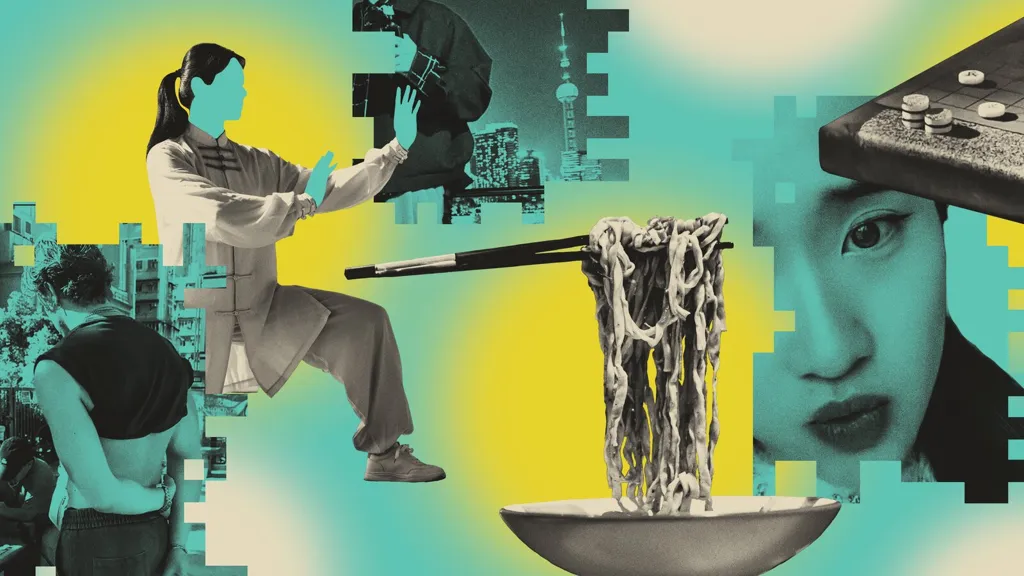
While "Chinamaxxing," users seem to be processing anxieties about the decline of their own country.
If you're reading this, you're Chinese. Or so says a genre of online content, which delivers instructions to the newly initiated. You should wear slippers and practice qigong; lay a zhen jin on your pillow to sleep; and exclusively drink warm water, ideally steeped with apples, jujubes and goji berries. Since the phrase took off last year, many Westerners have claimed they are in "a very Chinese time" in their lives, taking to social media to evangelize about their newfound Sinophilia. They're not only curious but also focused on the finer details: Should they peel their apples, for example, or even use pears instead?
References to "being Chinese" started as a mostly nonsensical joke, but they've become a trope that is loosely aspirational. Casual mimicry gradually emerged as creators "unlocked" their "Chinese uncle" personality (apparently: stoic; aloof; occasionally exposing midriff) or found themselves "damn close" to buying a floral quilted jacket, "the Chinese auntie drip" in one viewer's words. Now whole swaths of the internet have "just found out" they're Chinese or are declaring their complete transformation: "I don't even call it Chinatown anymore, I just call it town," states the text of one video. "That is how Chinese my mind has become." The joke has become so common that "Chinamaxxing" has been applied to the most mundane activities -- the American influencer Hasan Piker posted as much while standing before the Shanghai skyline, conspicuously pairing socks with slippers.
Several Chinese American influencers have happily taken up the role of cultural arbiter. Notable among them is Sherry Zhu, who often gives her audience lively Mandarin-English pep talks: Anyone staying in on a Friday night, for example, should instead eat hot pot and go to karaoke, because bed rotting is "not Chinese baddie of you." That "baddie" persona has made its way into a range of wellness content, most of which appropriate traditional Chinese medicine. The content multiplied recently on the occasion of Lunar New Year, with one infographic illustrating the components of a "Chinease Baddie Morning Routine" -- pun intended. It included photos of "morning herbs," "meditation" and "gua sha" alongside a set of disembodied abs (labeled "lymph drain belly massage") and a toilet (labeled, simply, "elimination").
Many Chinese people have of course objected to their culture's being trivialized, even fetishized, by Western audiences -- some have even likened the experience to the parasitic predation in Jordan Peele's horror movie "Get Out." In particular, the idea of being "diagnosed as Chinese" has stoked outrage for recalling stereotypes that were widely revived with the onset of the pandemic. "Where was this love for Chinese culture when they were getting attacked in the streets?" asks one user, recalling how anti-Asian hate crimes spiked in 2020, at a time when President Trump also called Covid-19 the "China virus." His vitriol helped rekindle a long tradition of Sinophobia that casts China as irrevocably backward, even barbaric. In this "very Chinese time," the same Orientalizing impulses have produced new variations on these themes: One "British guy showing you the real China," for example, regularly telegraphs his immersion in the culture by toting a local beer in one hand and a cigarette in the other.
What is unexpected about this trend -- and certainly unthinkable just six years ago -- is that these jokes are now inflected with reverence. As in the video that overlays scenes from Chinese pagodas, street markets and skylines with an admiring if enigmatic directive: "You have to get more locked in/You have to get more motion/You have to get more Chinese." Or as one account articulates, parodying Confucius' "Analects," "The sinicization of a man's mind comes not as an unbidden surprise, but is welcomed and greeted warmly like an old friend returning home."
Social media has long sustained cultural exchange between the United States and China, a relationship that seems to only strengthen when political tensions escalate. Anticipating Trump's second presidency in early 2025 -- and, more specifically, the proposed ban on TikTok -- users in the United States pre-emptively sought out the app's Chinese equivalent, Xiaohongshu, colloquially known as RedNote. It shot to the top of the U.S. Apple Store downloads list by mid-January. While many of these "TikTok refugees" simply wanted a new digital home, others took to the Chinese app to "troll" the American government. (Trump's inauguration featured a coterie of tech elites whose net worth exceeded one trillion dollars.) "In short, we're here to spite our government and to learn about China and hang out with you guys," one such refugee posted on Xiaohongshu.