As the U.S. is fighting Iran and its proxies, Iranian regime officials, military commanders, and propaganda outlets continue to operate freely on American social media platforms, as they have for years. During this time of war, they are spreading misinformation in English and shaping global perceptions of the conflict. Stopping them from doing so requires new policies, enforcement mechanisms, and accountability from U.S. social media companies. An America First policy must be extended to the digital battlefield.
The Iranian regime is scoring asymmetrical victories in the information war, due in large part to this social media activity. Internet access is heavily restricted for ordinary Iranian citizens, but regime officials, who are allowed access and have millions of online followers in the U.S. and worldwide, provide a steady supply of fake news to an audience eager for their anti-U.S., anti-Israel, and anti-West messaging. They are only part of a vast ecosystem of English-language accounts operated by or affiliated with Iranian state media, the IRGC, the Basij militia, and the country's religious establishment.
Some of the leading regime accounts in English belong to Supreme Leader Mojtaba Khamenei, the deceased Islamic Revolutionary Guard Corps (IRGC) commander, the deceased de facto political leader Ali Larijani and his replacement, and the foreign minister.
Just this week, the account of the deceased supreme leader Ali Khamenei—still active despite his death on February 28—posted a video claiming to show Iranian air defenses hitting an F-35 fighter jet in Iranian airspace and stating “The US empire is in decline.” The post has had nearly 6 million views. Most recently, a new “Khamenei Media” account on X addressed “Muslim countries depending on enemy,” stating: “America looks at you as a tool for preserving Zionist regime. Listen to Martyr Khamenei’s words on why Islamic governments and nations must stand united and fight the US arrogance in the region.”
The regime’s English-language outlet PressTV, designated and sanctioned by the Treasury Department, freely disseminates its coverage of the war to U.S. audiences. Remarkably, C-SPAN has aired no fewer than eight PressTV programs since Khamenei’s death, bringing Iranian state propaganda directly into millions of American homes. The outlet maintains active accounts on X as well as on YouTube, Facebook, Instagram, LinkedIn, Soundcloud, Odysee, Rumble, and other U.S. platforms.
This information campaign on American platforms extends beyond social media; Wikipedia is also an arena for influence. Iranian state media and IRGC-linked sources have been cited tens of thousands of times across Wikipedia’s English, Persian, Arabic and Spanish editions, promoting regime narratives in what is unfortunately one of the world’s most widely consulted references.
While the impact of the misinformation campaign is difficult to measure, it has likely influenced a significant portion of the 73 percent of Americans who oppose the war. They are also likely not aware of the hands behind the scenes—or that this content is being massively boosted and disseminated by the regime’s supporters in innumerable guises.
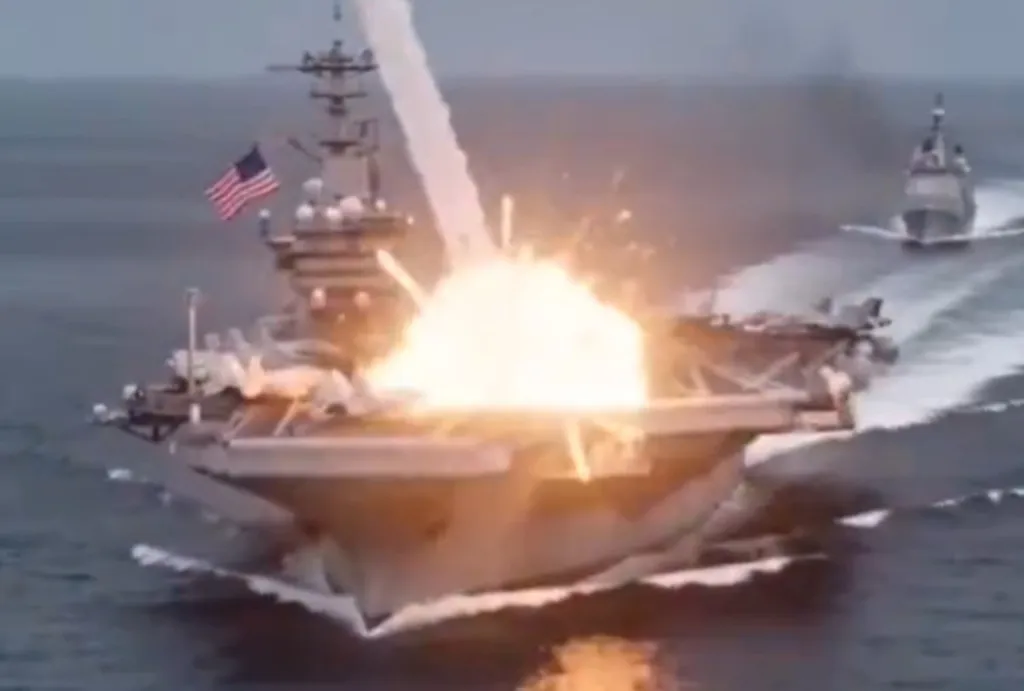
According to a New York Times investigation, over 110 unique AI-generated images and videos depicting events that never occurred circulated online in only two weeks—including reports of massive explosions and demolished neighborhoods in Israeli cities, Israeli soldiers protesting against the war, and U.S. warships attacked by missiles and torpedoes. This content spread rapidly across X, Facebook, and other platforms, garnering tens of millions of views and adding confusion to the information environment surrounding the conflict.
By my own observations, I and everyone I know have seen “news” from regime-affiliated outlets on X, including from the Tehran Times and Hezbollah’s Al-Mayadeen, claiming that U.S. soldiers were captured or converted to Islam en masse; that an American F-15 fighter jet was downed near Tehran; that the IRGC captured 50 elite Israeli soldiers; and more. According to other “breaking news,” Tel Aviv has been destroyed and Israeli Prime Minister Benjamin Netanyahu was killed and replaced by AI-generated videos. Such claims have been viewed hundreds of millions of times every day.
A recent disturbing example was “breaking” news of an attack on Manhattan, complete with a video that appears to comprise, at least in part, manipulated 9/11 footage. Posted by an account called “Iran Press,” launched in December 2025 that -- within 24 hours of the posting -- changed its name to “News Now.” It has nearly two million views so far.
“Something strange is happening in the information war,” observed former Obama adviser Van Jones in a widely circulated post. He asks: “Why is it you see young people in America who give a free pass to Iran, which is butchering people, shooting down young protesters, won’t give women rights, won’t give gay people rights—and yet are incredibly critical of the United States itself?”
Young Americans, he said, have “become pieces on a chessboard in a GRAY WAR—a conflict fought with information instead of bullets... What’s the impact of having a country where different factions inside the country are actually aligning with enemies outside the country? Without seeming to really know they’re doing that?” He added: “The battlefield isn’t overseas anymore. It’s in your feed.”
X’s new location labeling that shows every account’s country or region makes it impossible to hide that many pro-Iranian regime accounts—including some that had presented themselves as based in the U.S.—are actually operating out of Russia, China, or Iran itself.
Additionally, the Iranian regime’s and its proxies’ exploitation of American platforms for anti-U.S. activity is not limited to social media. App stores, hosting providers, cloud services and internet infrastructure companies are also enabling the dissemination of this misinformation and propaganda.
In peacetime, debates on free speech and content moderation are often contentious. Wartime raises different questions. Should Iran’s leadership, military organizations and propaganda outlets enjoy unrestricted access to American technology platforms? It is no different from giving them missiles and drones.
U.S. companies must take immediate action against the Iranian regime’s presence on these social media platforms and against its use of online services. They must identify and report designated terrorist organizations and representatives of hostile regimes, and, most importantly, remove them.
This moment should also prompt a long-overdue debate about restoring online guardrails. The Iranian regime’s current ability to easily manipulate American audiences is only part of the broader toxicity and growing societal harm from social media platforms that remain largely unregulated.
This conflict offers a preview of modern warfare in the digital age: fabricated narratives, the amplification of hostile actors, and AI-driven deception on American platforms. Absent action, this will only intensify as technology develops.
Steven Stalinsky is Executive Director of The Middle East Media Research Institute.