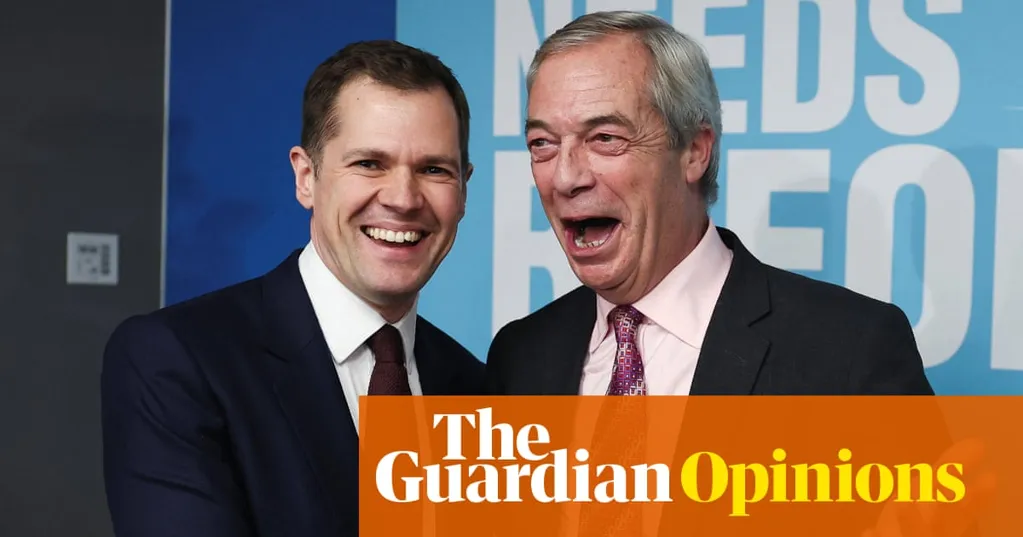
Farage was all smiles as the Tory rightwinger he once called a 'fraud' defected to Reform. Will it be big enough for the both of them? Keep watching
The best thing right now would be to read the turmoil in the Tory party as told by the spy novelist Len Deighton. He would give us more detail on Robert Jenrick's defection media-handling plan: a statement on what a future in Reform meant to him, how he'd wrestled with his decision to leave the Conservatives behind. Kemi Badenoch would discover it by a process of intricate deduction, rather than the more likely story - that some mischief-maker leaked it to her. The trail of clues would be ever more ominous, as Jenrick skipped opportunities to show loyalty to his party leader, mysteriously didn't show for longstanding commitments. The betrayal would unfold slowly in scarce-to-be-believed fashion until, wham: someone saw his to-do list. Iron turquoise shirt. Call Sophy Ridge.
Instead, Jenrick's ejection from his party is slightly spoiled, from a storytelling point of view, by the chaos of conjecture and semi-analysis. What happened this afternoon was beyond Deighton. For hours, Nigel Farage would confirm only that he'd had conversations with Jenrick, and stated categorically that he hadn't signed a deal with him. There were questions over whether Badenoch had successfully ruined Farage's Westminster press conference, planned for 4:30pm today, where he would purportedly reveal Jenrick as his latest defector. And even more about what it would mean for Jenrick's political ambitions, inside or outside the Tory party.
And then, the press conference came. Farage insisted there was no imminent deal with Jenrick and that a defection, if it came at all, could be months off. Badenoch sacking Jenrick had been seen by some as evidence of her political nous, blindsiding both him and Reform. Torching this narrative and basking in his own opportunism, Farage said: “I want to say thank you to Kemi Badenoch. This is the latest Christmas present we have had. I welcome Robert Jenrick into this room and into Reform UK.” Except it was something of a wait for his latest Tory acquisition to step into the light - a vacuum Farage was forced to fill until his new champion arrived to applause. They took the applause and shared the stage, but there is an immediate question: how long will that stage be big enough for the both of them?
For all the bonhomie and jollity on display, it is a mixed blessing for Reform when senior Conservatives defect: while it solidifies its claim to be the new centre of rightwing gravity in British politics, it has staked that claim on the basis that it is the outsider, that it is the new breed. The more high-profile its Conservative joiners, the more it's associated with (arguably tainted by) old eras of Conservatism, whether that's Nadine Dorries as an emblem of the Boris Johnson era, or Nadhim Zahawi as lieutenant to every Tory prime minister since Theresa May.
It's hard to ignore the relational fallout, all the old enmities that will have to be skimmed over or forgotten. Farage has explicitly called Jenrick "a fraud" in the recent past; though of insults, my personal favourite was "he is no friend of Epping". Zia Yusuf, Reform's punchy former chair, has claimed on X that Jenrick is a Farage impersonator. It's hard to imagine them working together harmoniously, but it's often hard to imagine Reform's leading lights working together at all; yet here they still are.
As engrossing as these personal considerations are, there is nothing dramatic about this from the perspective of values. Jenrick spent most of last year establishing how comfortable he was around the tropes of the far right, whether that's immigrants posing a threat to women and girls (specifically, he wrote in the Daily Mail, his daughters) or Birmingham not having enough white people in it. He will fit in fine with Reform, as he would with the BNP.
In an earlier press conference today, Farage sought to amp up the then rumoured defection as an earthquake for British politics, saying that "for all the talk that Kemi's doing better at PMQs, for all the talk of a supposed Kemi bounce, on 8 May, the Conservative party will cease to be a national party". Which would indeed be dramatic if the earthquake only happened this afternoon, but it's been happening in slow motion since 2016 reshaped the Tory hegemony. Since May quit in despair; since the membership dwindled to its current hardcore; since its nativist and pop-con voices became dominant.
Even through the return to sense that Rishi Sunak was supposed to represent, the party bears no resemblance to the unflappable, centre-right, establishment institution that historically defined its role. Do those mainstream Conservatives still exist, the ones that put business interests first, who are open-minded about immigration in the service of growth, who want life on the poverty line to be hard but not unlivable, who liked Europe for its seamless trade and prosecco? There seem to be a few of them in the Labour party, but as voters, who's to say; they are no longer represented, and therefore are invisible.
Farage would have us believe that pragmatists and conservation-minded one-nation Tories are extinct, because of course he would; that effectively anoints him. Badenoch wants to persuade us that she represents the whole of the right because, again, of course she does; that lends legitimacy to her posturing that is otherwise just Reform-only-less-exciting. Both strive for a populist energy and seek to dignify it with yesterday's branding. It's a hollow marketing exercise, and as such, Jenrick - the man of the moment - does seem its ideal mascot.