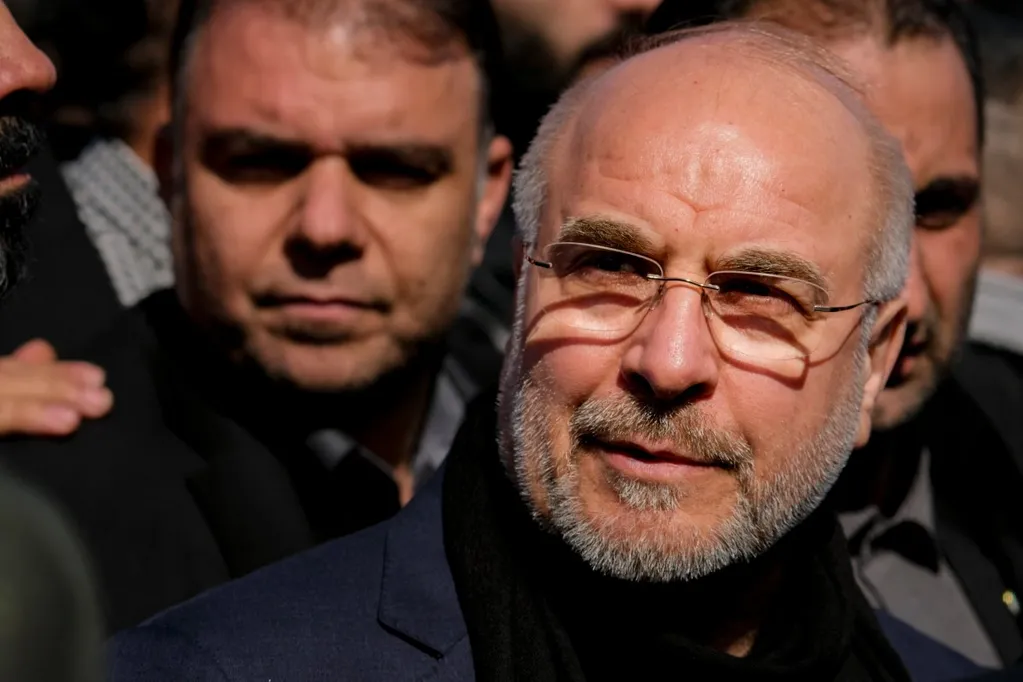
The United States does not negotiate with terrorists: a platitude repeated so often it has become reflex, from presidential podiums to Senate floors to Hollywood scripts. But it is worth asking whether it still applies. The central figure now being discussed in connection with a negotiated settlement with Iran is Mohammad-Bagher Ghalibaf -- former commander of the Islamic Revolutionary Guard Corps (IRGC) air force, U.S.-designated and sanctioned, and a man embedded in the machinery of the Islamic Republic's worst abuses for three decades. If Ghalibaf is at the table, the U.S. isn't refusing to negotiate with terrorists. It is legitimizing them and calling it diplomacy.
And if that is where we are, we should say the next part out loud: When the cost rises, we give in. A settlement structured this way signals permission, not compromise. To Tehran, it says defiance pays. To others watching, it says American red lines are negotiable.
With Supreme Leader Ayatollah Ali Khamenei and Supreme National Security Council Secretary Ali Larijani dead, the Iranian regime is a decapitated system running on the muscle memory of its remaining enforcers: Ghalibaf, Interim Leadership Council member Chief Justice Gholam-Hossein Mohseni-Ejei and IRGC Commander-in-Chief Brigadier General Ahmad Vahidi. In January 2026, they used that machinery to slaughter more than 30,000 unarmed Iranians in two days. Ejei instructed his judiciary to be "decisive, maximum" with punishments and to act "without any legal leniency." That is who is now being engaged. Not a government, but the architects of a massacre.
Each has a defined role. Ghalibaf, its operator, has moved through the regime's circuitry -- from IRGC command to parliament speaker -- building the networks that keep it intact. Ejei is the internal regulator, translating coercion into legal process and giving repression the veneer of law. Vahidi, now head of the IRGC, was central to building the Quds Force and the Axis of Resistance -- Hezbollah, Hamas and others -- and remains subject to an Interpol Red Notice for his role in the 1994 bombing of the AMIA Jewish community center in Buenos Aires, Argentina, that killed 85 people and injured over 300. These are not transitional figures. They are the system.
They rose together through the IRGC in the 1980s and have been at the center of every major crackdown from 2009 to January 2026. They engineered the succession of Mojtaba Khamenei as a controllable placeholder whose authority derives from them. To recognize him is to recognize their consolidation.
We have seen this movie. President Joe Biden thought he could hand Afghanistan to the Taliban and call it an orderly withdrawal -- a miscalculation that defined his presidency. The premise that you can manage an ideological, armed movement through accommodation, that legitimacy is a tool of moderation, is the same architecture being deployed on Iran right now. The Taliban were a medieval insurgency with small arms and a grudge. The Islamic Republic is just as immune to moderation, but its ballistic reach last week extended to Diego Garcia -- a range that puts London within reach. It has nuclear ambitions that have survived two decades of diplomacy and two rounds of strikes. And it is run by indiscriminate killers whose commitment to Israel's elimination is their raison d'être.
President Donald Trump has made clear he is not Joe Biden or Barack Obama. The question is whether that is a conviction or a preference. Because this is precisely the juncture where the distinction gets made; not in rhetoric, but in the decision about who gets to walk away from this with their apparatus intact. History, and its long memory, are watching. A settlement that leaves the trio in place and gives the IRGC command structure time to rebuild could only be described as an Obama-esque move and a Biden-level miscalculation with a Trump signature on it. The Islamic Republic has never moderated under external pressure. It has only consolidated into a harder monolith. Every accommodation has been read as a signal that the cost of defiance remains below the threshold of consequence. Empowering this cartel through negotiation isn't realpolitik. It's capitulation with a press conference attached.
This won't surprise anyone who has watched the Islamic Republic operate. There is a Persian saying, "Az in sotūn be ān sotūn faraj ast" -- literally, "from this pillar to that pillar, there is relief." It comes from prison culture -- the brief relief a condemned man felt when moved from one flogging post to another. The Islamic Republic has been living in that interval for nearly five decades, and the West has kept mistaking the pause for progress. This is not a negotiating strategy, but an existential one. They are cornered now like never before and would say and do anything to survive. Right now, what survival requires is a ceasefire, a seat at the table and enough international legitimacy to rebuild. Their trump card is the Strait of Hormuz. The question is whether that trump card is also the point at which President Trump capitulates. The rhyme would be unfortunate; the consequences biblical.
Unlike Venezuela, you cannot bury this by replacing the cartel's figurehead. A ceasefire that preserves the IRGC preserves Vahidi's life's work -- the proxy network, the Strait of Hormuz stranglehold, the entire apparatus -- and hands Washington a more dangerous, freshly legitimized version of the problem it already has.
There is an alternative. On January 8 and 9, when Ejei was promising maximum punishment for protesters, Crown Prince Reza Pahlavi called Iranians to the streets. Millions came in a country where dissent can be a death sentence. On February 14, the diaspora answered: 250,000 in Munich alone; hundreds of thousands more in Los Angeles and Toronto. It was the most significant expression of popular will the Islamic Republic has faced since its founding: coordinated, at enormous personal cost, in direct response to Pahlavi's call. Ignoring that signal has a price. It tells every Iranian who came to the streets, who watched a loved one die, that the West looked at their sacrifice and decided the paperwork wasn't worth it.
Iranians recognize this moment. They have waited generations for the alignment of internal fracture, external pressure and international attention. That window will not stay open. A premature settlement forecloses the possibility of change -- possibly for another generation. Ghalibaf, Ejei and Vahidi are not the solution. They are the problem. Anything short of regime change is not a diplomatic achievement. It is a decision, made with open eyes, to live with the consequences. And the consequences, as January showed, are paid in Iranian lives.