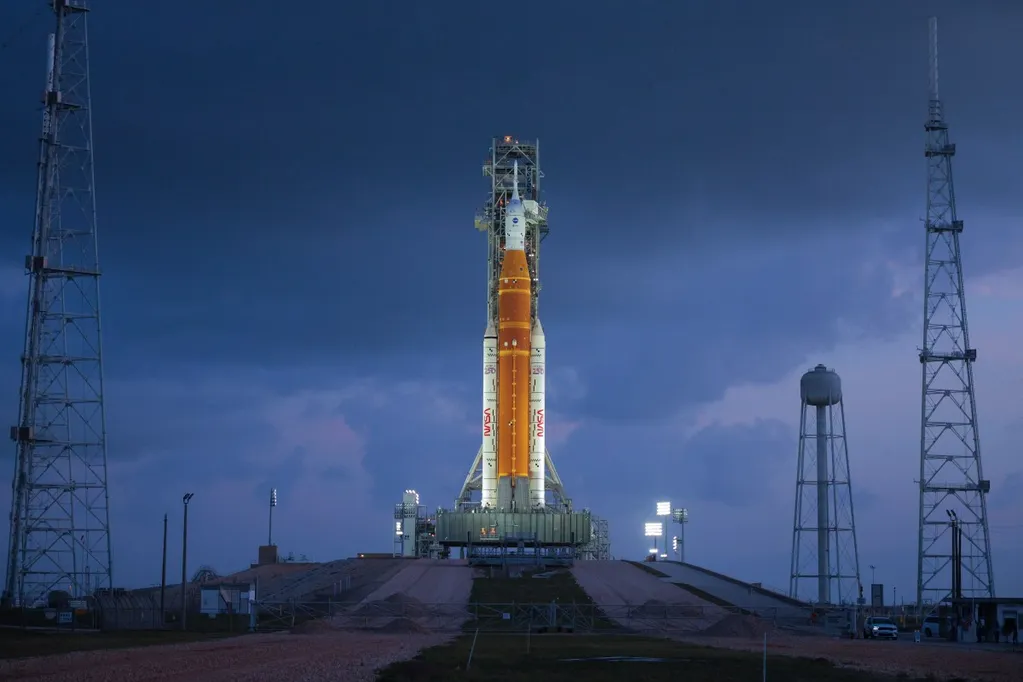
NASA is set to make history Wednesday evening as it launches Artemis II, the first crewed mission to travel toward the moon in more than 50 years.
The mission will send four astronauts aboard the agency's powerful Space Launch System rocket on a roughly 10‑day journey around the moon and back, marking a major milestone in NASA's long‑term plan to return humans to deep space.
The launch will be from Kennedy Space Center in Florida, with live coverage available on NASA's official YouTube stream.
Artemis II is the first time astronauts have headed beyond low Earth orbit since Apollo 17 went to the moon in December 1972.
The mission is designed to test the Orion spacecraft and life‑support systems with a crew onboard, paving the way for future lunar landings this decade. NASA officials say Artemis II is a critical step toward establishing a sustained human presence on the moon and eventually sending astronauts to Mars.
Artemis II will not include a lunar landing. Instead, the mission is a lunar flyby that will take the crew around the far side of the moon before returning to Earth. NASA has said the goal is to thoroughly test spacecraft systems and crew operations in deep space before attempting a landing on a future Artemis mission.
"Orion is developed to be capable of sending astronauts to the Moon and is a crucial step toward eventually sending crews on to Mars," NASA said on its website. "The Orion spacecraft will serve as the exploration vehicle that will carry and sustain the crew on Artemis missions to the Moon and return them safely to Earth."
NASA is targeting a launch window that opens at 6:24 p.m. ET Wednesday, April 1, from Launch Complex 39B at Kennedy Space Center in Cape Canaveral, Florida.
The window lasts two hours, and delays remain possible because of weather or technical concerns. Live coverage of the launch is available on NASA's official YouTube channel.
The Artemis II mission carries four astronauts:
The crew represents several historic firsts, including the first woman (Koch), first Black person (Glover) and first Canadian (Hansen) to travel to the lunar area.
After liftoff, Orion will enter high Earth orbit before firing its engines to break free of Earth's gravity and head toward the moon.
The crew will swing around the far side of the moon on a free‑return trajectory, traveling roughly 250,000 miles from Earth. This distance will be farther than any human has gone in more than five decades before the spacecraft turns back toward the Pacific Ocean.
Artemis II commander Reid Wiseman, on X: "Nothing but gratitude for the men and women of this great nation. It is time to fly."
Christina Koch, NASA astronaut and mission specialist, as reported by Ars Technica: "A destination is not just something we're looking at. It is our strong hope that this mission is the start of an era where everyone, every person on Earth, can look at the Moon and think of it as also a destination."
Victor Glover, the pilot on Artemis II, as reported by Ars Technica: "It is actually a very long day. We wake up about eight hours before launch, and there's a pretty tight schedule of things to get out there."
NASA says the data collected during Artemis II will directly inform Artemis III, the mission intended to return astronauts to the lunar surface later this decade.