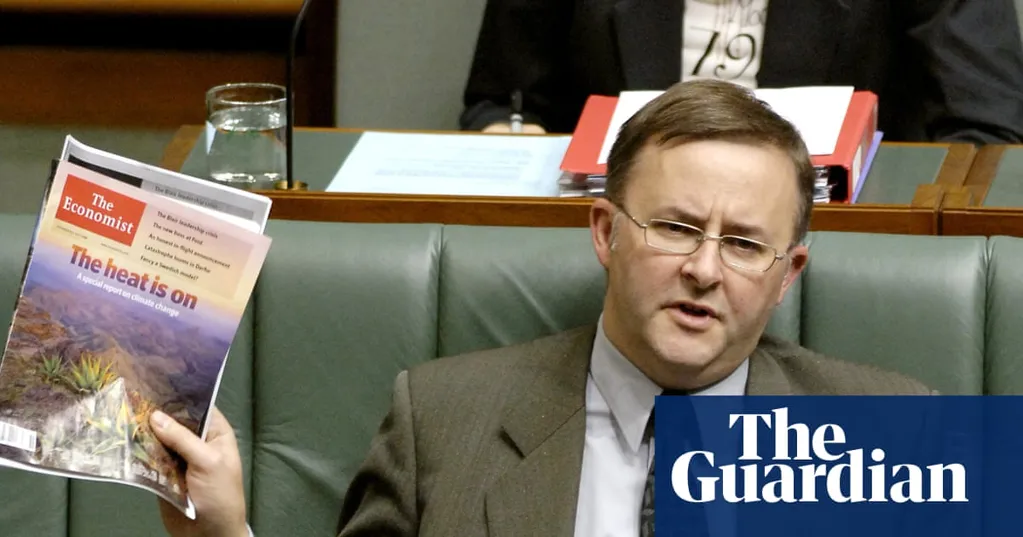
It's a point of pride for Anthony Albanese that his supporters drank Marrickville's Portugal Madeira Club dry on election night 1996.
Albanese's arrival in parliament, 30 years ago on Monday, coincided with John Howard's victory and the end of the Hawke-Keating era. Pauline Hanson was another notable 1996 rookie MP.
The election was a Coalition rout and Labor faced a return to the political wilderness after 13 years in government. Albanese's supporters exhausted the club's beer supply, before turning to wine, and then spirits.
"Everyone came from all the wakes that were happening that night," he says today. "It was quite the night."
Ahead of Monday’s anniversary, the Labor leader held a different kind of party on Sunday, celebrating with three decades’ worth of branch members, old friends and cabinet ministers.
The afternoon’s function, at the Marrickville District Lawn Tennis Club, was less boozy than in 1996. Vintage Albanese campaign posters decorated the walls. His new wife, Jodie Haydon, and his son, Nathan Albanese, mixed with friends. The prime ministerial dog, Toto, nearly overshadowed the speeches.
The event came less than 24 hours after Israel and the US launched strikes against Iran, action that the Labor government was quick to support, and at the end of a week where Albanese repeatedly voiced his "contempt" for IS-linked Australian women stuck in Syria with their children. The anniversary also comes with some criticism that Labor is moving too slow and cautiously on social reform compared to Labor governments of the past. Albanese's backing of the strikes in particular brought into focus how different the prime minister of today is from the Albanese of 1996, then a Left faction warrior who would go on to oppose the Iraq war and hardline policies to stop boat people arriving in Australia.
That contrast prompts an interesting question: what would the Albanese of 1996 think of the Labor leader today?
Political commentator and professor at Canberra University Chris Wallace said: "Albanese's arc from scrappy Labor Left activist to smooth Tory-curious Labor prime minister over the last 30 years is a mystery to many.
"It is explained by his transactional focus on the acquisition and maintenance of power first, and Labor values and policy ambition second - sometimes a long way second," she said.
Albanese is now the longest-serving member in the caucus, but his political career predated his election: he joined the Labor party in 1979 while still at school, cut his teeth in student politics, became a staffer for Labor great Tom Uren, and later an assistant NSW Labor secretary.
As an MP he learned his craft on committees and in backrooms, became Labor's leader of the house and infrastructure minister, and rose to deputy prime minister in 2013, a role he held for just a few months before Tony Abbott's landslide election.
Scarred by the chaos of the Rudd-Gillard-Rudd years, he has stressed the need for Labor to stay in power over multiple terms since succeeding Bill Shorten as opposition leader in 2019 and becoming prime minister in 2022.
John Mara remembers meeting Albanese before he won the seat of Grayndler.
"I felt very parochial about Anthony," the Labor party life member says.
"He had all the characteristics I like. He's working-class, he got a good brain, he is very loyal and very genuine. He's the sort of man you could rely on to come to your funeral."
Damian Spruce, president of Labor's Petersham branch, first met Albanese in the 1990s.
"He mentored people in student politics and Young Labor politics. A lot of the most talented people gravitated towards him. He never had any airs."
Not everyone thought Albanese would win, let alone reach The Lodge.
Noted psephologist Malcolm Mackerras predicted a minor party campaigning against noise emanating from the expanded Sydney airport would seize Grayndler in 1996, a seat Labor had held for nearly 50 years at the time. These days, Albanese's main opponent in the seat is the Greens.
Contesting the leadership ballot against Shorten after the 2013 election, Albanese won a majority of the rank and file, but Shorten was elected with support from the caucus. It was only after two defeats in 2016 and 2019 that some within Labor took a second look at Albanese.
As prime minister, Albanese dominated Labor's first term - in the parliament, in the party room and on major policy promises. Close observers say he was sometimes too confident in his own political abilities and insisted on solving every problem himself.
But after shaking off the political funk of the failed Indigenous voice to parliament referendum and stealing the Coalition's traditional position as voters' favourite to handle the economy, Albanese won a resounding re-election.
Jo Haylen, the NSW MP who worked as a staffer for Albanese, says the size of Labor's win means party faithful will talk of "the Albanese years" with the same passion they have for Bob Hawke.
Alan Griffin, a minister under Kevin Rudd and Julia Gillard, shared a house for parliamentary sitting weeks with Albanese and future finance minister Lindsay Tanner in the 90s. So grim were the lodgings in Queanbeyan, outside Canberra, the place was known as "Grozny".
Griffin says other than a political unicorn like Hawke, the most successful Australian prime ministers have been in parliament for at least 20 years. He says Albanese’s success is down to perfecting the craft.
“There are some people you look at and say, ‘they’ll be challenging for the leadership one day’.
“That wasn’t necessarily the conclusion you would have reached about Anthony in those days.”
He expected Albanese to be a big force in the party, but Griffin says the party’s left faction didn’t tend to be in a position to hold the leadership. Albanese’s ascendancy has coincided with the left having the majority in caucus since last year’s election.
“But as he points out, Albo’s spent his lifetime confounding the critics,” Griffin says.
Some within Labor say, privately, that Albanese’s biggest strength could be his biggest weakness. After so long in Canberra as a staffer and MP, he might be institutionalised.
The Labor Environment Action Network has pushed for the government to do more in its second term, including on the extinction crisis. The Labor Against War ginger group, led by former senator Doug Cameron, remains outspoken in its criticism, especially on the Aukus submarine deal.
As the world reacted to the weekend bombing of Iran, Cameron took swipes at Albanese and foreign minister Penny Wong. “There was a time when Labor pursued peace not war. That time is long gone,” he said. “Leadership [is] needed, not sycophantic capitulation to militarism.”
Keating has said, on defence and foreign policy, “this is not a Labor government”. He says Albanese adopted the defence and foreign ideas of Scott Morrison.
Chris Wallace said Albanese’s thirty-year-old self would tell the Albanese of today to “get real”.
“Social democratic governments that play footsie with the right of politics and break the hearts of their own supporters by doing too little, too late, risk spraying votes to other parties on the left.”
She said an upside of Albanese’s willingness to compromise had been reinforcement of Labor as a natural party of government.
“The downside is that Albanese is the handbrake on the bigger, bolder, better Labor government waiting to break out of this one. The Hawke and Keating Labor governments were bold and won five elections in a row; proving slow-mo isn’t the only speed successful Labor governments can manage.”
But she said no Labor leader has been so completely in control of the party as Albanese is right now.
Difficult months since the election have included Bondi terror attack and Albanese’s reluctance to call royal commission. Households are sweating interest rate movements as government spending is blamed for sticky inflation.
But as veteran press gallery journalist Michelle Grattan wrote recently, something must be going right. She said in public’s mind, Albanese is not an inspiring or charismatic leader, but rather “the traditional safe pair of hands, especially in increasingly disturbing times”.
Helen Rogers, a longtime Albanese supporter, staffer and former senior NSW public servant, said she feels proud seeing him represent country.
“Thirty years ago it would have been inconceivable to think of a young working-class firebrand ending up as prime minister. But what you see is who he is.
“He’s a consensus player. He understands and respects the intellect of his cabinet. He’s not a micro-manager, like some other prime ministers have been.”
Looking forward to a May federal budget with “some interesting decisions that will result in a contest”, Albanese could be forgiven for the occasional thought about life after parliament. In addition to his 30th anniversary, Monday is also his 63rd birthday.
Even with Hanson’s One Nation on the rise and the Coalition switching from Sussan Ley to Angus Taylor, the size of Labor’s win suggests the next election could be a cake walk, potentially giving Albanese the chance to be the first PM since Robert Menzies in 1966 to leave fully on his own terms.
In what might have been a veiled reference to that next chapter, he told the crowd in Marrickville he looked forward to “sitting on the porch sometime down the track”.