David E. Sanger has covered the Iranian nuclear program and negotiations, sabotage and military action to end it, for more than three decades.
When President George W. Bush began preparing the country for the invasion of Iraq, he traveled the country making the case that Saddam Hussein's government, and its weapons, posed an unacceptable threat to the United States.
Speaking in Cincinnati's Union Terminal one October night in 2002, he warned that Iraq could attack the United States "on any given day" with chemical or biological weapons. He compared the urgency of the moment to the 1962 Cuban Missile Crisis, declaring doing nothing was "the riskiest of all options."
Most of Mr. Bush's arguments turned out to be fanciful, based on selective intelligence and in some cases outright false claims. The war that followed is now considered by many historians as one of the gravest American strategic errors of modern times.
But if Mr. Bush made a false case, President Trump, facing a decision about whether to unleash a second major military assault on Iran in less than a year, has made almost no case at all.
With two carrier groups and dozens of fighter jets, bombers and refueling aircraft now massing within striking distance of Iran, Mr. Trump is threatening another attack. He is doing so without providing assessments about the urgency of the threat or any explanation of why he needs to strike again after claiming the nuclear sites he targeted had been "obliterated."
Though Mr. Trump is largely fixated on the nuclear weapons program, at various moments he and his aides have cited a range of other rationales for military action: protecting the protesters that Iranian forces killed by the thousands last month, wiping out the arsenal of missiles that Iran can use to strike Israel, and ending Tehran's support for Hamas and Hezbollah.
Then there is the question of whether military force, the hammer Mr. Trump reaches for so quickly, can even accomplish those ends. Most of Iran's near-bomb-grade uranium is already buried from the last strike, in June. And it is not clear how airstrikes would immediately aid protesters around the country or persuade Iran to stop funding terror.
Mr. Trump has never consistently described his goals, and when he talks about them it is usually in a haze of brief, offhand comments. The president has given no speeches preparing the American public for a strike on a country of about 90 million people, and sought no approval from Congress. He has not explained why he has chosen this moment to confront Iran instead of, for example, North Korea, which in the years after Mr. Trump's failed negotiations in the first term has expanded its nuclear arsenal to 60 or more warheads, by U.S. intelligence estimates, and is working to demonstrate they can reach the United States.
Mr. Trump's national security strategy did not mention North Korea once.
And when pressed on Iran, Mr. Trump regularly deflects questions about whether regime change is his true goal, leaving unclear what kind of end-state he seeks -- other than an Iran that can never obtain nuclear weapons.
His secretary of state, Marco Rubio, when pressed on the question in testimony in late January, conceded that forcing a leadership change in Iran -- something the C.I.A. last accomplished in 1953 -- would be "far more complex" than the operation the United States conducted to oust Nicolás Maduro as Venezuela's president.
"You're talking about a regime that's in place for a very long time," he told senators. "So that's going to require a lot of careful thinking if that eventuality ever presents itself."
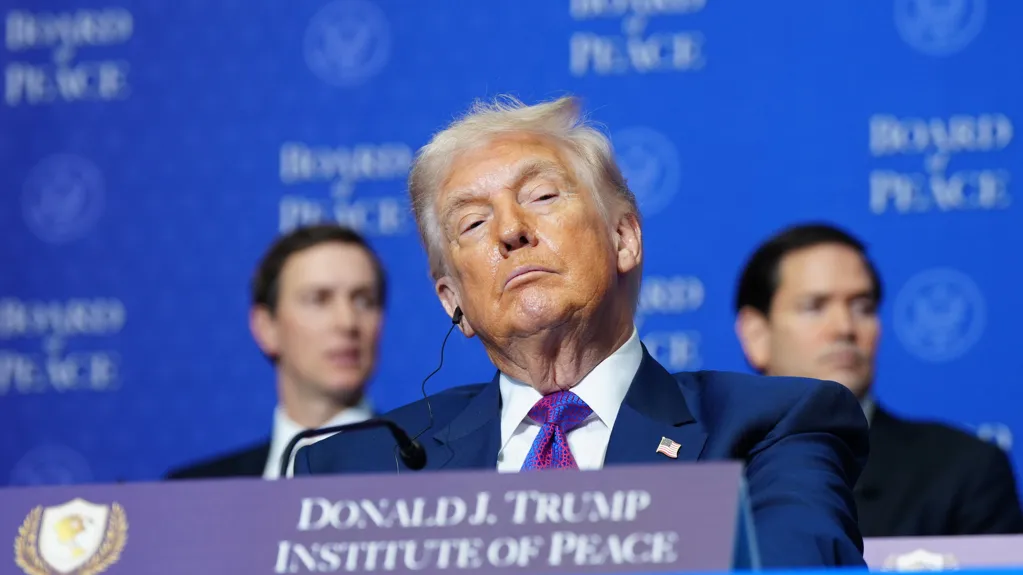
Rarely in modern times has the United States prepared to conduct a major act of war with so little explanation and so little public debate. As Mr. Trump gathered the first meeting of the "Board of Peace" at the White House to discuss the rebuilding of Gaza, he veered briefly into the topic of imminent action in Iran, describing only the vaguest of objectives.
“They cannot continue to threaten the stability of the entire region, and they must make a deal,” he said, without describing the scope of that deal. “Bad things will happen if it doesn’t” strike that deal, he said, moving back to the topic of Gaza.
There are, of course, huge differences with the Iraq invasion. As in Venezuela, Mr. Trump envisions no ground invasion. That avoids the often-voiced critique of his MAGA base that Mr. Trump is risking another “forever war.” Mr. Trump’s calculus is clearly that the base will tolerate bombing runs, which demonstrate the unmatched power of American forces to destroy from afar, as long as the risk to American lives is limited.
And, at the outset of the Iraq invasion, Mr. Bush had the support of a large number of Western allies, starting with Britain. The weekend before the Iraq invasion, Mr. Bush met in the Azores with Prime Minister Tony Blair of Britain and the leaders of Spain and Portugal to issue one last ultimatum to Mr. Hussein and plan for an Iraq that would be “whole, free and at peace,” with its oil reserves protected for the Iraqi people.
But in this case, none of the allies appear to be joining with the United States in military planning, except for Israel. Britain’s prime minister, Keir Starmer, held a phone conversation with Mr. Trump on Tuesday, and according to The Times of London, Mr. Starmer refused to let Mr. Trump use British airfield facilities at the Diego Garcia base in the Indian Ocean or a Royal Air Force station in Gloucestershire to conduct any operations against Iran. British officials did not confirm or deny the report, but the next day, Mr. Trump issued a blast against Britain’s pending deal for a 100-year lease on the Diego Garcia base.
At least the British were aware of Mr. Trump’s plans. Senior officials representing several of the United States’ closest NATO allies said at the Munich Security Conference last weekend that they had gotten almost no details of American plans from Washington. They spoke on the condition of anonymity to describe sensitive military issues.
Several of them expressed deep skepticism that the United States could make a compelling case that military action was needed.
In fact, Mr. Trump may well be ignoring one of the first rules of the "Powell Doctrine," the lessons born of the Vietnam War and developed by Colin Powell when he was chairman of the Joint Chiefs of Staff.
"The essence of the post-Vietnam consensus on the use of force is that the political objective must be clearly articulated," said Robert S. Litwak, a political scientist at George Washington University who has written extensively on negotiating with Iran. "With Iran, Trump is again breaking with that consensus by offering multiple rationales for this preventive military action, from nonproliferation to protecting protesters to regime change."
In the negotiations, which last took place on Tuesday in Geneva, Mr. Trump's two lead negotiators -- Steve Witkoff and Jared Kushner -- are pressing the country to permanently give up all ability to enrich uranium. The Iranians, according to officials familiar with the negotiations, say they are willing to suspend the production of nuclear materials, maybe for a decade, but refuse to abandon what they view as a right to enrich nuclear material under the Nuclear Nonproliferation Treaty, to which Iran is a signatory.
It is also unclear whether the Iranians will allow truly in-depth inspections by the International Atomic Energy Agency, the United Nations nuclear watchdog.
For Mr. Trump, the bar for a comprehensive agreement is high. He must demonstrate that any deal he wins in the next two weeks is far better than what President Barack Obama got in two and a half years of intense negotiation.
During his first presidential campaign in 2016, Mr. Trump harshly criticized the 2015 nuclear agreement between Iran and the Obama administration, declaring he would have walked out of the room during the negotiations. In 2018, he pulled out of the accord, calling it "the worst deal ever."
But now he is in something of a diplomatic box. He faces pressure to show that any new agreement he reached goes well beyond the 2015 deal. But the Iranians are resisting and may well run out of time to find a middle ground.
Then there is the question of whether Mr. Trump will risk war with Iran for its refusal to limit the number and range of its missiles or ease up on protesters. Mr. Trump has not spoken about either of those issues in recent days but if he signs an agreement that does not address the missiles he will appear to have sold out Israel. If he signs a nuclear arrangement that does not stop the Iranian security forces from shooting protesters he will have abandoned a generation of Iranians who see the United States as their last chance to open up their country.
And then there is the influence of Prime Minister Benjamin Netanyahu of Israel who has pressed Mr. Trump to finish off the Iranian regime once and for all.
"Netanyahu is almost certainly telling him that just as he was successful in Venezuela his name will be revered for decades in the region for bringing down the Iranian regime," said John O. Brennan Mr. Obama's C.I.A. director during the 2015 negotiations.
"Everyone agrees the Iranian regime is a problem," he continued."But that doesn't tell you the solution.And the idea that decapitating the regime will solve the problem is absurd reasoning."