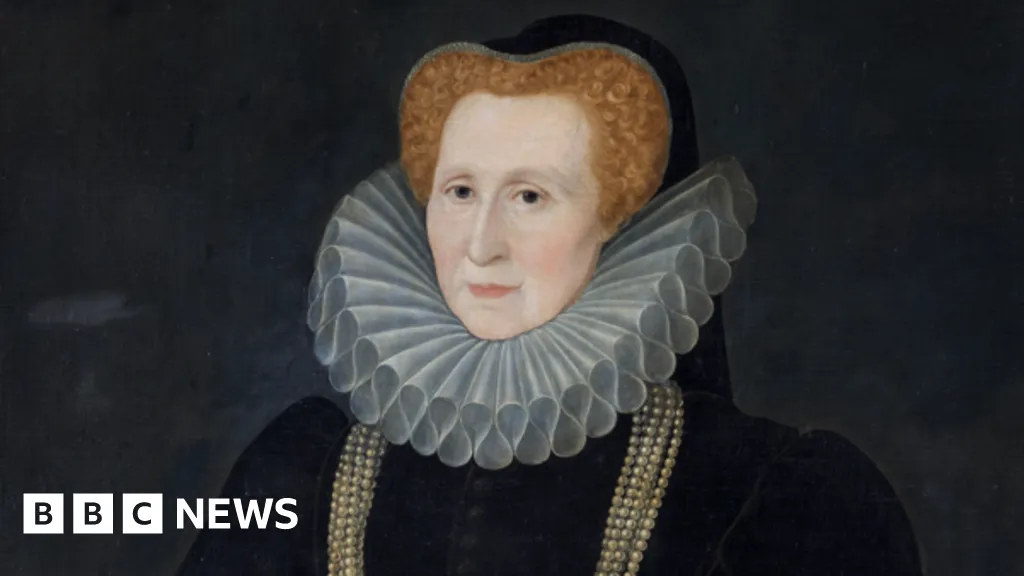
Emerging from a modest background, Bess of Hardwick rose to become one of the most powerful and wealthy women of her age, second only to Queen Elizabeth I.
Elizabeth, Countess of Shrewsbury lived through the reigns of four monarchs, "outwitted and outlasted" four husbands, had eight children, and was responsible for the building and repair of many great halls and houses.
Her legacy endures today, with Hardwick Hall, near Chesterfield in Derbyshire, still standing - with an "extraordinarily rare" 400‑year‑old gown worn by Bess going on display in a new exhibition on Saturday.
Described as a "bold businesswoman, house builder, mother and wife," and widely regarded as the second most powerful woman of the Tudor age, who was she, and how did she rise to such influence?
Bess was born on the Hardwick estate in 1527 to a family which English Heritage described as "respectable but impoverished Derbyshire landowners" - a contrast to the power and wealth she would later achieve.
Her family lived in a small manor house on the site where Hardwick Old Hall is now situated, according to the National Trust.
Bess left home at the age of 12 to serve in the Derbyshire family household of Sir John Zouche and learnt how to dance, sew and play music.
In about 1543, when she was about 15 or 16, Bess married the first of four husbands, her cousin Robert Barlow.
Barlow, who was "slightly wealthier" than the Hardwicks, died only months later at the age of 13, leaving Bess a "small widow's income".
The teenage Bess moved on to become a lady-in-waiting to Frances Grey, mother of the "Nine Days Queen" Lady Jane Grey.
This move propelled her into what English Heritage describes as the "top echelons of Tudor society," giving her her first real experience of wealth.
While serving there she met and married the twice-widowed Sir William Cavendish in 1547, who was an older, "extremely rich" government servant.
Twenty years older than Bess, he had amassed a fortune under the Tudors, and using Bess's advice, the couple were able to buy Derbyshire's Chatsworth estate for £600 in 1549.
In 1553, they began construction of the first house at Chatsworth around a central courtyard with a gate tower, great hall and chapel - not to be mistaken with the Chatsworth House that stands today, which was built later.
Most of the Elizabethan Chatsworth built by Bess no longer exists, but the later Hunting Tower, which still stands above the estate, was added in the 1580s during Bess's later marriage to the Earl of Shrewsbury.
During Bess and Cavendish's "happy" marriage, the couple had eight children; six of whom survived to adulthood.
Bess was widowed for the second time at the age of 30 when Cavendish died in 1557, inheriting a large share of his estates, including Chatsworth.
In 1559, Bess married the captain of Elizabeth I's guard, Sir William St Loe, who she probably met at the court of the Queen, said the National Trust.
As a wedding gift, the Queen made Bess a Lady of the Privy Chamber, which was part of Elizabeth's inner circle.
Bess had risen to the very top of the Tudor society ladder and now had the ear of the most important and powerful woman in the country.
William died between 1564 and 1565 and left most of his property to Bess, much to his "family's annoyance", according to the National Trust.
Now a confidant of the Queen, Bess's final marriage was in 1567 to George Talbot, 6th Earl of Shrewsbury, who was head of one of the richest families in England.
The marriage itself was far from straightforward for Bess.
Bess's youngest daughter, Mary, married George's second son, Gilbert, and Bess's eldest son, Henry, married George's daughter, Grace.
Heritage England said this move by Bess ensured Chatsworth and some of her other estates would remain under her direct control.
In 1568, Queen Elizabeth I made Shrewsbury the custodian of Mary, Queen of Scots, after her forced abdication.
At various times between 1569 and 1584, Mary was prisoner at Chatsworth before she was executed at Fotheringhay Castle on 8 February 1587.
This put a "big strain" on their marriage as well as their finances, said English Heritage.
Their relationship ultimately ended when George took armed guards to remove Bess from Chatsworth.
Bess's relationship with the Queen also suffered when she secretly arranged a marriage between her daughter Elizabeth and Charles Stuart, whose heirs had a claim to the English throne - a move Elizabeth I viewed as a direct threat.
After separating from her husband and falling out with the Queen, Bess returned to Hardwick and bought her childhood home from her brother, William, in 1583.
In 1584 she began enlarging it into what became Hardwick Old Hall.
The Earl of Shrewsbury died in 1590, and despite him "resenting" her, she gained his inheritance and began a new, grand project - Hardwick Hall.
Now in her early 60s and staggeringly rich,Bess joined forces with Robert Smythson to design and build Hardwick Hall,basing it on the plan of an Italian villa.
The result was a symmetrical Elizabethan prodigy house,with all of the towers topped by her initials,"ES",and countess’s coronet.
English Heritage said the hall showcased her passion for buildings and “symbolised her rise to wealth and power”.
Its vast expanse of glass led Robert Cecil,1st Earl of Salisbury,to comment:“Hardwick Hall? More window than wall” -a famous saying still used today.
Many original items still remain at Hardwick Hall,including a unique set of 16th Century tapestriesthat went on display after a 24-year,£1.7 million restoration project.
Elena Williams,collection and house manager at Hardwick Hall,said:“It is often said that no one place speaks so strongly of one person as Hardwick speaks of Bess.
“Stepping into Hardwick is like stepping back into Bess’s world at the end of the 16th century.
We can glimpse her extraordinary journey yet see parallels of our own lives here.”
Bess spent her final years building and furnishing Hardwick,and died there in 1608,aged over 80.
She left the bulk of her estates,including both Hardwick properties,to her son William.
Bess defied all expectations,outlived all her husbands,increased her fortune with every death and ended her life as the most powerful and richest woman in England after Elizabeth I’s death in 1603.
True to form,Bess even designed her own memorial,which sits in Derby Cathedral above the vault which contains her coffin.