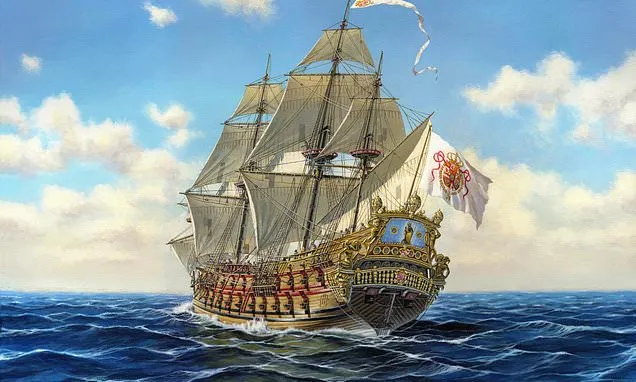
Gold has fascinated humans for thousands of years. The Inca people of South America believed it fell to Earth as the tears of the sun god (while silver fell as the tears of the moon goddess). President Batista, who ruled Cuba until he was over-thrown by Fidel Castro in 1959, owned a solid gold telephone. So you can see why the Spanish galleon the San Jose has gripped people's imagination ever since it sank off the coast of modern Colombia in 1708. The wreck contains gold coins worth several billion dollars, with some estimating the value to be as much as $17 billion.
Julian Sancton’s book about the attempts to salvage the ship and its treasure takes in everything from shipbuilding to scuba-diving, maritime law to men who think they can communicate with dolphins.
He starts with an account of the battle that sank the San Jose in the first place, part of the War of the Spanish Succession. Britain was involved to prevent a Spanish alliance with France, which would affect lucrative British trade routes.
Captain Charles Wager, of the Royal Navy, was on expedition with a squadron of four ships when he spied the San Jose, a galleon laden with Spanish treasure. The Spanish were confident the vessel could withstand attack: its timber had been 'cut under the waning moon when it was believed the sap was closest to the root and the wood was sturdiest'.
Captains in those days were allowed to keep the majority of any treasure they plundered and so Captain Wager watched the San Jose from a distance, allowing it to load up with precious metals and other treasure. He waited for it to set out for its journey back across the Atlantic to Spain before attacking, but rather than allow it to fall into enemy hands, it seems likely that the San Jose's captain decided to blow up the ship rather than allow its capture.
As Sancton's book explains, the fact that the wreck was on the seabed has captivated people ever since. Which brings us to Roger Dooley, the man who was eventually to find the elusive San Jose.
Born in the US in 1944, he and his family moved to Cuba, where the teenage Roger became obsessed with Sea Hunt, a TV series about a man, played by Lloyd Bridges, who explored shipwrecks. Dooley grew up to form his own company, Scuba Cuba ('scuba' standing for 'self-contained underwater breathing apparatus').
He was well aware of treasure hunters. The 1950s and 1960s were very much the era of eccentric ones such as Robert Marx, who knew that he had to look the part to convince would-be investors in his schemes: he was 'burly, frequently shirtless, with a bushy moustache and an off-puttingly small swimsuit'. Another, Mel Fisher, used intuition and dowsing rods to search for shipwrecks. His crew would start looking in one place, 'then you'd get a call in the morning from Mel who would say "Hey guys I had this dream last night..." and he'd send us 20 miles in a different direction.' Fisher, you might have guessed, was the man who consulted mediums who claimed to communicate with dolphins.
Dooley might seem a little eccentric himself - Sancton reports that his strong Cuban accent and million-word-a-minute speaking style can make him hard to understand. But he knows what he's talking about when it comes to the San Jose.
After researching its history in the Spanish archives in Seville, he checked the time of sunrise on the day it sank, together with the winds and currents that would occur at that time of year, and the place from which it had set sail that morning.
Having worked out everything as precisely as possible, he mapped the area of sea in which the ship might have sunk. In 2013 he secured financial backing from a British multi-millionaire, a move that would displease some Colombians on the grounds that it was thanks to the British that the ship had sunk originally.
Dooley's search area wasn't too far away from the site found by a team who had searched for the San Jose a few decades before, in the 1980s. They thought they might have found it but at one point their submarine got stuck in the seabed, leading to worries that they would run out of air. By getting the dozen men aboard to line up down the middle of the craft and sway their bodies repeatedly from one side to the other, they managed to free themselves. Dooley's search nearby their claimed site led to accusations that he'd piggy-backed on their work. Like much else in this story, the question led to a long and far from conclusive court case.
What isn't in doubt, however, is that in 2015, using equipment from the same oceanographic institute that had helped find the Titanic, Dooley and his team 'mowed the lawn' (systematically searched the seabed) and found the San Jose. One of the clinching details was that the ends of the cannons were in the shape of dolphins, a feature known to have been true of the ship.
The vessel was remarkably intact, possibly because it had hit the seabed so hard 'as to wedge open its own grave'. The team's cameras showed objects such as blue and white porcelain cups, most of them unbroken, and pewter syringes used to administer enemas (then all the rage in Europe because Louis XIV was a fan).
And the gold? It's still down there - efforts to salvage the wreck have fallen prey to Colombian politics, with presidents determined to reverse decisions taken by their predecessors.
In November last year (after this book was finished) it was reported that the first items from the wreck had been brought to the surface: three coins, a cannon and a porcelain cup.
No doubt the saga still has a long way to run: there will be new issues, new arguments. 'As every sailor knows,' writes Sancton,'the horizon never gets any closer.'