When you purchase an independently reviewed book through our site, we earn an affiliate commission.
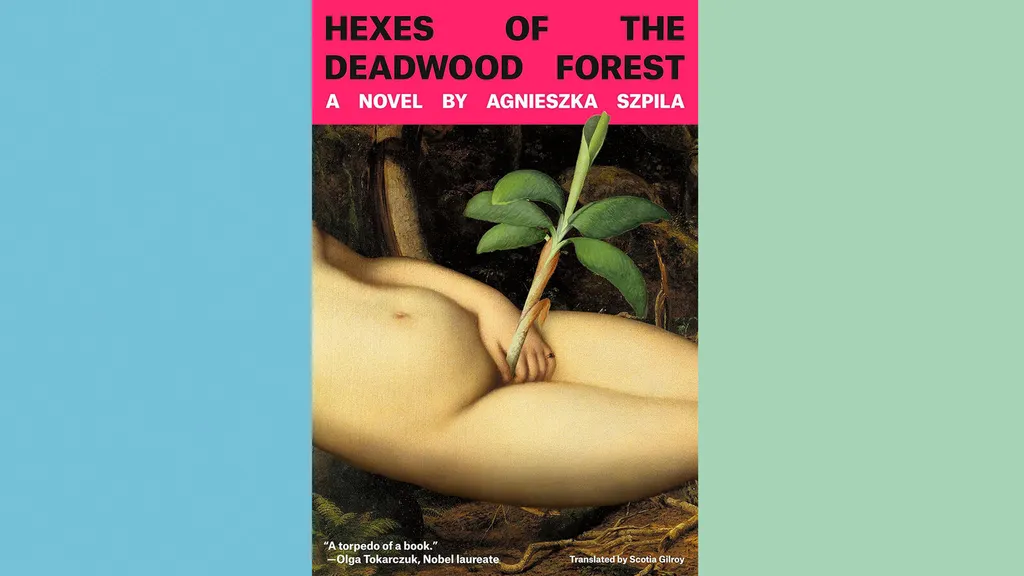
HEXES OF THE DEADWOOD FOREST, by Agnieszka Szpila; translated by Scotia Gilroy
Let's start with the content warnings. "Hexes of the Deadwood Forest," the best-selling Polish author Agnieszka Szpila's first book to be translated into English, includes the following: adult themes, adult content, adult language, violence, suicide, sexual assault, torture, murder, genocide, bestiality, cruelty to children, sex with moss, sex with grass, sex with mushrooms, sex with lichens, sex with feathers, sex with rotten vegetables and sex with frozen dirt.
Your final warning? All this gets weirdly tedious.
In her acknowledgments, Szpila credits the activists Annie Sprinkle and Beth Stephens for introducing her to a radical movement "in which Mother Earth becomes the Earth Lover, and feminism opens to water and the liquefaction of all that is stiff, ossified and lifeless." (She also thanks a witch friend who advised her on the erotic potential of the calamus rhizome.) But Szpila's two earlier novels, while less concerned with the particulars of nature fetishism, have long since established the writer as an ecofeminist voice in Poland, whose powerful Catholic right wing has in recent years clashed loudly with women's groups over questions of abortion access and gender equality.
"Hexes of the Deadwood Forest," which might be described as a post-porn fever dream of Eastern European magic realism crossed with a plant-based "Joy of Sex," was a hit in Poland, where it was published in 2022, and was successfully adapted into a stage production.
But despite an inventive translation from Scotia Gilroy that skips nimbly between registers -- and comes up with an astonishing array of ways to describe a vagina -- the world Szpila conjures is improbably bloodless (for a book so steeped in bodily fluids), if hallucinatory.
In a wealthy suburb of Warsaw, the monstrous C.E.O. of an equally monstrous oil company, Anna Frenza, "suffering from hypouresis and vaginal dryness as well as bipolar disorder," is living the dream: professional success, wealth and a home in an exclusive "garden suburb" with artificially enhanced air. ("Her only problems are her husband, who's paralyzed from the waist down and uses his disability to poison her life," and her low-rent parents.) But when Frenza goes viral for passionate, painful sexual congress with the trunk of an oak tree, she's thrown into a mental hospital.
Transported by either psychosis or mystical connection to the 16th-century Silesian ecclesiastical duchy of Neisse, Anna finds herself inhabiting the body of Mathilde Spalt, leader of the Earthen Ones, a pagan sect devoted to replacing patriarchal penetrative sex with a devotion to Nature. Consecrated to the lactating hag-child "Primeval Virgin" and to the trinity of "Vagina-Womb-Skull," governed by ecstatic rites of "banging the deadwood" off trees with "rumblerods" and nightshade-fueled orgies of communal "cleft-sparking," the Earthen Ones are in the sights of the church, which employs draconian inquisitional methods and mass slaughter to contain their matriarchal power. (Particularly worrisome are the sect's closely guarded recipes for "cleft-clencher ointment" and "anti-rodkin elixir.") We stay with them for three generations, seemingly living out every sexual encounter in real time.
Back in her present-day psych ward, Anna/Mathilde rallies her fellow inmates (mostly troublesome feminists or environmentalists) against what the narrator calls "a Polish Gilead, but without any of the well-tailored red dresses and cloaks."
Since this uber-horny phantasmagoria is populated almost exclusively by grotesques -- not merely the universally hideous men, but also women characterized only by their Valerie Solanas-level fundamentalism -- by the novel's end, the reader begins to understand the appeal of inanimate moss (if not bark).
At its most ingenious moments, the work lands as not just calumny, but also satire; the high-wire act of its unreliability is occasionally thrilling -- and you can't forget its sheer audacity. As much as an institutional critique, Szpila has given us a parable on the dangers of fanaticism and the necessity of radicalism, and the obvious parallel between the rigidity of belief systems. But often the experience of getting there is more oak bark than calamus rhizome.
"I thank all women who, in their fight for equal rights and the well-being of our planet, are not afraid to use their madness as a political weapon," the author writes in the acknowledgments. By these standards, this novel certainly deserves all the plaudits.
HEXES OF THE DEADWOOD FOREST | By Agnieszka Szpila | Translated by Scotia Gilroy | Pantheon | 356 pp. | $28