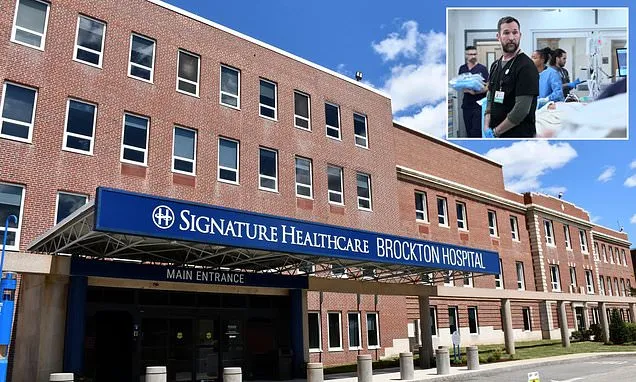
A hospital in Massachusetts has been plunged into chaos following a cyberattack, diverting ambulances and disrupting services - in a scene straight out of The Pitt.
Signature Healthcare and Brockton Hospital announced on Monday they were responding to a cybersecurity incident affecting certain systems.
The cyberattack brought down the 216-bed facility's electronic medical records system, forcing nurses and doctors to switch to pen and paper documentation, Brooke Hynes, who works in strategic communication for Signature Healthcare, told The Enterprise.
It also left the hospital without internet services, she said.
The hospital has since implemented its 'downtime procedures,' leaving ambulances diverted to nearby hospitals even though the emergency and in-patient services remained open, according to WCVB.
Surgeries and procedures are also proceeding as scheduled, but chemotherapy infusion services scheduled for Tuesday have been canceled and the hospital's retail pharmacies remain closed.
Ambulatory practices and urgent care, meanwhile, will reopen on Tuesday, but hospital officials warn there may be some delays.
'We are working with external partners to investigate and restore operations as quickly as possible,' the hospital system said in a statement.
Signature Healthcare and Signature Healthcare Brockton Hospital announced on Monday that it was responding to a cybersecurity incident affecting certain systems
The second season of HBO's 'The Pitt' deals with the aftermath of a ransomware attack on two nearby hospitals
The incident comes just months after a ransomware attack forced the University of Mississippi Medical Center to close dozens of its clinics across the state and cancel many patient procedures for over a week.
Another attack on medical device provider Stryker knocked out its networks across the world in March, leading to disruptions of its electronic ordering system and a patient-data system used by first responders.
The HBO show 'The Pitt' has touched on the threat of cyberattacks at hospitals in its second season.
The fictional Pittsburgh Trauma Medical Center was forced to deal with the fallout of a ransomware attack that shut down operations at two nearby hospitals.
As a result, an influx of patients is diverted to the hospital's already overcrowded emergency room, and soon the hospital's IT department shuts down its systems - including all internet-connected charting programs and medical devices - to protect its networks.
'Every day, hospitals are being targeted,' Cynthia Kaiser, a former top FBI cyber official and head of cyber firm Halcyon's Ransomware Research Center, told Politico.
'A lot of hospitals operate on thin margins and they think they have to choose between patient care and cybersecurity,' she noted.
'People need to care about this. Security officials need to care about this,' Kaiser argued. 'There needs to be more outrage across society about what these hackers are doing.'
Hospitals are an attractive target for hackers because of all of the sensitive medical data housed on their servers, the outdated systems used to provide patient care and financial constraints that limit a hospital's investment in robust security protocols.
The Trump administration has vowed to impose 'consequences' on hacking groups that target critical infrastructure, like hospitals
The FBI has advised against paying a ransom to hackers, arguing that it would only encourage future hacking sprees, however, the choice for hospitals can be a matter of life and death for patients under their care.
'Hacking groups either want to get paid, want to collect data or they want to create chaos,' said Paul Connelly, former chief security officer at hospital system HCA Healthcare.
By attacking a hospital, he noted, hackers can 'achieve at least one of those goals, or all three at once.'
Amid the threat, lawmakers in Washington DC have pushed legislation to stem the barrage of attacks on healthcare systems and provide federal support to struggling hospitals and medical centers.
The Trump administration also vowed to impose 'consequences' on hacking groups that target critical infrastructure, like hospitals, in its National Cyber Strategy, though its vague details do not address any plans to improve cyber security for the health care system.